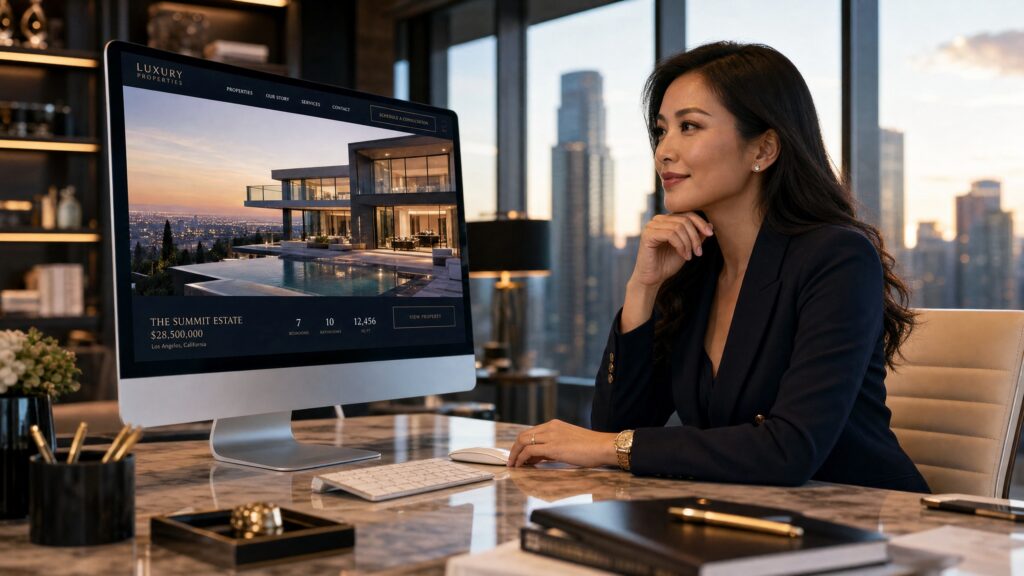
Selling $2 million homes with a website that looks like it was built for $200,000 listings creates a credibility gap that no amount of marketing can fix. Luxury real estate buyers notice design quality instantly. They evaluate you based on your online presence before they ever respond to your outreach. And an IDX website that looks generic or dated signals that you don’t operate at their level.
Here’s what luxury agents need from an IDX website and how to choose a platform that matches the caliber of your business.
Why Standard IDX Fails for Luxury
Most IDX websites are designed for the mass market. They prioritize function over form, get the listings displayed, capture the lead, move on. The templates are utilitarian. The typography is generic. The layouts are cramped with listings stacked tight to show maximum inventory per page.
For an agent selling homes in the $250,000 to $500,000 range, this works fine. Buyers at that price point are primarily shopping on functionality, search speed, filter options, listing accuracy. They care less about how beautiful the website itself looks and more about whether it helps them find homes efficiently.
Luxury buyers are different. They’re shopping for a lifestyle, not just square footage. The website experience needs to reflect the premium nature of the properties. Large, high-resolution photography displayed prominently. Clean, sophisticated typography. Generous white space that communicates quality and exclusivity rather than quantity and urgency. A design language that feels like a luxury brand, not a real estate marketplace.
Design Elements That Matter for Luxury IDX
Photography presentation. Luxury listings live and die by their photography. Your IDX website needs to display images at their full potential, large format, high resolution, with smooth gallery navigation. Thumbnail grids that compress stunning photography into tiny squares defeat the purpose. Full-width image carousels, lightbox galleries, and video integration are essential.
Minimal, elegant design. Luxury brands use restraint. Limited color palettes. Clean lines. Plenty of negative space. Your IDX website should follow the same principles. Cluttered layouts with bright call-to-action buttons scattered everywhere feel desperate and cheap. A refined layout with subtle interaction invites exploration.
Custom neighborhood and community showcasing. Luxury buyers aren’t just buying a home, they’re buying into a community, a lifestyle, a neighborhood. Your IDX site should feature dedicated community pages with curated content about the most desirable areas: lifestyle photography, amenity highlights, architectural styles, and local culture. These aren’t generic MLS data pages. They’re editorial content that positions you as the authority on luxury living in your market.
Mobile excellence, not just mobile compatibility. Luxury buyers use their phones, but they notice poor mobile experiences immediately. Your IDX search on mobile needs to be flawless, not a scaled-down version of the desktop site, but a genuinely excellent mobile experience with touch-optimized navigation and full-quality image display.
Lead Capture for Luxury Buyers
The standard IDX approach of forcing registration after three listing views can feel aggressive to luxury buyers. High-net-worth individuals are more sensitive to being “sold” and more likely to leave a site that demands their information too quickly.
For luxury IDX, consider a softer registration approach. Allow more listing views before gating (five to seven instead of three). Offer value in exchange for registration, exclusive off-market listings, early access to new luxury inventory, or curated property selections based on their preferences. Frame registration as access to an exclusive club rather than a data capture form.
The follow-up after registration also needs to match the luxury caliber. Generic drip emails about “hot new listings in your area” feel mass-market. Personalized messages that reference the specific properties they viewed, the architectural styles they gravitated toward, and the neighborhoods they explored feel like concierge-level service.
This is where AI-powered follow-up demonstrates its value in the luxury space. CloseDaily’s AI system generates follow-up based on individual browsing behavior, creating messages that feel personally crafted rather than auto-generated. For luxury buyers who expect personalized attention, this level of intelligent engagement sets the tone for the relationship from the very first interaction.
SEO for Luxury Real Estate Keywords
Luxury real estate SEO targets a different keyword set than general real estate. “Luxury homes for sale in [city],” “waterfront estates in [area],” “million-dollar homes in [neighborhood],” and “exclusive properties in [community]” are the searches you want to capture.
The advantage of targeting luxury keywords is lower competition. Fewer agents create optimized content for luxury-specific searches because the volume is lower. But the value per lead is dramatically higher. One luxury closing can generate more commission than ten standard-price closings. Ranking for luxury search terms is the highest-value SEO play in real estate.
Build dedicated landing pages for luxury-focused searches in your market. Create content about luxury lifestyle, high-end neighborhoods, architectural features of premium homes, and market analysis specific to the luxury segment. This content builds topical authority that lifts your IDX listing pages for luxury searches.
What Luxury Real Estate Website Design Actually Requires
Strip away the agency pitch decks and luxury real estate website design comes down to a short list of signals buyers register in seconds. Typography with restraint, meaning one refined serif or sans-serif family used consistently instead of five fonts fighting for attention. Photography-first layouts that let full-width images carry the page rather than cramming them into cards. A restrained palette, usually two or three colors with generous white space. Pages that load fast, because a slow site reads as a careless one no matter how pretty the mockup looked. And IDX search that feels bespoke to your market, styled to match the rest of the site instead of sitting there like a bolted-on widget.
Design agencies price accordingly. Bespoke luxury agency builds are commonly quoted in the $5,000 to $25,000+ range before ongoing maintenance, and shops that specialize in luxury real estate often start higher than that. The math can work for a team doing steady volume at the top of the market. For most luxury agents, it is a lot of money for a site that still needs a CRM, follow-up, and lead routing added afterward. CloseDaily’s Dominate plan runs $299 a month with the IDX website included, built on the design principles above, alongside the CRM and the AI follow-up covered earlier.
Which Platform Delivers for Luxury
The ideal luxury IDX platform combines modern, premium design with the full lead generation and nurture capability that any serious agent needs. It should look like a luxury brand while operating like a lead conversion machine behind the scenes.
CloseDaily’s design-forward approach, clean layouts, modern typography, generous photography display, naturally aligns with luxury branding requirements. Combined with the AI follow-up that delivers personalized, concierge-style engagement, it creates an experience that luxury buyers respond to positively.
Some agents in the ultra-luxury space ($10M+) opt for fully custom-designed websites with IDX integrated via API. This provides maximum design control but comes with significant development costs ($10,000-$50,000+) and ongoing maintenance requirements. For the vast majority of luxury agents working in the $1M to $10M range, a well-designed IDX platform delivers the right balance of premium presentation and operational efficiency.
Your website is the first impression for every buyer who finds you online. In luxury real estate, first impressions aren’t just important, they’re everything. Make sure your IDX website communicates that you operate at the same level of quality and attention to detail that your clients expect in their next home.
Ready to close more deals?
Join thousands of agents using CloseDaily to build their business.