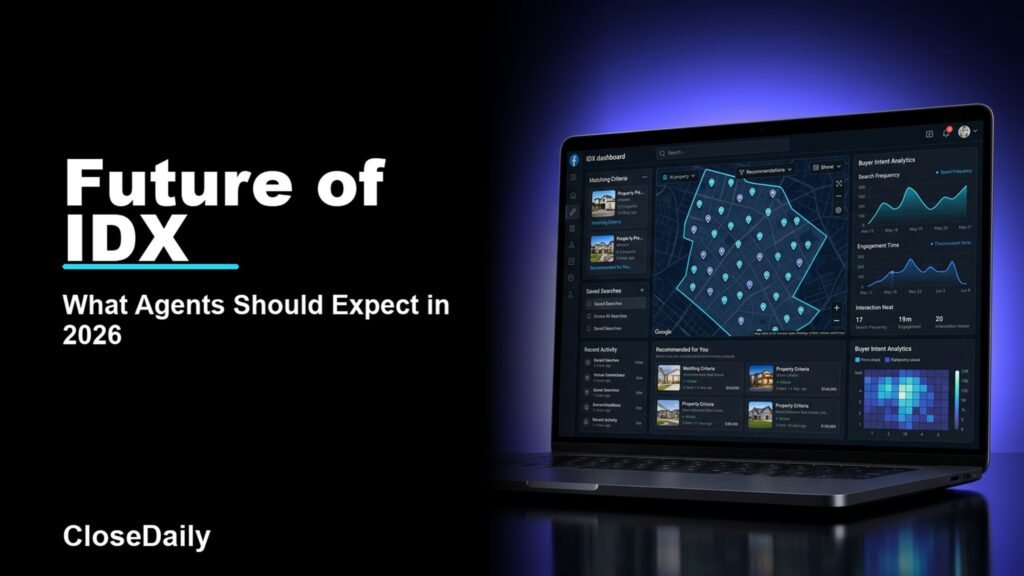
IDX has existed in some form since the early 2000s, and for most of that time, the fundamental experience hasn’t changed much. Connect to the MLS. Display listings on a website. Let buyers search. Capture registrations. The core loop has been largely the same for two decades.
That’s about to change dramatically. Advances in AI, data integration, and consumer expectations are reshaping what an IDX website can do, and what buyers and agents will expect from one. Here’s where IDX is heading and what it means for your business.
AI-Powered Property Search
The current IDX search experience is based on filters. Buyers set criteria, price, bedrooms, location, and the system returns matching results. It works, but it’s limited by the buyer’s ability to articulate what they want in structured filter terms.
AI-powered search changes this. Instead of clicking through dropdown menus, a buyer describes what they want in natural language: “I’m looking for a home with a big backyard near good elementary schools in a quiet neighborhood where I can walk to coffee shops.” The AI interprets the intent, weighs multiple factors simultaneously, and returns results that match the spirit of the request rather than just the literal criteria.
This is already being developed by several platforms. The technology exists, large language models combined with structured listing data can understand nuanced search queries. The winners in IDX over the next few years will be the platforms that implement this most effectively, creating a search experience that feels like talking to a knowledgeable agent rather than filtering a database.
Predictive Lead Scoring
Current lead scoring is reactive. A lead visits your site frequently, views lots of listings, saves searches, and based on this past behavior, the system estimates their likelihood to buy. It’s useful but backward-looking.
Predictive lead scoring uses AI to anticipate future behavior based on patterns observed across thousands of similar leads. The system recognizes that when a lead exhibits a specific combination of behaviors (particular search pattern + visit frequency + listing save rate + time-of-day patterns), there’s an 80 percent probability they’ll be ready to tour homes within the next two weeks.
This shifts your outreach from reactive (“this lead seems active, I should call”) to proactive (“this lead will be ready in 10 days, let me start warming them up now”). The timing advantage is significant. Reaching out just before a lead is ready to act is dramatically more effective than reaching out after they’ve already started talking to another agent.
Platforms like CloseDaily are at the forefront of this shift, using AI not just to track what leads have done but to predict what they’re about to do.
Personalized Listing Experiences
Today, every visitor to your IDX website sees the same search interface and the same listing pages. The experience is identical whether the visitor is a first-time buyer looking at starter homes or a luxury buyer searching for waterfront estates.
The next evolution of IDX personalizes the experience based on who the visitor is and what they’ve shown interest in. A returning registered lead who has been searching for mid-century modern homes in a specific neighborhood sees a homepage that highlights new mid-century modern listings in that area, not a generic search bar.
This personalization extends to listing detail pages. Instead of showing identical information to everyone, the page adapts based on visitor profile. A buyer who’s been focused on school quality sees school ratings prominently displayed. A buyer who’s been looking at commute times sees estimated drive times to major employment centers. The same listing, presented differently based on what matters most to each individual buyer.
Integration with Transaction and Financial Data
IDX has traditionally been limited to active listing data from the MLS. The future of IDX includes deeper integration with transaction history, tax records, mortgage rates, insurance costs, and neighborhood data to provide a more comprehensive picture on every listing page.
Imagine a listing page that doesn’t just show the asking price, but calculates the estimated monthly payment based on current mortgage rates, includes property tax history, shows comparable sales from the past 12 months on an interactive map, estimates insurance costs, and projects five-year equity growth based on neighborhood appreciation trends.
This level of data integration transforms your IDX website from a listing search tool into a buying decision tool. Buyers spend more time on sites that help them evaluate rather than just browse. More time means more engagement. More engagement means higher registration rates and stronger lead relationships.
Video and Virtual Integration
Listing photos have been the backbone of IDX since the beginning. But static photography is giving way to richer media experiences. Video walkthroughs, 3D virtual tours, and interactive floor plans are becoming standard expectations rather than premium extras.
IDX platforms that integrate these media types smoothly, embedding video tours directly on listing pages, offering virtual open house experiences, and providing interactive floor plans that buyers can explore, create a significantly more engaging experience. Buyers who watch a video tour of a listing spend three to four times longer on the page than those who only view photos.
The platforms that handle rich media well will capture and retain more visitors. The ones that still treat IDX as a photo gallery with text fields will fall behind as buyer expectations continue to rise.
What This Means for Your Platform Choice
The IDX platform you choose today should be built for where the industry is going, not just where it’s been. A platform that handles basic listing search but has no AI capabilities, no personalization framework, and no modern search technology is going to feel increasingly outdated as competitors evolve.
When evaluating platforms, ask: what’s on the product roadmap? Is AI a core part of the development strategy, or a checkbox feature? Is the platform investing in the kind of personalization and predictive capabilities that will define the next generation of IDX?
CloseDaily was built with AI as a foundational element, not an afterthought. The current AI follow-up and lead scoring capabilities are early indicators of a platform that’s investing in the future of IDX technology rather than maintaining the status quo.
The Constant: Leads Still Come from Search
For all the technology changes on the horizon, one thing remains constant: buyers search for homes online before they talk to an agent. The agent who provides the best search experience captures the lead. The agent with the best follow-up converts the lead. The agent with the best tools closes the deal.
The specific technology will keep evolving. AI search will replace filter-based search. Predictive scoring will replace reactive scoring. Personalized experiences will replace one-size-fits-all websites. But the fundamental principle, be where buyers search and convert their interest into a relationship, will remain the foundation of online lead generation for as long as people buy and sell homes.
The agents who invest in the right platform today and stay current as the technology evolves will compound their advantage year after year. The agents who wait for the future to arrive before adapting will find that their competitors arrived first.
Ready to close more deals?
Join thousands of agents using CloseDaily to build their business.