How to Build a Real Estate Team: From Solo Agent to Team Leader
The Moment You Know You Need a Team
Every successful solo agent hits the same wall. You’re closing 30, 40, maybe 50 transactions a year. Your phone rings constantly. Your inbox is unmanageable. You’re showing houses during the day, writing contracts at night, and answering client texts at 11 PM. You’re making good money but you have no life, and you’ve started dropping balls — missing follow-ups, returning calls late, losing leads because you simply don’t have the bandwidth to work them.
That wall is the ceiling of a solo operation. You can’t prospect because you’re servicing current clients. You can’t service clients because you’re drowning in admin. You can’t do admin because you’re showing houses. Something has to give — and for the agents who want to scale beyond their personal capacity, the answer is building a team.
But building a real estate team is one of the most consequential — and most misunderstood — decisions in an agent’s career. Done right, it multiplies your income, frees your time, and creates a business that doesn’t depend entirely on you. Done wrong, it multiplies your expenses, creates drama, and produces less net income than you were earning as a solo agent. The difference between these outcomes comes down to timing, structure, hiring, and systems.
This guide walks you through the entire process: how to know when you’re ready, which team model fits your business, who to hire first, how to compensate them, how to train and lead them, and how to scale from two people to ten or more. If you’ve already explored the basics in our team building overview, this guide goes deeper into the operational and leadership challenges that actually determine whether your team succeeds.
Signs You’re Ready to Build a Team — And Signs You’re Not
You’re Ready If:
You’re consistently turning away business. If you’re declining new leads, referring out potential clients, or losing opportunities because you don’t have capacity, you’ve outgrown your solo operation. The business exists — you just need people to help you capture it.
Your systems are documented and repeatable. A team can only scale what’s already systematized. If your lead follow-up, transaction management, marketing, and client communication processes are documented and consistent, a new team member can learn and replicate them. If everything lives in your head, you’ll spend more time explaining than delegating.
You have a reliable lead generation engine. Teams need leads to survive. If your business depends entirely on referrals and personal relationships that only you can leverage, adding buyer’s agents who need leads to work will create frustration and turnover. You need predictable lead flow — from your website, paid advertising, SOI marketing, or other sources — before you add people who depend on those leads.
Your finances can support the investment. Building a team requires upfront investment before the return materializes. You’ll need to cover additional CRM licenses, technology costs, marketing spend, potentially office space, and — depending on your model — base salaries or draws. You should have at least 3-6 months of operating reserves before hiring your first team member.
You’re Not Ready If:
You’re hoping a team will fix your lead generation problem. If you’re not generating enough business as a solo agent, adding team members won’t solve the problem — it will make it worse. You’ll have more mouths to feed with the same amount of leads. Fix your lead generation first, then build the team to handle the overflow.
You don’t have documented systems. If your business runs on instinct and improvisation, a new team member will flounder. Before hiring anyone, document your processes: how you handle a new lead, how you prepare for a listing appointment, how you manage a transaction from contract to close. These don’t need to be perfect — they just need to exist.
You want to hire to avoid work you don’t like. Building a team because you hate prospecting or hate paperwork is the wrong motivation. Those problems are solved by hiring a VA or transaction coordinator — not by building a team. A team is a growth strategy, not an avoidance strategy.
Team Models: Choose Your Structure
There isn’t one right way to build a real estate team. The model you choose should match your market, your strengths, and your long-term goals.
The Rainmaker Model
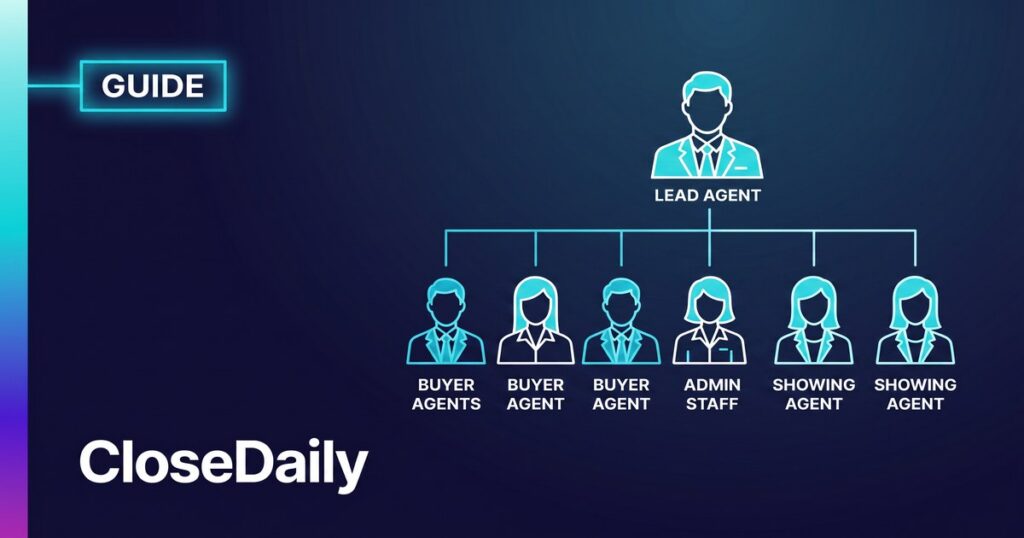
You are the primary lead generator and listing agent. You bring in the business, convert the leads, and take the listings. Your buyer’s agents handle the buyer side, showing homes and writing offers for the leads you generate. This is the most common starting model because it lets you leverage your existing lead generation and reputation while handing off the most time-consuming work (buyer showings).
Best for: Agents with strong personal brands, high listing volume, and robust lead generation. Risk: The business is still dependent on you personally — if you stop generating, the team stops producing.
The Mentor/Split Model
You bring on newer agents, provide them with training and leads, and take a larger split in exchange. As agents develop, their splits improve. This model works well when you have more leads than you can handle and enjoy coaching and developing talent.
Best for: Experienced agents who enjoy teaching, have excess leads, and want to build culture. Risk: Your best agents will eventually leave for better splits or their own teams — plan for turnover.
The Partnership Model
Two or more experienced agents join forces, pooling leads, expenses, and support staff while maintaining their own client relationships. Each partner brings their own strengths — one might be a listing specialist while the other excels with buyers, or one handles a specific geographic area.
Best for: Experienced agents who want to share expenses and support without a hierarchical structure. Risk: Partnership disagreements can be destructive — clear operating agreements and role definitions are essential.
The Expansion Model
You build a self-sufficient team in your primary market, then replicate the model in additional markets with team leaders in each location. This is the most complex model but offers the greatest scale potential.
Best for: Agents with proven systems, strong leadership skills, and ambitions beyond a single market. Risk: Remote team management requires excellent systems and the right leaders — expanding too fast without the right infrastructure leads to collapse.
Your First Hire: Who Should It Be?
This is where most team leaders make their first mistake. They hire a buyer’s agent first because they want someone to handle their overflow leads. But the smarter first hire is almost always administrative support.
Hire an admin or transaction coordinator first. Before you add another agent to your team, you need someone to handle the operational work that’s consuming your productive hours. A transaction coordinator handles paperwork, deadline management, vendor coordination, and compliance for $300-$500 per transaction. An administrative assistant handles your CRM, email management, listing input, appointment scheduling, and marketing coordination for $2,000-$4,000/month.
The reason this hire comes first is that it frees up your time for the highest-value activities — prospecting, listing appointments, and lead conversion — which generates the additional revenue you need to fund your next hires. An admin creates capacity without consuming leads.
Your second hire should be a buyer’s agent. Once your admin is handling operations, hire one buyer’s agent to handle your overflow buyer leads. Start with one — not three. You need to work out the kinks of lead routing, training, mentoring, and accountability before you scale. If one buyer’s agent is productive and happy, you can add a second.
Your third hire depends on your model. If you’re generating more buyer leads than two agents can handle, hire a third buyer’s agent. If you’re spending too much time on marketing, hire a marketing coordinator. If you’re growing fast enough to need a dedicated showing assistant or inside sales agent (ISA), that might be your third hire. Let the bottleneck in your business dictate the next position.
Compensation Models: How to Pay Your Team
Compensation is where most team leaders either overpay (killing profitability) or underpay (causing turnover). Getting the balance right requires understanding what each role is worth and what the market will bear.
Buyer’s Agents
The most common compensation model for buyer’s agents on a team is a commission split. Typical splits range from 40/60 (agent/team) for new agents receiving leads and mentoring to 50/50 for experienced agents with some lead generation, to 60/40 or higher for top performers who self-generate some of their own business. The split reflects a tradeoff: the team provides leads, training, brand, and infrastructure; the agent provides the time and effort to convert those leads into closings.
Some teams also provide a small base salary or monthly draw (typically $1,500-$3,000/month) that’s drawn against future commissions. This helps new agents survive the ramp-up period and signals that you’re investing in their success. The draw should be recoupable — meaning it’s deducted from their commission earnings — not a guaranteed salary on top of commissions.
Inside Sales Agents (ISAs)
ISAs qualify incoming leads, make outbound prospecting calls, and set appointments for your buyer’s agents. They’re typically compensated with a base salary ($30,000-$45,000/year) plus a bonus per qualified appointment set or per closed transaction that originated from their efforts. A common structure is $25-$50 per appointment set plus 5-10% of the agent’s commission on closed transactions the ISA sourced.
Administrative and Operations Staff
Administrative assistants, transaction coordinators, marketing coordinators, and operations managers are typically salaried positions. Compensation ranges vary by market and experience, but expect to pay $35,000-$55,000 for a full-time admin or TC, $40,000-$60,000 for a marketing coordinator, and $50,000-$75,000 for an operations manager. Virtual assistants (often offshore) can handle many administrative tasks for $8-$15/hour.
Training and Onboarding: Building a Playbook
The single biggest predictor of team success isn’t who you hire — it’s how you train them. Agents who join a team with a clear onboarding process and documented playbook ramp up faster, produce more, and stay longer than agents who are handed leads and told to “figure it out.”
Your team playbook should include your lead handling process — how leads are routed, response time expectations, the initial contact script, and the follow-up cadence. It should cover your buyer process from first consultation through closing — when to present the buyer agency agreement, how to prepare for showings, how to write offers, and how to navigate inspections and appraisals. It should document your listing process if buyer’s agents will eventually take listings. And it should spell out your systems — which CRM to use, how to log activities, how to update pipeline stages, and where to find resources and templates.
New agents should spend their first two weeks shadowing you or a senior agent before working leads independently. During this period, they should attend listing appointments, observe buyer consultations, sit in on negotiations, and learn your systems hands-on. The time you invest in training pays for itself many times over through faster production and fewer costly mistakes.
Lead Distribution: Fair, Effective, and Motivating
How you distribute leads across your team will be one of the most politically sensitive and performance-critical decisions you make. There are several common approaches.
Round robin: Leads are distributed evenly in rotation. Agent A gets lead 1, Agent B gets lead 2, Agent C gets lead 3, then back to Agent A. This is simple and perceived as fair, but it doesn’t account for differences in agent skill or response speed.
Speed to lead: The first agent to respond to a new lead gets the lead. This rewards hustle and ensures the fastest possible response time, but it can create a competitive atmosphere that some teams find stressful.
Performance-based: Top-performing agents receive more leads or higher-quality leads. This rewards results and motivates performance, but it can demoralize newer agents who need leads to build their production.
Hybrid: New leads are distributed round-robin, but agents who don’t follow up within a set timeframe (typically 5 minutes for online leads) lose the lead, and it goes to the next agent in rotation. This balances fairness with accountability.
Whatever system you choose, the rules must be clear, consistently enforced, and documented. Nothing destroys team morale faster than perceived favoritism in lead distribution. If an agent believes the team leader’s favorite is getting the best leads, they’ll leave — and they’ll be right to.
Team Culture and Accountability
Culture isn’t something that happens by accident on successful teams — it’s built deliberately through consistent standards, regular communication, and visible accountability.
Weekly team meetings: Hold a 30-60 minute meeting every week with a consistent structure: wins from last week, pipeline review, training topic, and action items for next week. Keep it focused and positive. This is where your team builds cohesion and where you catch problems early.
Individual one-on-ones: Meet with each agent individually every two weeks for 15-30 minutes. Review their numbers, discuss challenges, provide coaching, and check in on their goals and satisfaction. These conversations are where you retain your best people — or lose them because you weren’t paying attention.
Clear performance expectations: Every agent should know exactly what’s expected: minimum contact attempts per lead, maximum response time, minimum transactions per quarter, CRM compliance standards, and any other metrics you track. Make the expectations clear on day one, reinforce them regularly, and address underperformance quickly and directly.
Celebration and recognition: Recognize wins publicly — closed deals, positive reviews, personal milestones. A team that only hears about problems and never hears about successes won’t stay motivated. The cost of recognition is zero; the cost of losing a productive agent to a team that values them is enormous.
Technology Stack for Teams
Solo agents can get away with duct-taping together a collection of tools. Teams cannot. Your technology stack needs to support collaboration, accountability, and consistent client experience across multiple agents.
CRM (non-negotiable): Your CRM is the central nervous system of your team. Every lead, every interaction, every pipeline stage lives here. It must support multiple users with role-based permissions, automated lead routing, activity tracking, and performance reporting. You need to see what every agent is doing without micromanaging — the CRM provides that visibility.
Transaction management: A transaction management platform keeps every deal organized with checklists, deadlines, document storage, and communication logs. This is especially critical when multiple team members touch the same transaction — the admin, the agent, the team leader, and any support staff all need access to the same information.
Communication: Your team needs a communication platform — Slack, Microsoft Teams, or a similar tool — for real-time messaging, quick questions, and collaboration. This keeps team communication out of personal text threads and email, where it gets lost. Create channels for different topics: general, leads, transactions, marketing, and social.
Marketing automation: Your marketing tools should support multiple agents under one brand — consistent templates, shared content libraries, and individual agent customization within brand guidelines. This ensures every client receives the same quality of marketing regardless of which agent is working with them.
Scaling: What Changes at Each Stage
2-3 people (you + admin + 1 agent): At this stage, you’re still hands-on with everything. You’re the lead generator, the listing agent, the trainer, the manager, and the closer of last resort. The key challenge is learning to let go — trusting your buyer’s agent to handle clients without you hovering. Focus on documenting everything you do so it can be replicated.
4-6 people: This is the awkward middle stage where you’re too big to be a solo operation and too small to have professional management infrastructure. You’ll need to start delegating management responsibilities — perhaps appointing a lead agent or operations manager who handles day-to-day questions so they don’t all come to you. This is typically where team leaders either learn to lead or burn out trying to do everything themselves.
7-10 people: At this size, you need a dedicated operations manager or team administrator who handles the systems, logistics, and day-to-day coordination while you focus on leadership, lead generation, and high-value activities. You should be spending 50% or more of your time on team leadership and business development rather than individual transactions.
10+ people: Now you’re running a business, not a team. You need formal HR processes, dedicated marketing staff, systematic training programs, and potentially team leads who manage their own small groups within your larger organization. Your role shifts from top-producing agent to CEO — and that transition is one of the hardest in real estate because it means producing less personally to build something larger.
Common Team-Building Mistakes
Hiring too fast. Adding three buyer’s agents in the same month because you had a great quarter is a recipe for disaster. Hire one, get them productive, then evaluate whether you need another. Rushing to add headcount before your systems and lead flow can support them leads to agents sitting around without enough business — and then leaving.
Hiring friends. Your best friend might be a great person and a terrible agent. Hiring friends complicates every management decision — can you hold your friend accountable? Can you fire your friend if they underperform? Keep your friendships and your business decisions separate.
No operating agreement. Even on small teams, you need a written agreement covering lead ownership, split structure, termination terms, non-compete provisions, and what happens to active clients if an agent leaves. Addressing these issues when everyone is happy prevents expensive conflicts when someone isn’t.
Neglecting retention. The cost of losing a productive agent and replacing them — lost leads, training time, client disruption, recruitment effort — is enormous. The agents who leave usually cite the same reasons: they don’t feel valued, the lead distribution isn’t fair, the splits aren’t competitive, or the team leader doesn’t communicate. Most retention issues are preventable with regular one-on-ones, competitive compensation, and genuine recognition.
Failing to evolve your role. The skills that made you a great solo agent — personal selling, client relationships, hands-on transaction management — are different from the skills you need as a team leader: recruiting, coaching, system building, strategic planning, and people management. Team leaders who can’t make this transition end up doing $200/hour tasks when they should be doing $2,000/hour work.
Building a real estate team is one of the most rewarding — and challenging — phases of an agent’s career. The agents who succeed at it combine strong systems, intentional culture, and the willingness to invest in people with the discipline to hold them accountable. If you’re looking for a platform that grows with your team — from solo agent to multi-agent operation with shared CRM, lead routing, and marketing under one roof — CloseDaily was built for the way real teams actually work.
Keep Reading

How Much Do Real Estate Agents Make? Income Guide by Experience Level
The real numbers behind real estate agent income — from first-year earnings to top-producer pay. Includes commission breakdowns,...

How to Get 5-Star Reviews and Build Your Online Reputation as an Agent
Build a 5-star online reputation as a real estate agent. Covers review platforms, timing and scripts for requesting...

How to Transition From Part-Time to Full-Time Real Estate Agent
Plan your transition from part-time to full-time real estate agent. Covers readiness signs, financial runway calculator, 90-day transition...
