How to Build a Real Estate Marketing Plan That Actually Generates Leads
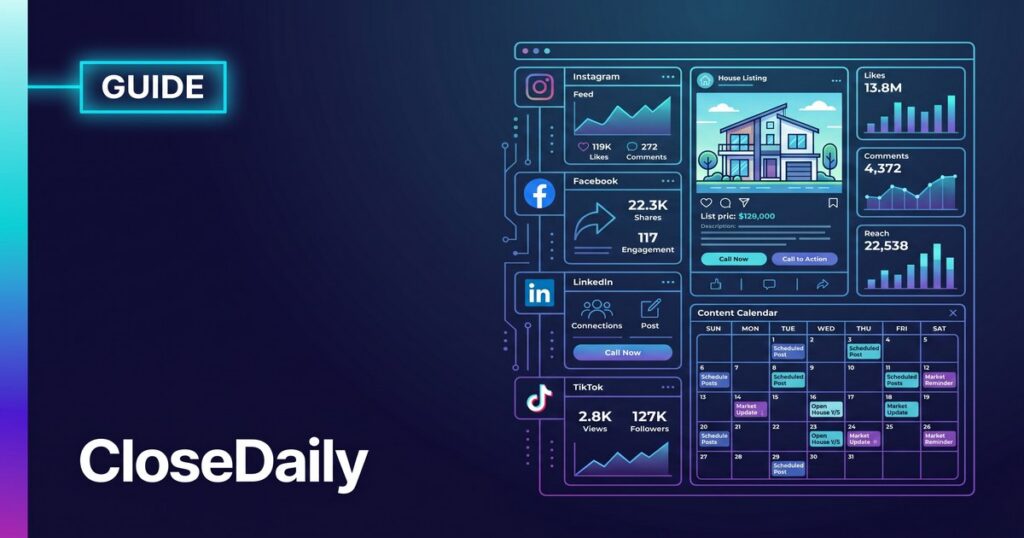
Why Most Agents Market Randomly — And Why a Plan Changes Everything
Ask most real estate agents what their marketing plan is, and you’ll get a vague answer: “I post on social media sometimes,” “I send out a newsletter,” “I do open houses.” That’s not a marketing plan. That’s a list of random activities with no strategy, no budget, no timeline, and no way to measure what’s working.
The agents who consistently generate leads and close deals don’t market randomly — they follow a plan. They know exactly who they’re targeting, which channels they’re investing in, how much they’re spending, and what return they’re getting. And because they have a plan, they can optimize: doubling down on what works and cutting what doesn’t.
This guide walks you through building a real estate marketing plan from scratch — from defining your target audience to allocating your budget, building a content calendar, and tracking the metrics that actually predict business. Whether you’re a solo agent with a $200/month budget or a team leader spending $5,000/month, the framework is the same. For the full business planning context, see our business plan guide.
Step 1: Define Your Target Audience and Ideal Client
Before you spend a dollar on marketing, you need to know exactly who you’re trying to reach. “Everyone who wants to buy or sell a home” isn’t a target audience — it’s everybody. Effective marketing speaks to specific people with specific needs.
Build Your Ideal Client Avatar
Think about your best past clients — the ones who were easy to work with, referred their friends, and represented profitable transactions. What did they have in common? Consider their demographics (age, income, family status), their geographic preferences (which neighborhoods, which school districts), their transaction type (first-time buyer, move-up buyer, downsizer, investor, luxury), and their pain points (what worried them most about buying or selling).
Once you have this profile, you can create marketing that speaks directly to those people. A first-time buyer in their early 30s responds to different messaging than a retiring couple downsizing from their family home. A real estate investor cares about cap rates and ROI, not school districts and community events. The more specific your targeting, the more effective your marketing.
Choose Your Geographic Focus
Unless you’re on a large team with market-wide reach, you’re better off dominating a few neighborhoods than being unknown across an entire metro area. Pick 2-3 geographic areas where you have the most knowledge, the most connections, or the most potential for growth. All of your local marketing — farming, community involvement, local content — should focus on these areas.
Step 2: Allocate Your Marketing Budget
The NAR Profile of Members found that the median agent spends approximately 5-10% of their gross commission income (GCI) on marketing. If you’re earning $100,000 GCI, that’s $5,000-$10,000 per year — roughly $400-$800 per month. New agents building their business may need to invest more as a percentage; established agents with strong referral networks can often spend less.
Budget Allocation Framework
Here’s how to split your marketing budget across channels based on where you are in your career:
New agents (0-2 years): Allocate 50% to digital marketing (website, SEO, social media ads), 20% to local/community marketing (farming, sponsorships), 20% to sphere of influence nurturing (events, gifts, mailers), and 10% to tools and systems (CRM, email platform, design tools).
Established agents (3+ years): Allocate 30% to digital marketing, 20% to local/community, 30% to sphere and past client nurturing, and 20% to tools, branding, and professional development.
The key principle: your marketing budget should shift toward relationship-based marketing as your database grows. New agents need to generate awareness; established agents need to nurture existing relationships and generate referrals.
Step 3: The Four Pillars of Real Estate Marketing
Every effective real estate marketing plan is built on four pillars. Neglect any one of them, and you’ll have gaps in your lead pipeline.
Pillar 1: Digital Marketing
Your digital presence is your storefront. Most buyers and sellers start their agent search online, and your digital marketing determines whether they find you.
Website and IDX: Your website is the hub of your digital marketing. It should include IDX property search (so buyers can search listings directly on your site), neighborhood and market content (to capture search traffic), testimonials and social proof, clear calls to action for lead capture, and a professional bio that builds trust. Your IDX integration is especially critical — it turns your website from a digital brochure into a lead generation tool by allowing visitors to search, save properties, and register.
Search engine optimization (SEO): SEO is the long game. Create content targeting keywords that your ideal clients search for: “[city] homes for sale,” “best neighborhoods in [city],” “[city] real estate market update.” Each piece of content is an asset that can generate leads for years. SEO content takes 3-6 months to gain traction, but it compounds over time.
Paid advertising: Google Ads and social media ads can generate immediate leads while your organic marketing builds momentum. Start with a small budget ($300-$500/month), test different audiences and messaging, and scale what works. Track your cost per lead and cost per acquisition religiously — if a channel isn’t producing at an acceptable cost, reallocate the budget.
Pillar 2: Social Media Marketing
Social media is where you build relationships at scale. The goal isn’t to sell on social media — it’s to stay top-of-mind so that when someone in your network is ready to buy or sell, you’re the first agent they think of. For platform-specific strategies, see our social media marketing guide and our social media brand-building guide.
Choose 2-3 platforms and commit. Being mediocre on five platforms is worse than being excellent on two. For most agents, the best combination is Instagram (visual content, stories, reels), Facebook (community groups, marketplace, events), and one additional platform based on your audience (YouTube for long-form content, TikTok for younger audiences, LinkedIn for relocation and corporate clients).
Content mix: Follow the 80/20 rule — 80% valuable, entertaining, or educational content, and 20% promotional content (listings, open houses, calls to action). The agent who only posts “Just Listed!” and “Just Sold!” gets unfollowed. The agent who shares market insights, neighborhood highlights, homeowner tips, and behind-the-scenes content builds a following that generates referrals.
Pillar 3: Local and Community Marketing
Digital marketing gets you found. Local marketing gets you known. In real estate, being known in your community is the most sustainable competitive advantage you can build.
Geographic farming: Choose a neighborhood of 200-500 homes with a healthy turnover rate (5-8% annually) and no dominant competitor. Build your presence through consistent mailers, door knocking, community events, and hyperlocal content. Farming takes 6-12 months to produce results but creates a pipeline that compounds year after year.
Community involvement: Sponsor a local sports team, volunteer for a community event, participate in your HOA or neighborhood association, host a community cleanup day. These activities build genuine relationships and position you as someone who invests in the community, not just someone who wants to sell houses in it.
Strategic partnerships: Build referral relationships with mortgage lenders, home inspectors, insurance agents, financial planners, divorce attorneys, and estate attorneys. These professionals interact with potential buyers and sellers regularly, and a strong partnership can generate consistent referrals in both directions.
Pillar 4: Referral and Sphere Marketing
Your sphere of influence — past clients, friends, family, professional contacts — is your highest-converting lead source. Referral leads convert at 14-17%, compared to 2-5% for online leads. Yet most agents neglect their sphere after the initial transaction.
Stay in touch systematically. Every person in your sphere should hear from you at least once a month — through a combination of email newsletters, social media engagement, personal calls, handwritten notes, and pop-by visits. Your CRM should automate the reminders so no one falls through the cracks.
Past client nurturing: Your past clients are your most valuable marketing asset. Stay in touch with home anniversary messages, annual market updates on their home’s value, holiday gifts or notes, and invitations to client appreciation events. The cost of nurturing a past client relationship is a fraction of acquiring a new lead — and the conversion rate is dramatically higher.
Step 4: Build Your Monthly Marketing Calendar
A marketing plan without a calendar is just a wish list. Convert your strategy into specific actions scheduled across every week and month.
Weekly Recurring Activities
Post on social media 3-5 times per week (batch content creation on one day). Send one email to your database (market update, new listings, or educational content). Make 10-15 sphere of influence touches (calls, texts, notes). Engage with your audience’s social media posts for 15-20 minutes daily. Update your Google Business Profile with a post or photo.
Monthly Recurring Activities
Send one neighborhood farm mailer or door drop. Create one piece of long-form content (blog post, video, or neighborhood guide). Review your marketing metrics and adjust budget allocation. Meet with one referral partner for a coffee or lunch. Attend one community event or networking opportunity.
Quarterly Activities
Send a detailed market report to your entire database. Host a client appreciation event or community gathering. Review and adjust your marketing plan based on results. Update your website content and listings. Audit your online reviews and request new ones from recent clients.
Seasonal Marketing Adjustments
Real estate has natural seasonal patterns, and your marketing should reflect them. In January and February, focus on “thinking about selling this spring?” messaging and preparing listing content. March through May is prime listing season — increase your paid advertising budget, ramp up social media posting frequency, and host more open houses. During the summer months, maintain consistent marketing but shift some budget toward buyer-focused content as inventory grows. In the fall, target sellers who want to list before the holidays and buyers who are relocating for the new year. During the winter holidays, focus on relationship nurturing — client gifts, holiday cards, and year-in-review content that reminds your sphere you’re thinking of them.
The agents who plan for seasonal shifts spend less and generate more because their messaging aligns with what buyers and sellers are actually thinking about at each point in the year.
Step 5: Track the Metrics That Actually Matter
Most agents track vanity metrics — social media followers, website visits, email open rates — that feel good but don’t predict business results. Here are the metrics that actually matter.
Lead source tracking: Where is each lead coming from? Your website, social media, referrals, open houses, farming, or paid ads? You can’t optimize what you can’t measure. Tag every lead by source in your CRM.
Cost per lead (CPL): How much does it cost to generate a lead from each channel? Divide your total spend on a channel by the number of leads it generated. If your Google Ads cost $500/month and generated 10 leads, your CPL is $50.
Cost per acquisition (CPA): How much does it cost to acquire a closed transaction from each channel? This is the metric that matters most. A channel with a $200 CPL but a 15% conversion rate costs $1,333 per closed deal. A channel with a $50 CPL but a 2% conversion rate costs $2,500 per closed deal. The cheaper leads aren’t always the better investment.
Return on investment (ROI): For every dollar you spend on marketing, how many dollars do you earn in commission? Track this by channel. If you spent $3,000 on farming and earned $15,000 in commissions from farm leads, your ROI is 5x. If you spent $6,000 on online ads and earned $9,000 in commissions, your ROI is 1.5x. Let the numbers guide your budget allocation.
Pipeline velocity: How long does it take from first contact to closed transaction, by lead source? Referrals might close in 45 days. Online leads might take 6 months. Understanding this helps you forecast revenue and manage expectations.
Step 6: Adjust Quarterly — Kill What’s Not Working
A marketing plan isn’t a set-it-and-forget-it document. Every quarter, review your results and make decisions. Double down on channels with the best ROI. Cut or reduce channels that aren’t performing. Test one new marketing tactic each quarter. Reallocate budget from underperforming channels to high-performers.
The most common mistake agents make is continuing to spend on channels out of habit rather than results. If your monthly newsletter has a 5% open rate and has generated zero leads in six months, it’s time to either radically change the format or reallocate that effort elsewhere.
Common Marketing Plan Mistakes to Avoid
Spreading too thin. Trying to be everywhere at once — five social platforms, three paid ad channels, weekly blog posts, daily videos, and a farming campaign — when you can only afford to do two things well. Pick your highest-potential channels and commit fully before adding more.
No tracking infrastructure. If you can’t attribute a lead to a specific marketing channel, you’re spending blind. Set up lead source tracking in your CRM from day one. Ask every new lead “How did you hear about me?” and log the answer. Without this data, every budget decision is a guess.
Inconsistency. Marketing compounds over time, but only if you’re consistent. Posting on social media every day for two weeks, then disappearing for a month, is worse than posting three times a week every week for a year. Consistency builds trust, familiarity, and search engine authority. The agents who succeed with marketing are the ones who show up reliably, not the ones who show up sporadically.
Copying competitors instead of differentiating. If every agent in your market posts the same “Just Listed” graphics, market stat carousels, and home-buying tip lists, doing the same thing makes you invisible. Find your unique angle — whether it’s humor, deep neighborhood expertise, educational video content, or a specific niche like relocation or investment properties — and lean into what makes you different.
Ignoring your database. The single highest-ROI marketing activity for most agents is nurturing their existing database — past clients, sphere of influence, and warm leads. Yet most agents spend 80% of their budget chasing new leads and 20% nurturing existing relationships. Flip that ratio as your database grows. A well-maintained database of 500 people will outproduce $50,000 in annual ad spend.
No call to action. Every piece of marketing should tell the reader what to do next. “Thinking about selling? Get a free home value report at [link].” “Ready to start your home search? Let’s connect — [phone number].” Marketing without a clear CTA is content, not marketing. The difference between content and marketing is the ask.
Your Marketing Plan Is Your Business Plan
The agents who build predictable, scalable businesses treat marketing as a system — not a series of random activities. They know their numbers, they follow a calendar, they measure results, and they adjust based on data. That discipline is what separates the agents who hope for leads from the agents who generate them on demand.
If you’re ready to execute your marketing plan with a platform that integrates your IDX website, CRM, email campaigns, and lead tracking in one place, CloseDaily was built to make your marketing systematic, measurable, and effective.
Keep Reading

How to Choose a Real Estate Brokerage: What New Agents Must Know
The complete guide to choosing the right brokerage as a new real estate agent. Compare 6 brokerage models,...

Real Estate Agent Time Management: How Top Producers Protect Their Hours
Master time management as a real estate agent. Covers time audits, time blocking, the Big 3 priorities system,...

How to Transition From Part-Time to Full-Time Real Estate Agent
Plan your transition from part-time to full-time real estate agent. Covers readiness signs, financial runway calculator, 90-day transition...
