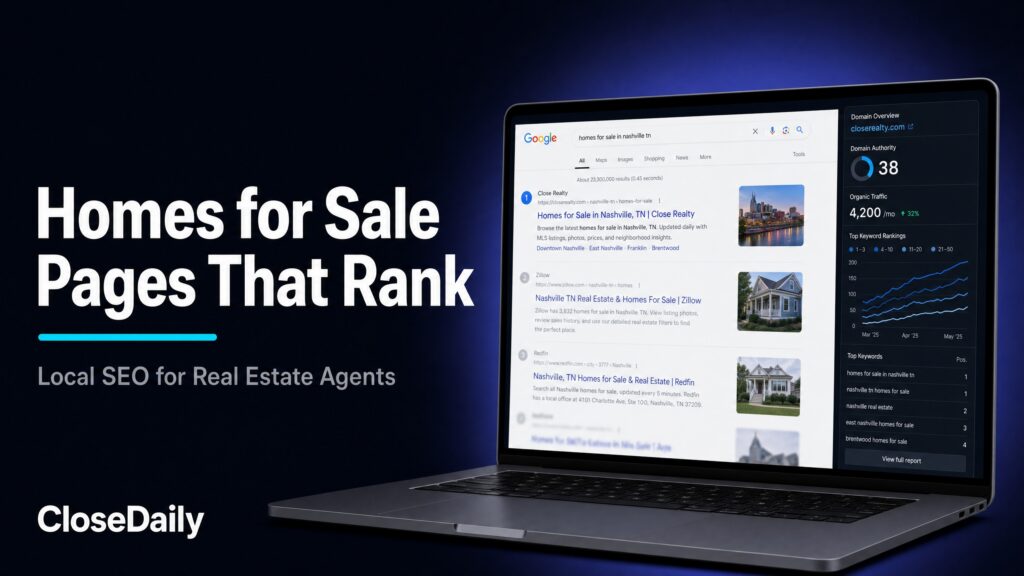
The most valuable search query in real estate is some variation of “homes for sale in [location].” Buyers type this into Google millions of times per month, and whoever ranks on the first page for their local version of this search gets free, high-intent leads delivered to their IDX website every single day.
Right now, those first-page spots are dominated by Zillow, Realtor.com, and Redfin. But individual agents DO rank for neighborhood-level and hyper-local versions of these searches. And at the neighborhood level, the competition is dramatically lower while the lead quality is arguably higher, a buyer searching for “homes for sale in Westlake Hills” knows exactly where they want to live.
Here’s how to create local “homes for sale” pages that rank on Google and drive organic traffic that converts into IDX leads.
The Page Structure That Ranks
Google ranks pages that comprehensively answer the searcher’s intent. When someone searches “homes for sale in [neighborhood],” they want to see available listings AND context about the area. A page that delivers both outranks a page that delivers only one.
Your local homes-for-sale page needs three components:
Live IDX search results. An embedded, pre-filtered IDX search showing current listings in that specific neighborhood or area. This is the functional component that gives the page real utility, the visitor can immediately start browsing homes without any additional clicks.
Unique local content. Two hundred to five hundred words of original content about the area that doesn’t exist on any other website. Neighborhood description, school information, lifestyle highlights, market statistics, commute context, and what makes this area desirable. This content differentiates your page from every other IDX site showing the same listings.
Clear calls to action. Registration prompts, saved search options, and contact methods placed naturally throughout the page. The visitor found your page through Google. Now you need to convert them into a lead before they click the back button.
Writing Content That Google and Buyers Both Love
The content on your local pages needs to serve dual purposes: ranking factors for Google and genuine value for the buyer reading it.
Start with what makes the neighborhood unique. Not the generic “great community with friendly neighbors” that could describe any area anywhere. Specific details that demonstrate local knowledge. The walking trail that connects to the greenway. The Saturday farmer’s market in the parking lot of the old hardware store. The school that just opened a new STEM wing. The restaurant that every local will tell you about.
Include market data that changes over time. “The median home price in [neighborhood] is currently $425,000, up 4.2% from last year. Homes here spend an average of 18 days on market, which is faster than the city average of 31 days.” This data-driven content signals expertise to both Google and buyers, and it gives you a reason to update the page quarterly, which Google rewards with freshness signals.
Answer the questions buyers are actually asking. What are property taxes like? Is the area in a flood zone? What HOA restrictions exist? How far is the commute to downtown? Are there good daycare options nearby? Each answered question adds unique value and potentially captures long-tail search traffic.
On-Page SEO Essentials
Title tag: “Homes for Sale in [Neighborhood] | [City] Real Estate | [Your Name or Brand].” Keep it under 60 characters so it displays fully in search results.
Meta description: A compelling summary that includes the location and encourages clicking. “Browse [X] homes for sale in [Neighborhood]. See photos, prices, and details. Updated daily with the latest MLS listings.” Keep under 155 characters.
H1 heading: “Homes for Sale in [Neighborhood], [City] [State]”, match the search query as closely as possible.
H2 subheadings: Use natural variations like “About [Neighborhood],” “Market Stats for [Neighborhood],” “Schools Near [Neighborhood],” and “Why Buyers Choose [Neighborhood].”
Internal links: Link to your other neighborhood pages, relevant blog posts, and your main IDX search page. This internal linking web helps Google understand the topical structure of your site and distributes authority across your pages.
Schema markup: Add RealEstateAgent schema to your page and, if your platform supports it, RealEstateListing schema to individual listing displays. This structured data can produce rich snippets in Google search results.
How Many Pages to Create
Start with your top five neighborhoods, the areas where you have the most knowledge, the most activity, and the most potential clients. Create thorough, comprehensive pages for each one.
Then expand. Over the next three to six months, build pages for every significant neighborhood, community, zip code, and school district in your farm area. A well-developed local page network of 20 to 50 pages creates a comprehensive local presence that Google sees as authoritative.
Don’t create thin pages for areas you know nothing about. Quality matters more than quantity. One excellent page for a neighborhood you know intimately will outrank ten generic pages for areas you’ve never visited. Build from your strengths outward.
Maintaining and Updating Your Pages
Creating the pages is the first step. Maintaining them is what keeps them ranking. Google favors content that stays current over content that’s published once and forgotten.
Set a quarterly review schedule. Update market statistics (median price, days on market, inventory levels). Add new information about developments, school changes, new businesses, or community events. Refresh the content to reflect current conditions rather than the conditions when you first wrote the page.
Each update signals to Google that this page is actively maintained and contains current information. Stale pages gradually lose ranking to fresher competitors. Updated pages hold and often improve their positions.
The Compounding Effect
Local homes-for-sale pages are a compounding investment. The traffic they generate starts small, maybe a handful of visitors per page per month in the first few months. But as Google indexes the pages, recognizes the topical authority of your site, and starts ranking them higher, the traffic grows exponentially.
An agent with 30 well-optimized neighborhood pages, each ranking for local searches and driving five to twenty visitors per day, can generate 150 to 600 organic visitors daily. At a 3 to 5 percent registration rate, that’s 5 to 30 free leads every single day from Google alone.
No ad spend. No cold calling. No buying leads from portals. Just buyers finding your website because you invested the time to create the content they were searching for.
This is the organic lead generation engine that the top-ranking agents in every market have built. It’s not magic. It’s not a secret. It’s content, consistency, and a platform that converts that traffic into leads. Start building your local pages today and let the compounding begin.
Ready to close more deals?
Join thousands of agents using CloseDaily to build their business.