Your sphere of influence is your goldmine. Not your website. Not your ads. Not your social media followers. Your real money comes from the people who know, like, and trust you, and there’s data backing this up.
According to the National Association of REALTORS® 2024 Profile of Home Buyers and Sellers, 76% of real estate transactions involve a referral source, a friend, family member, neighbor, or past client connecting the buyer or seller to an agent. Yet most agents treat their sphere like an afterthought, sending a birthday card in December and wondering why the phone doesn’t ring.
This isn’t about being busy. It’s about being strategic. The top 1% of agents don’t chase strangers, they systematically nurture relationships with people who’ve already proven they’ll do business with them. They’ve built a sphere system, and you can too.
Here’s what separates the $500K agents from the $2M agents in my market: consistent, intentional contact with a well-organized sphere. No gimmicks. No desperation. Just relentless focus on the people closest to you.
Your sphere is the highest-converting channel in the complete guide to real estate lead generation, which makes working it well non-negotiable.
What Actually Is Your Sphere of Influence?
Your sphere isn’t a vague concept. It’s a defined, measurable list of people who know you and are likely to give you business or refer you business. This includes past clients, friends, family, neighbors, colleagues, social connections, and service providers you interact with regularly.
The critical difference between average and top-producing agents is organization. Average agents keep contacts scattered across email, text, and their head. Top producers have a documented, segmented sphere with clear follow-up strategies for each tier.
Most agents have 150-500 people in their sphere. That’s more than enough to hit $1M+ in annual transactions if you work it right. The question isn’t how big your sphere is, it’s how strategically you’re engaging with it.
Build Your Sphere System From the Ground Up
Stop thinking of your sphere as static. Think of it as a living ecosystem that needs constant input and maintenance. You need four layers:
1. A-Tier: Your Hottest Contacts (25-50 people)
These are people who’ve already transacted with you, referred to you, or are extremely close (family, best friends). They know your value. They trust you. They’re your immediate revenue source. Contact each of these people at least once per month, ideally twice. Make it personal, a video message, a phone call, a specific question. Not a mass blast.
2. B-Tier: Warm Sphere (75-150 people)
These are your social connections, past acquaintances, colleagues, and neighbors who know you but may not have done business with you yet. They need regular touchpoints to stay top-of-mind. Target contact frequency: every 6-8 weeks. This is where automated email and SMS sequences pay off, you can stay consistent without the daily grind.
3. C-Tier: Extended Sphere (200-300 people)
LinkedIn connections, parents from your kids’ school, members of your gym or community group, people you meet at events. They know your name but may not know what you do. Contact them quarterly with valuable content, not sales pitches. This tier becomes gold when someone needs real estate, you’re already in their mental Rolodex.
4. Service Providers & Strategic Partners (50-100 people)
Mortgage brokers, home inspectors, attorneys, contractors, insurance agents, and other professionals who work in real estate. These relationships generate referrals consistently if you stay in touch and send them business first. Monthly contact minimum. This is a two-way street.
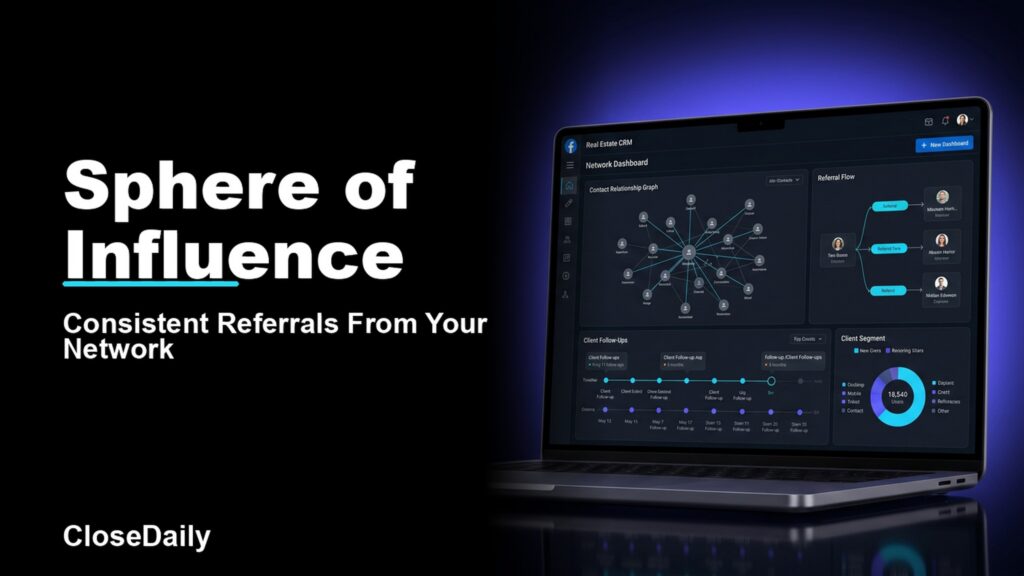
Once you’ve segmented your sphere, you need a system to manage it. Use your CRM to store contact information, transaction history, preferences, and last contact date. Without this visibility, you’ll chase the same people randomly and miss others entirely.
The Follow-Up Infrastructure That Actually Works
Having a sphere means nothing if you’re not in front of them regularly. But “in front of them” doesn’t mean annoying them with constant sales calls. It means staying connected through genuine, valuable touchpoints.
Personal Outreach for A-Tier Contacts
For your hottest 25-50 people, block time on your calendar for personal interaction. One day per week, make 10 calls or send 10 personalized videos. Ask how they’re doing. Ask about their family. Tell them about your recent transactions and ask if they know anyone who might need real estate services. This one activity, genuine, personal contact, will generate more referrals than anything else you do.
Automated Campaigns for B & C Tiers
You can’t call 300+ people personally. You need automation that doesn’t feel automated. SMS sequences and email drips let you deliver consistent messages at scale without looking like you’re mass-texting everyone. Send them market updates, local insights, funny videos, neighborhood highlights. Anything that reminds them you exist and that you’re the expert they should call when they’re ready to move.
Event-Based Touchpoints
Seasonal touchpoints work. Holiday cards in November, New Year congratulations, spring market updates, summer neighborhood spotlights, fall preparation guides. Consistency beats cleverness every time. If your sphere knows they’ll hear from you on a predictable schedule, they’ll expect and anticipate your contact instead of dreading it.
Top-producing agents build sphere contact into their daily habits, treating it as non-negotiable as showing properties. They know that 30 minutes per day of intentional sphere engagement beats 8 hours of cold prospecting every single time.
The Script That Generates Referrals
When you do contact your sphere, what do you say? Here’s the script I use almost word-for-word with my A-tier contacts:
“Hey [Name], I was thinking about you today. I just closed a transaction in [neighborhood/property type] and it reminded me of our conversation about [specific detail]. How is everything going with you and [family member]? I’d love to catch up. Also, as you’re out and about, if you come across anyone looking to buy or sell real estate, I’d love the opportunity to help them. I’d take great care of them, just like I did for you.”
This script works because it: (1) personalizes the contact, (2) demonstrates recent success, (3) asks about their life, (4) makes the referral ask simple and natural. No pressure. No desperation. Just a professional asking for the opportunity to help their network.
How This Played Out Recently in My Business
May 5th 2026 I had a contact tagged “B-tier” in my CRM, a guy named Mark who I’d helped buy some land in Winchester in December of 2025. We hadn’t talked in months. I was working my Monday sphere block, called him, asked how his wife and family are doing. About fifteen minutes in, he mentioned his sister had just gotten engaged and was moving back to Middle Tennessee from Charlotte. Two phone calls and a Brentwood listing tour later, I had the buyer side of a $640K closing, from one sphere call I almost skipped because I “didn’t have time.” Call your sphere!
The deal would never have happened if I’d waited for Mark to remember me on his own. It only happened because I used the script above to start a real conversation, and the referral came up naturally, not because I asked for it.
That’s the whole game. The system isn’t fancy. It’s just consistent.
Creating Sphere Content That Keeps You Top-of-Mind
Content is the engine of sphere engagement. You don’t have to create it from scratch. Here’s what works:
Market Updates (Monthly)
Share local market data with context. Not “prices up 2%.” Instead: “If you’re thinking about selling, here’s what’s happening in your neighborhood right now, and why timing matters.”
Neighborhood Insights (Weekly or Bi-Weekly)
Spotlight local events, new businesses, school updates, or property sold data from specific neighborhoods. This proves you’re plugged into the community and thinking about your contacts’ surroundings.
Success Stories (As They Happen)
When you close a transaction, share the story with your sphere. Not the contract price, the story. “We just helped the Martinez family find their dream home after they’d been searching for 6 months. Here’s what made it work…” This positions you as someone who delivers results.
Seasonal Guides (Quarterly)
Spring buying guide, summer market report, fall preparation checklist, winter planning worksheet. Offer genuine value, not sales pitches.
The frequency matters more than perfection. A consistent “good enough” message beats a sporadic “perfect” message every time.
The Psychology of Referral Generation
People give referrals when three things are true: (1) they trust you completely, (2) they know exactly what you do, and (3) they think about you when the opportunity arises.
Most agents fail at #2 and #3. They do good work, but their sphere doesn’t know they’re open for business or doesn’t remember them at decision time. This is why consistency and visibility matter so much. You’re not trying to convince anyone to refer you, you’re just making sure you’re the first person they think of.
Here’s the uncomfortable truth: your sphere doesn’t sit around thinking about you. They’re solving their own problems. Your job is to stay visible and helpful enough that when they or someone they know needs real estate help, you’re the obvious choice. Not the best choice. The obvious choice.
This shifts your mentality from “I’m asking for favors” to “I’m providing value.” That difference is everything. When you send a market update, you’re providing value. When you make a personal call just to say hi, you’re building the relationship. When you ask for a referral after months of valuable contact, it feels natural to both of you.
Segment Your Messaging Based on Life Stage
Don’t send the same message to everyone. A young family with kids needs different information than empty nesters. A real estate investor needs different data than a first-time homebuyer.
Create messaging buckets: young families, investors, seniors, professionals, service providers. Tailor your content to each group’s likely needs. This dramatically increases engagement and referral quality.
The Monthly Sphere Check-In Ritual
Every month, block 2 hours on your calendar for sphere work:
Hour 1, Review & Update. Open your CRM, look at your A and B tier contacts, note who you’ve contacted recently, identify who’s overdue. Update notes on recent conversations. Look for any changes in their life (new job, kid in college, recent promotion). This context makes your next interaction feel personal and thoughtful.
Hour 2, Proactive Contact. Make 15-20 calls or send 15-20 personalized video messages. About 10 minutes each. This doesn’t sound like much, but 15-20 quality conversations per month with your hottest prospects equals 180-240 conversations per year. Do the math on referrals from that level of activity.
That’s it. Two hours per month of intentional sphere work. If you do this, you will generate referrals. Repeatedly.
Handling the Sphere That Won’t Transact or Refer
Not every contact will become a transaction. Some people simply don’t have the need or the connections to refer. That’s fine. Your job isn’t to convert everyone, it’s to stay in front of the people who will. Over time, you’ll naturally identify who your “hot” contacts are and adjust your effort accordingly.
The key is having a system that lets you scale your contact without burning out. If you’re manually calling 300 people, you’ll quit in two months. If you’re using automation to stay in touch with 300 people while focusing your personal time on your hottest 50, you’ll sustain it for years.
The 90-Day Sphere Challenge
Here’s your action plan for the next quarter:
Week 1-2. Build your list. Document every contact in your CRM. Segment them into A, B, C, and service provider tiers. Update their information. Add notes about their life, family, and interests.
Week 3-4. Create your messaging calendar. Plan your monthly themes (market update, neighborhood spotlight, success story, seasonal guide). Create templates and scripts. Set up automation for B and C tiers.
Month 2. Execute personal outreach. Dedicate 2 hours weekly to your A-tier contacts. Make calls, send videos, schedule coffee meetings. Document results.
Month 3. Analyze and optimize. Look at which contacts are responding, which messages are working, which segments are generating interest. Double down on what’s working. Refine what isn’t.
By month 4, you’ll see referrals start flowing in. Not because you’ve done anything magical, but because you’ve done the unglamorous work of staying consistently in front of people who already trust you.
Your Sphere Is Your Business
Stop thinking of your sphere as a side project. It’s your core business. The money you make this year largely depends on how well you worked your sphere last year. The money you’ll make next year depends on how well you work it today.
The agents making $1M+ in annual GCI aren’t smarter than you. They’re not better looking. They’re not luckier. They’re just more disciplined about staying in front of people who know and trust them. They’ve built a system, stuck with it, and reaped the rewards.
Your sphere is not a nicety. It’s your foundation. Everything else, your website, your ads, your social media, should support your sphere work, not replace it.
Start today. Build your list. Segment your contacts. Set up your automation. Block time for personal outreach. Make this your non-negotiable ritual. In six months, you’ll wonder why you didn’t start sooner.
Related CloseDaily tools. If you want a CRM purpose-built for sphere work, segmented contacts, automated SMS/email drips, and reminders so nothing falls through, CloseDaily was built for this exact workflow. Start a free trial.
Ready to close more deals?
Join thousands of agents using CloseDaily to build their business.