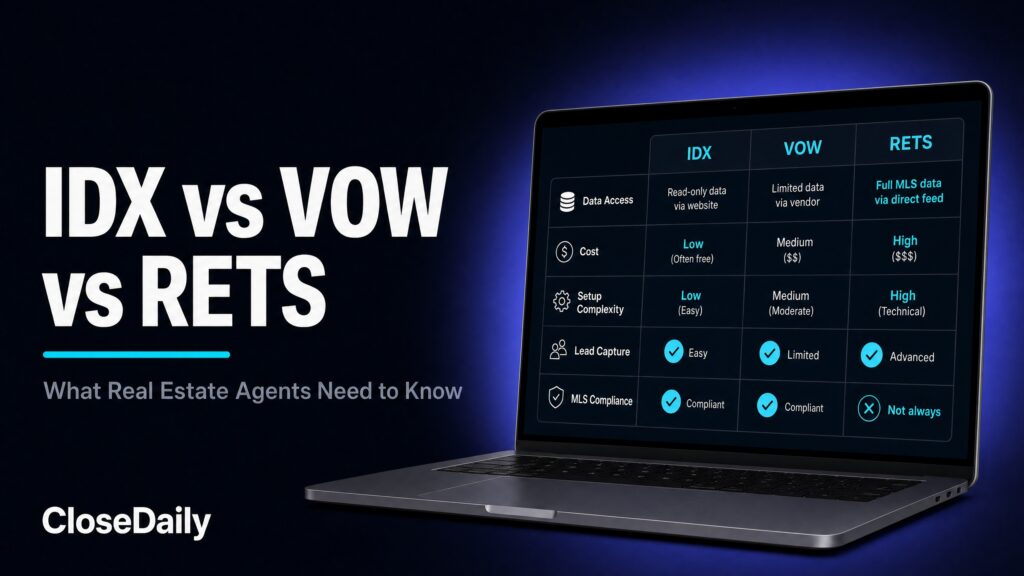
Real estate technology loves acronyms. IDX, VOW, RETS, RESO, MLS, the alphabet soup is thick enough to make any agent’s eyes glaze over. But understanding what these terms actually mean helps you make better decisions about your website, your data, and your lead generation strategy.
Here’s the plain-English guide to the three terms that come up most often: IDX, VOW, and RETS. What each one does, how they differ, and which one you should care about.
IDX: Internet Data Exchange
IDX is the one that matters most for your business. It’s a set of policies and technology standards created by the National Association of Realtors that allows MLS listing data to be displayed on broker and agent websites.
When someone talks about an “IDX website,” they mean a website that displays MLS listings through an authorized data feed. Buyers can search for homes, view listing details, save favorites, and set up alerts, all on your branded website instead of on Zillow or Realtor.com.
IDX data is publicly accessible to anyone who visits your website. Visitors don’t need to be clients or have a pre-existing relationship with you to view IDX listings. However, you can (and should) require registration after a few listing views to capture lead information.
Key IDX characteristics: listings from all participating brokers in your MLS are displayed (not just yours), listing broker attribution is required, opt-out listings are excluded, and the data refreshes on a regular schedule (typically every 15 minutes to a few hours).
VOW: Virtual Office Website
VOW stands for Virtual Office Website, and it provides a different type of MLS data access than IDX. While IDX shows listings to any website visitor, VOW data is only available to registered users who have agreed to the terms of a broker-consumer relationship.
The practical difference: VOW can display more data than IDX. VOW feeds typically include sold listings, expired listings, withdrawn listings, and other data that IDX rules restrict from public display. This historical data is valuable for market analysis, pricing comparisons, and showing buyers what homes in their target area have actually sold for.
The tradeoff is that VOW requires a more formal registration process. Visitors must acknowledge that they’re entering a brokerage relationship and agree to the terms of service before accessing VOW data. This higher barrier to entry means fewer casual browsers will register, but the ones who do tend to be more serious.
Most agent websites use IDX rather than VOW because the lower registration barrier captures more leads. However, some platforms offer VOW data as a premium feature for registered users, after someone registers through the IDX gate, they gain access to additional VOW data like sold prices and expired listing history.
RETS: Real Estate Transaction Standard
RETS is not something buyers or agents interact with directly. It’s the technical protocol that powers data transfer between MLS databases and technology platforms. Think of it as the plumbing that delivers listing data to your IDX or VOW website.
When CloseDaily “connects to your MLS,” they’re typically establishing a RETS connection. RETS defines how data is requested, formatted, and transmitted between systems. It handles the technical details of pulling listing photos, property descriptions, status changes, and all the other data points that appear on your website.
RETS has been the standard for nearly two decades, but it’s being gradually replaced by the RESO Web API, which is faster, more modern, and better suited for real-time data delivery. The industry is in the middle of this transition, some MLS boards have fully migrated to RESO Web API, while others still rely on RETS.
As an agent, you don’t need to understand the technical details of RETS. What you should know is that your IDX platform should support both RETS and RESO Web API to ensure compatibility with your MLS regardless of which standard they use today or transition to tomorrow.
How They Work Together
These three concepts operate at different layers of the same system.
RETS (or RESO Web API) is the data transport layer, it moves listing data from the MLS to your technology provider. IDX and VOW are the display policy layers, they define what data can be shown and to whom. Your IDX website is the presentation layer, it takes the data delivered via RETS and displays it according to IDX (or VOW) rules.
When a buyer searches for homes on your website, the chain looks like this: MLS database → RETS/RESO API feed → your IDX platform processes and stores the data → IDX display rules determine what’s shown → the buyer sees listings on your site → they register → they become a lead in your CRM.
What About RESO?
RESO (Real Estate Standards Organization) is the industry body that creates and maintains data standards for real estate technology. The RESO Web API is their modern replacement for RETS. You’ll also hear about RESO Data Dictionary, which standardizes field names across different MLS systems so that “bedrooms” means the same thing regardless of which MLS the data comes from.
RESO matters for the long-term health of real estate technology, but for your day-to-day business, what matters is whether your IDX platform delivers accurate, fast, and complete listing data to your website. The standards behind the scenes are important to your technology provider. They’re less important to you as long as the end result works.
Which One Should You Focus On?
For the vast majority of real estate agents, IDX is the only one of these concepts that directly affects your business decisions. You need an IDX website to display MLS listings and capture leads. Everything else, VOW data, RETS connections, RESO compliance, is handled by your technology platform.
When choosing a platform, focus on the outcomes rather than the technical architecture: does the search load fast? Does it display accurate, current listings? Does it capture leads effectively? Does it integrate with a CRM? Does it offer intelligent follow-up?
Platforms like CloseDaily handle all the technical complexity behind the scenes, RETS connections, RESO compliance, IDX display rules, so you can focus on what actually grows your business: getting in front of buyers, capturing their information, and converting them into clients.
The acronyms are worth understanding once so you can make informed decisions and ask smart questions when evaluating platforms. But don’t let the technical jargon paralyze you. The technology works. The agents who benefit from it are the ones who stop researching and start implementing.
Ready to close more deals?
Join thousands of agents using CloseDaily to build their business.