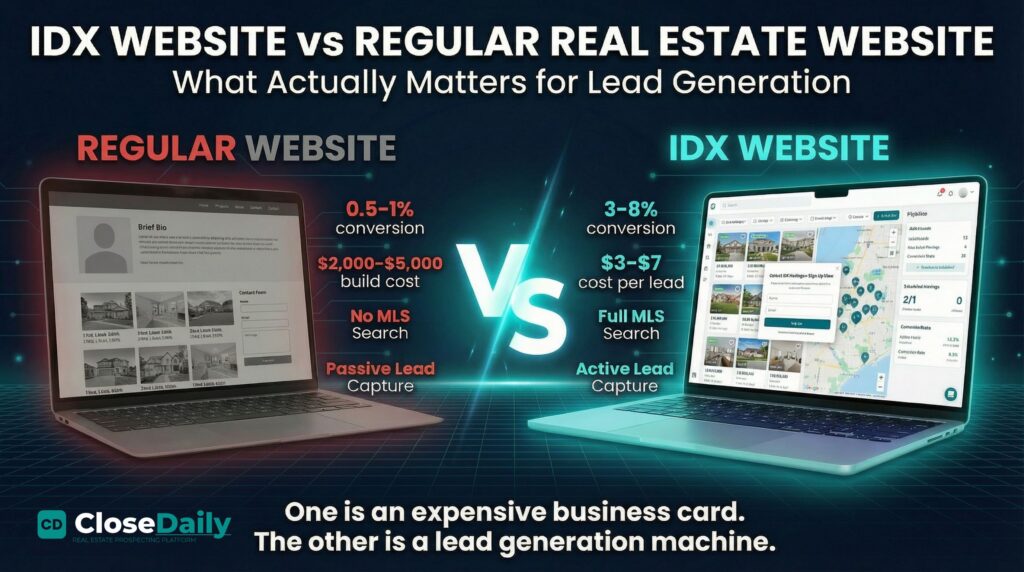
There are two types of real estate agent websites. One is an expensive business card. The other is a lead generation machine. The difference comes down to three letters: IDX.
If you’re trying to decide whether you need an IDX website or whether a standard real estate website is good enough, this article will give you the unfiltered answer, not the sales pitch from website vendors trying to upsell you.
What a Regular Real Estate Website Actually Does
A standard real estate website is what most agents start with. You pay a web designer or use a template service to create a site with your headshot, your bio, your current listings, some testimonials, and a contact form. It looks professional. It costs anywhere from $500 to $5,000 to build, plus $50 to $100 per month in hosting.
And for about 95% of agents, that’s where the story ends. The site goes live. Nobody visits it except the agent’s mom and a handful of people who Googled their name. Leads don’t come in. The agent concludes that “websites don’t work for real estate” and goes back to cold calling and door knocking.
But the problem isn’t websites. The problem is that a standard website gives visitors absolutely no reason to stay. A buyer lands on your page, sees your bio, maybe clicks through your four current listings, and leaves in under a minute. There’s nothing interactive. Nothing dynamic. Nothing that makes them want to come back tomorrow.
What an IDX Website Does Differently
An IDX website does everything a regular website does, plus it lets visitors search the entire MLS inventory directly on your site. That one addition fundamentally changes how the website functions as a lead generation tool.
Think about what buyers actually spend hours doing when they’re looking for a home. Searching for properties. Scrolling through listing photos. Comparing prices across neighborhoods. Checking out school districts. Figuring out what they can afford.
An IDX website lets them do all of that on YOUR site, which means they’re spending 10, 20, even 30 minutes per session instead of 45 seconds. And time on site is the single strongest predictor of whether someone will become a lead. Nothing keeps a visitor on a real estate website longer than active MLS search.
The Lead Capture Gap
Here’s where the difference between IDX and non-IDX becomes impossible to ignore.
A regular website has a contact form. Maybe a home valuation landing page. That’s passive lead capture. The visitor has to independently decide they want to reach out to you. Most don’t. They browse for a minute and leave.
An IDX website has active lead capture built directly into the search experience. After a visitor views three to five listings, the platform prompts them to create an account to continue browsing. They enter their name, email, and phone number. They save a search. They start getting listing alerts delivered to their inbox.
Now you have a lead who has told you, through their actual search behavior, exactly what they’re looking for. Price range. Location. Number of bedrooms. Property type. You know more about this lead’s buying criteria from their search history than you’d learn in a 30-minute discovery call.
The numbers tell the story. A well-optimized IDX website converts visitors to registered leads at a rate of 3 to 8 percent. A standard real estate website converts at 0.5 to 1 percent on a good day. That’s a five to ten times difference in lead generation from the exact same amount of traffic.
The SEO Advantage Nobody Talks About
Here’s something most agents don’t consider when comparing website options: an IDX website generates thousands of unique, indexable pages that a regular website simply doesn’t have.
Every active listing in your MLS becomes a page on your website. Every neighborhood search becomes a landing page. Every zip code, every property type, every price range filter creates searchable content that Google can index and rank.
“Homes for sale in Westlake Hills”, your IDX website has a page for that. “3 bedroom houses under $400,000 in Round Rock”, your IDX website has a page for that too. A regular website with your bio and six featured listings doesn’t rank for any of these searches. It can’t. The pages don’t exist.
The agents who dominate Google’s first page for local real estate searches almost always have IDX websites with optimized listing pages and supporting blog content. It’s not a coincidence. It’s a structural advantage built into how IDX works.
Real Cost Comparison
Let’s do the math with actual numbers instead of vague claims.
A custom real estate website typically costs $2,000 to $5,000 to build and $50 to $100 per month to maintain and host. If it generates two to five leads per month (which is optimistic for a site without IDX), your cost per lead lands somewhere between $50 and $200 depending on how you calculate the buildout amortization.
An IDX website platform like CloseDaily costs $299 per month, which includes the website, IDX search, CRM, and automated follow-up. A properly optimized IDX site in an active market generates 20 to 50 leads per month. Your cost per lead drops to $3 to $7.
Even if the IDX platform carries a higher monthly price tag, the cost per lead is dramatically lower. And in real estate, where a single closing can pay $5,000 to $15,000 in commission, the ROI calculation isn’t even close.
When a Regular Website Is Actually Fine
In the interest of honesty, there are situations where a basic website is genuinely sufficient.
If you’re a brand-new agent whose entire business comes from personal relationships and referrals, a simple website with your bio and testimonials serves as a credibility piece. Prospects Google your name, find a professional website, and feel comfortable working with you. In that case, the website is a trust signal, not a lead generation tool, and IDX isn’t necessary yet.
But the moment you want to generate leads online, whether through SEO, social media advertising, Google Ads, or content marketing, you need IDX. Sending paid traffic to a website with no interactive search experience is like paying for a billboard that points to an empty storefront. The visitor arrives, finds nothing to do, and leaves.
The WordPress Plugin Compromise
Some agents try to split the difference by adding an IDX plugin to their existing WordPress site. This approach can work, but it comes with real compromises.
Third-party IDX plugins often load noticeably slower than native IDX platforms. The search interface looks different from the rest of your site, creating a jarring experience. Lead capture options are limited. The listing data may update less frequently. And you’re still managing a separate CRM and follow-up system because the plugin only handles search.
The better approach is using a platform where IDX is built into the foundation of the website rather than layered on top. When the search, the website, and the CRM are all one integrated system, the lead capture is smooth, the data flows automatically, and nothing falls through the cracks.
Making the Switch Without Losing What You Have
If you currently have a regular website and you’re considering moving to an IDX platform, here’s what to think about so you don’t lose existing SEO value in the process.
Keep your domain. Do not start over on a new domain name. Your existing domain has built some authority with Google over time. Point it at your new IDX website and preserve that equity.
Migrate your blog content. If you have blog posts on your current site that rank in Google for anything, move them to the new platform. Losing indexed content means losing whatever organic traffic those posts were generating.
Set up 301 redirects. If any URLs are changing (which they probably will be), set up permanent redirects from the old URLs to the new ones. This tells Google the content moved rather than disappeared.
Choose a platform with CRM built in. The biggest mistake agents make when upgrading to IDX is picking a provider that only handles the website. Then they need a separate CRM ($70-$400/month), a separate email marketing tool ($30-$100/month), and a separate follow-up system. CloseDaily puts all of this in one platform so every IDX lead flows directly into your pipeline without extra software, extra cost, or extra complexity.
The Verdict
A regular real estate website is adequate if all you need is a digital business card for credibility. An IDX website is essential if you want to generate leads online, build a sustainable pipeline, and compete with the agents in your market who figured this out years ago.
The gap between agents with IDX and agents without it gets wider every month. Buyers are searching online every single day. The only question is whether they’re searching on your website or on Zillow. If the answer is Zillow, you already know who’s getting those leads.
It’s not you.
Ready to close more deals?
Join thousands of agents using CloseDaily to build their business.