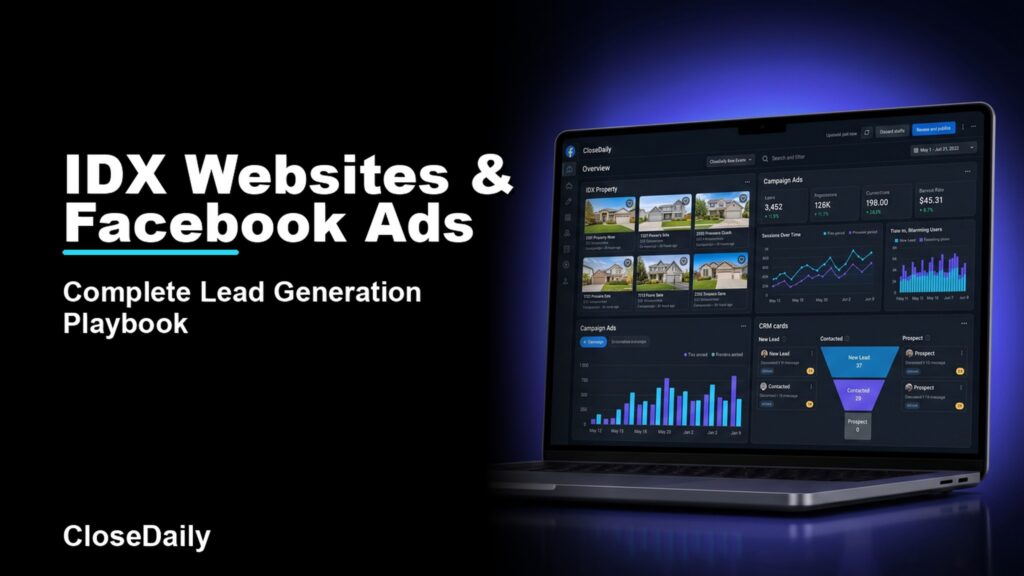
Organic traffic from SEO is the most cost-effective way to generate IDX leads. But it takes months to build. If you want leads this week, Facebook ads driving traffic to your IDX website is the fastest path to a full pipeline.
The combination works because Facebook has the targeting and your IDX site has the conversion mechanism. Facebook puts your ad in front of people likely to be buying a home. Your IDX site gives them a compelling reason to engage (listing search), captures their information (registration gate), and nurtures them into clients (CRM and follow-up).
Here’s the complete playbook for making these two tools work together.
The Funnel Architecture
The most effective Facebook-to-IDX funnel has three stages, each with a specific purpose.
Stage 1: The ad. Catches attention and generates a click. The ad targets local home buyers and drives them to a specific page on your IDX site.
Stage 2: The landing page. This is a pre-filtered IDX search page (not your homepage). When the visitor arrives, they immediately see listings relevant to the ad that brought them there. They start browsing, hit the registration gate, and become a lead.
Stage 3: The follow-up. Automated and personal follow-up that converts the registered lead into a conversation and ultimately a client.
Most agents mess up by skipping Stage 2, they run Facebook ads to their homepage instead of to specific, pre-filtered search pages. The homepage is too generic. The visitor lands, doesn’t immediately see what they expected, and bounces. Pre-filtered pages that match the ad’s promise convert dramatically better.
Targeting That Works
Facebook’s real estate targeting has restrictions (you can’t target by zip code for housing ads due to fair housing rules), but you can still reach the right audience through broader geographic and behavioral targeting.
Geographic targeting: Target your metro area or city. You can’t narrow to specific neighborhoods in housing-category ads, but you can target at the city level and let your ad copy do the neighborhood-level work.
Behavioral signals: Target people who are “likely to move” based on Facebook’s behavioral data. Combine with interests like “Zillow,” “Realtor.com,” “home buying,” “mortgage,” and “real estate.” These signals indicate active or near-future home search intent.
Lookalike audiences: If you have a customer list (past clients, current leads), upload it to Facebook and create a lookalike audience. Facebook identifies people who share demographic and behavioral similarities with your existing clients. These audiences consistently produce the lowest cost per lead.
Retargeting audiences: Place a Facebook pixel on your IDX website. Create a retargeting audience of visitors who browsed listings but didn’t register. Show them ads that bring them back to complete their registration. Retargeting audiences convert at five to ten times the rate of cold audiences because these people have already demonstrated interest.
Ad Creative That Converts
Real estate Facebook ads work best when they’re specific rather than generic. “Beautiful homes for sale!” doesn’t work. “Just listed: 4 homes under $400K in Cedar Park with pools” does.
Effective ad formats for IDX lead generation:
New listing carousel ads. Show three to five new or attractive listings from a specific area in a carousel format. Each card has a listing photo, price, and brief description. The CTA drives to your IDX search page filtered to that area. This format consistently produces the lowest cost per click because people engage with the visual carousel.
Market update video ads. A 30 to 60 second video of you sharing a quick market update for a specific area. “12 new listings hit the market in [neighborhood] this week and 3 of them are under $450K.” End with a CTA to search all current listings on your site. Video ads build trust and personal brand while driving traffic.
Just-listed single-image ads. One compelling listing photo with the price, key details, and a CTA. Drive traffic to either that specific listing on your IDX site (where the registration gate still captures the visitor) or to the neighborhood search page.
Landing Page Strategy
Never, ever, drive Facebook ad traffic to your homepage. Drive it to a specific, pre-filtered IDX search page that matches the promise of your ad.
If your ad promotes “homes under $400K in Round Rock,” the landing page should be your IDX search pre-filtered to Round Rock with a max price of $400K. The visitor clicks the ad, arrives on a page showing exactly what was promised, and starts browsing immediately. No extra clicks. No navigation required. No friction between ad click and listing engagement.
Create dedicated landing pages for each ad campaign. “Cedar Park homes with pools” gets its own page. “New construction in Pflugerville” gets its own page. “Luxury homes in Westlake” gets its own page. This specificity is what separates high-converting campaigns from money-wasting ones.
Budget and Expected Results
For a solo agent in a mid-size market, here’s a realistic starting framework:
Monthly budget: $300 to $500 to start. This is enough to test ad variations, build audiences, and generate meaningful lead volume without overcommitting before you’ve proven the funnel works.
Expected cost per click: $1 to $3 depending on your market’s competitiveness.
Expected cost per registered lead: $5 to $20 when driving to pre-filtered IDX pages with registration gates. This is dramatically lower than buying leads from Zillow ($50-$200+) and the leads are exclusive to you.
Expected monthly leads at $500 budget: 25 to 100 registered leads depending on your market and ad optimization.
Scale gradually. Start with $300, optimize for two to four weeks, identify your best-performing audiences and ad creatives, then increase budget on what’s working. Don’t dump $2,000 into Facebook ads on day one, you’ll waste most of it learning what doesn’t work.
The Follow-Up That Makes or Breaks the ROI
Facebook-to-IDX leads are captured at an earlier stage in the buying process than many agents expect. These aren’t people who are ready to tour homes this weekend. They clicked an ad, browsed some listings, and registered to keep searching. They’re interested but not urgent.
The follow-up approach needs to match this reality. Aggressive “when can we set up a showing?” calls within minutes of registration will get you ignored or blocked. Patient, value-based nurture over two to eight weeks will convert a meaningful percentage of these leads into active clients.
This is where the platform matters as much as the ad strategy. AI-powered follow-up from CloseDaily monitors each lead’s ongoing behavior and sends contextual messages when their activity indicates increasing seriousness. A lead who browsed casually for two weeks and suddenly starts saving listings and visiting daily gets a different follow-up cadence than one who registered and went silent.
The agents who profit from Facebook-to-IDX lead generation are the ones who build the entire system, ads, landing pages, registration, CRM, and follow-up, as an integrated machine. Each component amplifies the others. Remove any piece and the whole system underperforms.
Build the machine. Feed it budget. Optimize it over time. And let your IDX website do what it was designed to do: turn clicks into leads and leads into closings.
Ready to close more deals?
Join thousands of agents using CloseDaily to build their business.