You just got your license. You have no database, no sphere of influence, no past clients for referrals, and a brokerage telling you to “work your sphere”, which consists of your mom and three college friends who rent apartments.
This is where most new agents stall. They don’t have the relationships that drive referral-based business, they can’t afford to buy leads from Zillow at $200 a pop, and cold calling strangers feels like trying to sell ice in a blizzard without knowing anyone’s address.
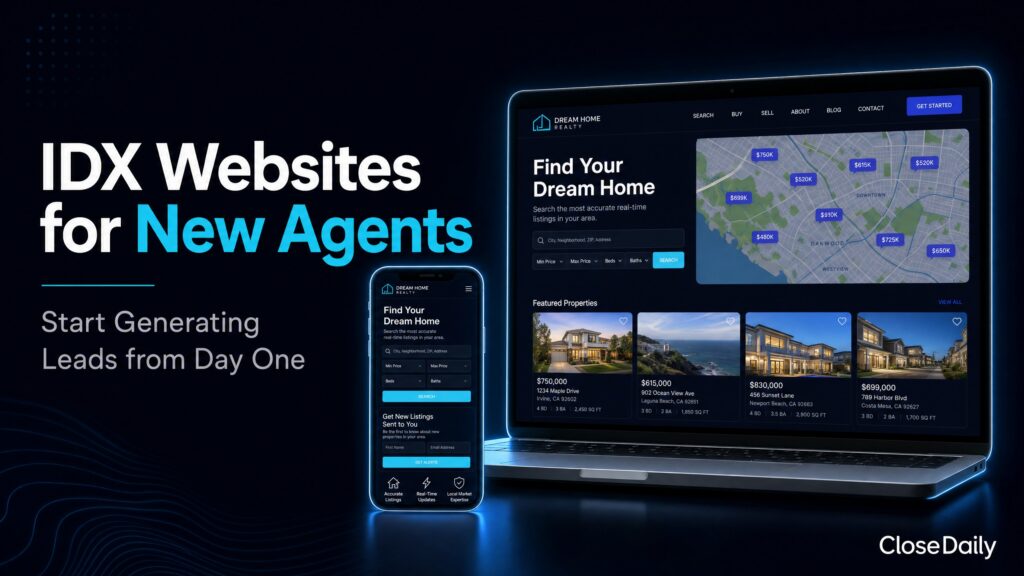
An IDX website solves the fundamental problem new agents face: how to get leads when you don’t have a network yet. Here’s how to set one up and start building your pipeline from day one.
Why IDX Is the Best First Investment for New Agents
As a new agent, your marketing budget is limited and every dollar needs to count. Here’s why an IDX website is the highest-leverage investment you can make.
It works while you’re learning everything else. While you’re studying contracts, shadowing experienced agents, attending training sessions, and figuring out how this business actually works, your IDX website is online 24 hours a day capturing leads from buyers who are actively searching for homes in your market.
It builds your database from zero. Every visitor who registers on your IDX site becomes a contact in your database. Within three to six months of consistent effort, you can go from zero contacts to hundreds of leads with known search preferences and behavioral data. That database becomes the foundation of your entire business.
It positions you as a legitimate professional immediately. A new agent with a polished IDX website looks indistinguishable online from a veteran agent with twenty years of experience. Buyers don’t see your transaction count when they search your site, they see a professional website with comprehensive MLS listings and a modern search experience.
Choosing the Right Platform on a New Agent Budget
Budget matters when you’re new. You might be three to six months from your first closing, and every monthly expense needs justification.
The temptation is to choose the cheapest IDX option available. Resist it. A $50 per month IDX plugin that captures leads but has no CRM and no follow-up system will generate leads that you can’t effectively manage or convert. You’ll spend more time wrestling with technology than talking to potential clients.
An all-in-one platform like CloseDaily at $299 per month gives you the IDX website, CRM, and AI follow-up in one package. That’s everything you need to capture, manage, and convert leads without bolting together three separate tools. For a new agent, the simplicity is as valuable as the features, you should be spending your time learning the business, not debugging technology integrations.
Your First 30 Days: The Setup Sprint
Days 1-3: Platform setup. Sign up, connect your domain, and configure your basic branding. Choose your site template, add your headshot and bio, and set your target areas.
Days 3-7: MLS feed activation. Request IDX access from your MLS board. While waiting for approval, start creating content for your site, your bio page, your about page, and your first neighborhood guide.
Days 7-14: Lead capture configuration. Set your registration gate to trigger after four listing views. Configure your lead capture forms. Set up your automated welcome sequence, the emails that go out when someone registers. If you’re on a platform with AI follow-up, this is handled automatically.
Days 14-21: Create neighborhood landing pages. Build five to ten pages targeting specific neighborhoods in your farm area. “Homes for sale in [neighborhood]” with pre-filtered IDX search results. These pages will be your organic traffic drivers over the coming months.
Days 21-30: Start publishing content. Write your first three blog posts, a neighborhood guide, a first-time buyer tips article, and a local market update. Link each post to relevant IDX search pages on your site.
Driving Traffic as a New Agent
Your IDX site is live. Now you need people to visit it. Here are the traffic strategies that work for new agents with limited budgets.
Social media content. Share your neighborhood pages and blog posts on Instagram, Facebook, and TikTok. You don’t need a huge following, you need consistency. Post three to five times per week about your local market, linking to your IDX site. Over time, your social presence drives traffic.
Google Business Profile. Set up and optimize your Google Business Profile immediately. Add your website link. Post weekly updates. This is free and puts you in local search results when buyers search for agents in your area.
Local Facebook groups. Join every Facebook group for your target neighborhoods. Don’t spam links, provide genuine value. Answer questions about the market. Share insights. When someone asks about the housing market in your area, you can naturally reference your website: “I actually just wrote a market update about that, happy to share the link.”
Small paid advertising budget. Even $200 per month on Facebook ads targeting local home searchers can drive meaningful traffic to your IDX site. Create ads that promote specific neighborhood searches, “See all homes for sale in [area]”, and send traffic to your pre-filtered IDX pages where the registration gate captures leads.
Managing Your First IDX Leads
Your first IDX leads will feel exciting and terrifying. Someone registered on your site. They’re looking at homes. Now what?
The automated system handles the immediate response. Your welcome sequence goes out. AI follow-up engages them based on their search behavior. They start receiving listing alerts for their saved searches.
Your job is the personal touch. Call each new lead within 24 hours. Be genuine, you’re a new agent, and that’s okay. Lead with helpfulness, not a sales pitch: “I saw you were looking at homes in [area]. I specialize in that neighborhood and would love to help you find the right place. What questions do you have?”
Track everything in your CRM. Note the conversation, set a follow-up task, and maintain consistent contact. Your first IDX leads are building the relationship skills and pipeline management habits that will serve you for your entire career.
The 90-Day Benchmark
If you follow this approach consistently for 90 days, here’s what you can realistically expect:
Your IDX site should have 10 to 15 neighborhood and content pages driving organic traffic. Your database should contain 30 to 75 registered leads. Your automated follow-up should be nurturing all of them. And two to five of those leads should be in active conversation about buying or selling.
That’s not a guarantee, but it’s what consistent effort typically produces. And compared to cold calling strangers from a list for 90 days, the leads from your IDX website are warmer, more qualified, and more likely to convert because they found you organically and chose to engage with your site.
Every veteran agent you admire started with zero clients. The difference between agents who build successful businesses and those who wash out isn’t talent or connections, it’s whether they built systems early. Your IDX website is the first and most important system you’ll ever build. Start now.
Ready to close more deals?
Join thousands of agents using CloseDaily to build their business.