The agents who consistently close 40, 50, 60 deals a year from online leads aren’t working harder than everyone else. They’re not more talented. They don’t have a secret source of leads that nobody else knows about.
They built a machine.
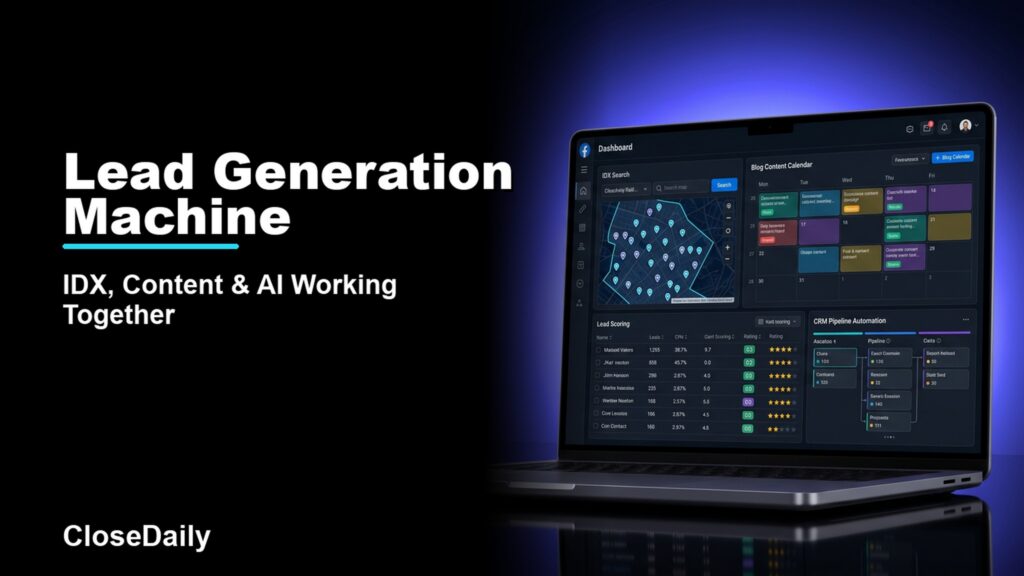
A lead generation machine has three components: an IDX website that captures leads, content that drives traffic to that website, and AI-powered follow-up that converts those leads into appointments and closings. When these three elements work together, they create a self-sustaining system that generates business every single day without requiring you to cold call, door knock, or buy leads from portals.
Here’s the complete blueprint.
Component 1: The IDX Foundation
Everything starts with your IDX website. Without it, you have no mechanism for capturing buyer intent. With it, every visitor who’s looking for a home in your market has a reason to stay on your site, engage with your content, and eventually give you their contact information.
Your IDX setup needs three things to function as a lead capture machine:
Fast, modern search. If your search experience is slower or clunkier than Zillow, buyers will use Zillow. Your search needs to load in under two seconds, work flawlessly on mobile, and offer the map-based, filter-rich experience that modern buyers expect.
A properly configured registration gate. Set to trigger after three to five listing views. Not disabled. Not set to 20 views. The gate is the conversion point where anonymous visitors become known leads. Every visitor who passes through it becomes a contact in your CRM with known search preferences.
A connected CRM. Lead capture without a CRM is like collecting business cards and throwing them in a drawer. Every registered lead needs to flow immediately into a CRM where their activity is tracked, their intent is scored, and follow-up is triggered. All-in-one platforms like CloseDaily handle this natively. If you’re using a separate IDX plugin, make sure the CRM integration is reliable.
Component 2: The Content Engine
Your IDX website is the machine. Content is the fuel that makes it run. Without content driving traffic, your IDX site is a lead capture tool with nothing to capture.
The content engine has three types of fuel, each serving a different purpose:
Neighborhood landing pages (traffic from Google). Create pre-filtered IDX search pages for every significant neighborhood, zip code, and community in your market. “Homes for sale in [neighborhood]” is the highest-intent search query in real estate. Each page you create targeting a specific area is a permanent traffic channel that sends buyers directly to your IDX search.
Build 20 to 50 of these pages over your first three to six months. Add unique content to each one, market stats, neighborhood descriptions, school information, lifestyle highlights. This content differentiates your pages from every other IDX site showing the same listings and helps them rank higher on Google.
Blog posts (authority and organic traffic). Publish two to three posts per week covering topics your target buyers are searching for. Market updates, neighborhood guides, buyer tips, home buying process explanations, local events, and market analysis. Every post should link to relevant IDX search pages and neighborhood landing pages.
The blog serves dual purposes: it drives organic traffic from long-tail searches, and it builds the topical authority that helps your neighborhood pages rank for the competitive “homes for sale” queries. Neither works as well without the other. Together, they create a compounding content machine.
Social media content (traffic and brand building). Share your blog posts, new listing highlights, and market insights on Instagram, Facebook, and TikTok. Link to your IDX site in every post that’s relevant. Social media doesn’t build SEO directly, but it drives warm traffic to your site and builds the brand recognition that makes leads more likely to register and engage.
Component 3: AI-Powered Follow-Up
Traffic plus capture minus follow-up equals wasted money. This is where most agents’ lead generation systems break down. They invest in a website and content, generate leads, and then fail to convert those leads because the follow-up is manual, inconsistent, and generic.
AI-powered follow-up solves the three biggest follow-up problems simultaneously:
Speed. AI sends the first engagement within minutes of registration. Not hours. Not “when I get around to checking my email.” Minutes. The data on response time is unambiguous, leads contacted within five minutes convert at dramatically higher rates than leads contacted later.
Personalization. Instead of generic templates, AI crafts messages based on each lead’s actual search behavior. The lead who’s been browsing 4-bedroom homes in Cedar Park gets a message about Cedar Park inventory. The lead who’s been comparing condos downtown gets a message about condo market trends. Relevance drives response rates.
Persistence. The average IDX lead needs 8 to 12 touchpoints over weeks or months before they’re ready for a real conversation. Most agents give up after two or three attempts. AI doesn’t give up. It maintains consistent, intelligent follow-up indefinitely, adapting its messaging as the lead’s behavior evolves.
When AI handles the volume nurture, your job shifts from “try to remember to follow up with 50 leads” to “have conversations with the five leads that AI identified as ready to act.” This is a fundamentally different and far more productive use of your time.
Assembling the Machine: The 90-Day Plan
Days 1-14: Get your IDX website live with CRM and AI follow-up configured. Create your first five neighborhood landing pages. Publish your first three blog posts.
Days 15-30: Expand to 15 neighborhood pages. Establish a publishing rhythm of two to three blog posts per week. Start sharing content on social media daily. Consider allocating $300 to $500 for initial Facebook ads to generate immediate traffic while your organic content builds.
Days 31-60: Continue expanding content. You should have 20+ neighborhood pages and 15+ blog posts. Organic traffic should be showing early signs of growth. Your database should have 30 to 75 registered leads. AI follow-up should be nurturing all of them. Review your metrics: registration rate, lead volume, response rates to follow-up.
Days 61-90: 30+ neighborhood pages, 25+ blog posts. Organic traffic should be generating leads without paid advertising. Your first IDX leads should be converting to appointments and active clients. The machine is running.
The Compounding Effect
Here’s why this system is a machine rather than a tactic: every piece of content you create, every lead you capture, and every follow-up sequence you run makes the system stronger.
More content drives more traffic. More traffic captures more leads. More leads provide more behavioral data for AI to optimize follow-up. Better follow-up produces higher conversion rates. Higher conversion rates generate more revenue. More revenue enables more content investment.
Month one, you generate 10 leads. Month three, you generate 30. Month six, you generate 60. Month twelve, you generate 100+. The growth isn’t linear, it compounds because every component amplifies the others.
This is how the top-producing agents built their businesses. Not through one magic tactic, but through a machine where every part reinforces every other part. IDX captures. Content fuels. AI converts. And the whole thing runs 24 hours a day, 7 days a week, whether you’re at a closing, on vacation, or sleeping.
The blueprint is in front of you. The technology exists and it’s accessible. CloseDaily provides the IDX, CRM, and AI follow-up in one platform. Your local expertise provides the content. Your commitment provides the consistency.
Build the machine. The leads follow.
Ready to close more deals?
Join thousands of agents using CloseDaily to build their business.