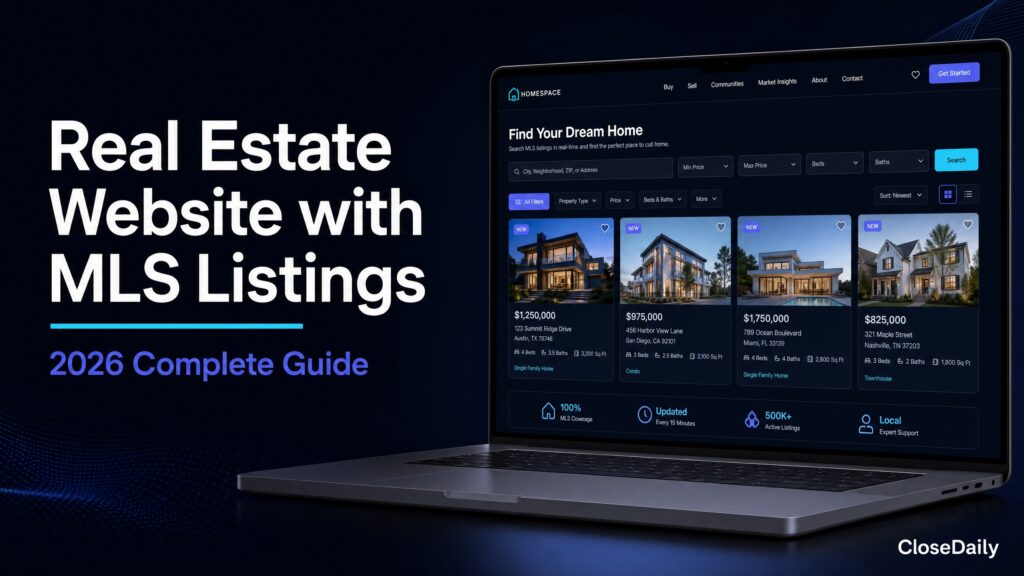
Buyers search for homes online before they talk to an agent. That’s not a trend, it’s a permanent shift in how real estate works. The question for every agent isn’t whether to have a website. It’s whether your website has what buyers are actually looking for: MLS listings they can search, save, and explore.
A real estate website with MLS listings transforms your online presence from a digital business card into an active lead generation tool. Instead of hoping visitors will fill out a contact form, you’re providing the exact tool they need, property search, and capturing their information in the process.
Here’s every option available for getting MLS listings on your website, what each approach costs, and which one is most likely to generate actual leads for your business.
How MLS Listings Get on Your Website
MLS listings don’t automatically appear on your website. The data lives in your local Multiple Listing Service database, and displaying it on your site requires authorization, a data feed connection, and technology to render the listings as searchable web pages.
The authorization comes through IDX, Internet Data Exchange, which is a set of policies that govern how MLS data can be shared and displayed on member websites. You apply through your MLS board, sign an IDX agreement, and get permission to display listing data.
The data feed is the technical pipeline. Your MLS sends listing data to your technology provider, which processes and displays it on your site. Feeds update regularly, anywhere from every 15 minutes to every few hours depending on your provider and MLS.
The display technology is what turns raw MLS data into the polished, searchable property pages buyers interact with on your site. This is where the differences between providers become significant.
Option 1: IDX Plugin on Existing Website
If you already have a WordPress or other CMS-based website, you can add MLS listings through an IDX plugin. That route can work as a temporary patch, but it usually bolts search onto a site that was not built around lead capture, CRM sync, or automated follow-up.
Pros: Keep your existing website and SEO. Relatively quick to add. Lower switching cost if you’re happy with your current site design.
Cons: Search speed is typically slower than native platforms. The plugin styling often clashes with your site design. No built-in CRM or follow-up. You’ll need separate tools for lead management and nurture. Integration complexity and potential sync issues.
Cost: $50-$150/month for the plugin, plus your existing website hosting ($10-$50/month), plus a separate CRM ($25-$400/month). Total: $85-$600/month.
Option 2: All-in-One IDX Platform
Instead of adding MLS listings to an existing site, you use a platform where IDX is built into the website itself. The listing search, agent website, CRM, and follow-up tools are all one integrated product. CloseDaily is built around this all-in-one approach.
Pros: Smooth search experience, no plugin conflicts or styling issues. Built-in CRM eliminates integration headaches. Typically faster search performance. AI follow-up available on platforms like CloseDaily. Single subscription covers everything.
Cons: Requires replacing your existing website (or running both). Learning a new platform takes time. Less design flexibility than a fully custom site.
Cost: $299/month for CloseDaily plus any MLS data fee charged by your local board. The important comparison is total stack cost: website, IDX, CRM, follow-up, and automation in one subscription instead of several disconnected bills.
Option 3: Custom Website with IDX API
For agents or teams with significant budgets and specific design requirements, a fully custom website can integrate MLS listings through an IDX API. A web developer builds the site from scratch and connects to the MLS data through API endpoints provided by your IDX data vendor.
Pros: Complete design control. Unique site that stands out from template-based competitors. Can be optimized for specific niches like luxury or investment properties.
Cons: High development cost ($10,000-$50,000+). Ongoing maintenance required (developer on retainer). Slower to launch. Still needs a separate CRM and follow-up system.
Cost: $10,000-$50,000+ initial build, plus $500-$2,000/month for hosting, maintenance, and updates, plus CRM costs. Realistic total: $1,000-$3,000+/month.
Option 4: Brokerage-Provided Website
Some brokerages provide IDX websites to their agents as part of the brokerage technology package. KW Command, Compass sites, eXp-provided websites, and similar platforms fall into this category.
Pros: Often included in your brokerage split or fees. No additional technology decisions needed. Pre-configured for your brokerage’s MLS connections.
Cons: Limited customization. Usually basic IDX with minimal lead capture. No CRM or follow-up tools. You look identical to every other agent at your brokerage. If you leave the brokerage, you lose the website and all its SEO value.
Cost: $0-$50/month (often absorbed into brokerage fees). But the lead generation capability is proportionally limited.
Which Option Generates the Most Leads?
The lead generation comparison isn’t even close. All-in-one IDX platforms consistently outperform other options because they’re specifically designed for the lead capture and conversion workflow.
A brokerage-provided website might generate two to five leads per month if it generates any at all. A WordPress site with an IDX plugin might generate five to fifteen leads if the plugin works well and you have traffic. A dedicated IDX platform like CloseDaily can generate 20 to 50+ leads per month with proper traffic and content strategy.
The difference comes from three factors: faster search keeps visitors engaged longer. Smooth lead capture converts more visitors to registered leads. Built-in CRM and AI follow-up converts more registered leads to conversations and appointments.
Each factor multiplies the others. Faster search means more page views. More page views means more registrations. Better follow-up means more registrations become conversations. The compounding effect produces dramatically better results from the same amount of traffic.
The Decision Framework
Choose based on where you are in your business, not on what sounds most impressive.
New agent, limited budget: All-in-one IDX platform. Get everything in one subscription, skip the integration complexity, and focus on building your business instead of managing technology. CloseDaily at $299/month is purpose-built for this scenario.
Established agent with ranking WordPress site: Preserve your SEO equity, but do it carefully. Crawl the current site, map redirects, and migrate to a connected IDX and CRM platform only when you can protect the pages already earning traffic.
Team or high-volume agent: All-in-one platform with team features. The integration benefits and lead routing capabilities justify the platform cost, and the time savings from not managing multiple tools is significant.
Luxury agent with premium brand requirements: Custom website with IDX API if your budget supports it, or a design-forward platform like CloseDaily if you want the quality without the custom development cost.
Regardless of which option you choose, the fundamental principle remains the same: a real estate website without MLS listings is leaving the most powerful lead generation tool in the industry unused. Buyers want to search for homes. Let them do it on your website. Everything else follows from that.
Ready to close more deals?
Join thousands of agents using CloseDaily to build their business.