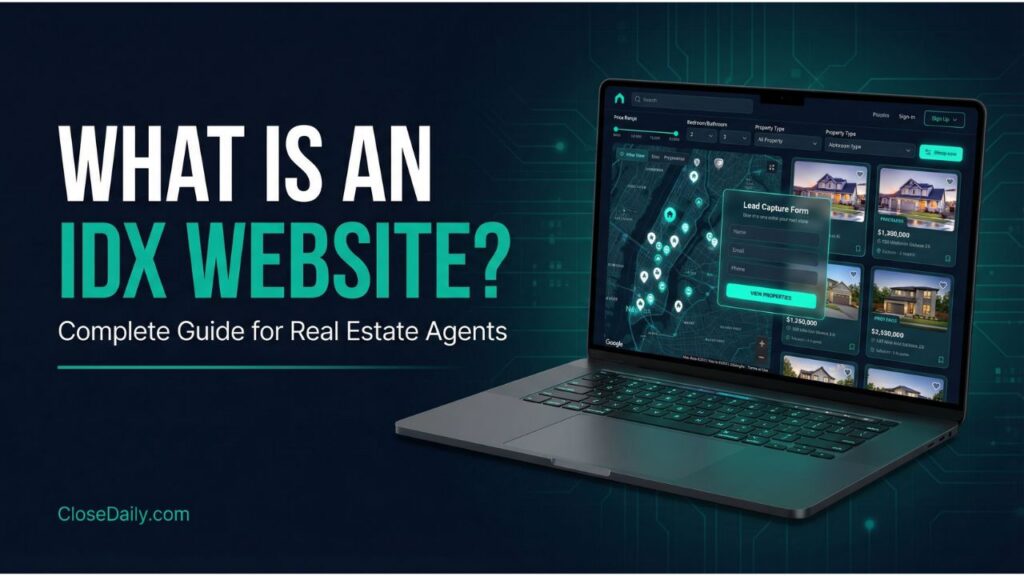
Every real estate agent has heard the term IDX. Most have a vague sense that it involves listings on their website. Few actually understand what it does, why it matters, or how to use it to generate leads consistently.
That changes today.
IDX stands for Internet Data Exchange. It’s a set of policies and technology standards created by the National Association of Realtors that allows MLS listing data to be displayed on your personal real estate website. Instead of sending buyers to Zillow or Realtor.com to search for homes, IDX lets them search directly on your site, with your branding, your contact info, and your lead capture forms.
That distinction is the difference between building a business and building someone else’s.
How IDX Actually Works
Here’s the simplified version. Your local MLS maintains a database of every active listing in your market. When you sign up for IDX access (typically through your brokerage or MLS board), you get permission to display those listings on your website through a data feed.
CloseDaily connects to that feed, pulls the listing data, photos, price, address, descriptions, property details, and renders it as searchable pages on your website. When a buyer visits your site, they see an experience similar to Zillow. Property search, map views, filters by price, bedrooms, neighborhood. But it’s all happening on YOUR domain.
This matters more than most agents realize. When a buyer searches on Zillow, Zillow captures that lead and sells it to three other agents. When that same buyer searches on your IDX website, you get the lead. Nobody else.
IDX Website vs. Regular Real Estate Website
A regular real estate website is essentially an online business card. It has your bio, your contact information, maybe some testimonials. It looks professional enough, but it gives visitors zero reason to stay longer than thirty seconds.
An IDX website gives visitors a reason to come back every single day. Buyers can save searches, get email alerts when new listings match their criteria, and browse the same inventory they’d find on any major portal, except they’re doing it on your site, building familiarity with your brand, and becoming your lead in the process.
The difference in lead generation is dramatic. A typical agent website with no IDX generates maybe two to five leads per month from organic traffic. An optimized IDX website in the same market can generate 20 to 50 or more leads per month because visitors actually have a reason to use it.
What Makes a Good IDX Website
Not all IDX websites are created equal. The basic ones just slap a search bar on your homepage and call it a day. The listings load slowly, the search filters are clunky, and the design looks like it was built in 2012.
A good IDX website has several key elements that separate it from the generic options.
Fast, intuitive search. Buyers should be able to filter by price, bedrooms, bathrooms, square footage, lot size, property type, and neighborhood, all without the page reloading. Map-based search is essential. If your search experience is worse than Zillow’s, buyers will go back to Zillow. It’s that simple.
Automatic lead capture. The best IDX platforms require visitors to register after viewing a few listings. This isn’t about being annoying. It’s about creating a fair exchange. The buyer gets unlimited access to MLS data. You get their contact information so you can actually help them find a home.
Saved search alerts. When a buyer saves a search, they should get automated email alerts when new listings match their criteria. This keeps them coming back to your site instead of setting up alerts on Zillow. Every alert is a touchpoint that keeps you top of mind.
Mobile-first design. Over 70% of home search traffic happens on phones. If your IDX website doesn’t work flawlessly on mobile, you’re losing the majority of your potential leads before they ever see a listing.
CRM integration. Capturing a lead means nothing if it sits in a spreadsheet forever. Your IDX website should feed leads directly into a CRM that tracks their search behavior, sends automated follow-up sequences, and tells you which leads are actively looking at homes right now. CloseDaily’s IDX website does all of this in a single platform, no stitching together three different tools.
The Real Cost of IDX
IDX access typically involves two costs. First, there’s an MLS data fee, usually $25 to $50 per month, which gives permission to display listings. Second, your IDX platform charges for the technology that displays those listings on your website. With CloseDaily, we handle the MLS setup and connection process for you so you don’t have to deal with any of the technical details.
Platform costs vary significantly. Basic IDX plugins for WordPress run $50 to $100 per month but offer limited features and often look dated. Full IDX website platforms start at $299 per month (that’s what CloseDaily charges) and include the website, IDX search, CRM, and AI-powered follow-up in one package. Enterprise platforms can run $400 to $500 or more per month.
The real question isn’t whether you can afford IDX. It’s whether you can afford to keep sending your potential buyers to Zillow where they’ll get matched with your competitors. One closing from an IDX lead pays for years of the platform.
Common IDX Mistakes Agents Make
After working with thousands of agents building their online presence, these are the patterns that kill IDX ROI over and over again.
Getting IDX but not capturing leads. Some agents display listings on their site but never require registration. Visitors browse anonymously, find a listing they like, and call the listing agent directly. Your IDX website generated the lead, for someone else. Always enable registration gating after three to five property views.
No follow-up system. An IDX lead who registers on your site is interested but rarely ready to talk yet. They’re in browse mode. Most agents call once, get voicemail, and never follow up again. The agents closing deals from IDX leads have automated drip campaigns that nurture those leads for weeks or months until they’re ready to have a real conversation. This is where AI-powered follow-up changes the game.
Ignoring SEO entirely. Most IDX websites are invisible to Google. The listing pages are dynamically generated with thin content, and there’s no supporting blog content to build topical authority. If your IDX website doesn’t rank for “homes for sale in [your city]” you’re leaving the highest-intent organic traffic on the table.
Choosing the cheapest option available. A $50 per month IDX plugin that loads slowly, looks outdated, and has no CRM will cost you far more in lost leads than the $100 difference between it and a proper platform. You’re not saving money. You’re losing deals.
Who Needs an IDX Website
Every agent who works with buyers needs an IDX website. Period. If you’re exclusively a listing agent who never works with buyers, you might get away without one, but even then, the lead generation potential and the authority it adds to your online presence is hard to ignore.
Solo agents, teams, and brokerages all benefit from IDX, but the strategy differs. Solo agents should focus on a single, well-optimized IDX website that targets their farm area with hyper-local content. Teams need a platform that can route leads based on geography or lead source. Brokerages need enterprise features like agent sub-sites and automated lead distribution rules.
Getting Started with Your IDX Website
If you don’t have an IDX website yet, here’s the fastest path to getting one live and generating leads.
Step 1: Check your MLS access. Sign up with CloseDaily. We handle your MLS connection, IDX authorization, and data feed setup from start to finish. You don’t need to deal with any MLS paperwork, we take care of all of it.
Step 2: Choose your IDX platform. Look for one that includes the website, search, CRM, and follow-up tools in a single platform rather than stitching together multiple vendors. CloseDaily’s agent website includes all of this out of the box, starting at $299 per month.
Step 3: Connect your MLS feed. CloseDaily handles this entire process for you. It typically takes 24 to 48 hours for your MLS to approve the data feed connection.
Step 4: Customize and brand your site. Add your branding, set up your target neighborhoods, configure lead capture settings, and create saved search pages for your most popular areas.
Step 5: Drive traffic. An IDX website without traffic is just an expensive business card. Combine it with content marketing, social media, paid advertising, and local SEO to start generating real leads.
The Bottom Line
An IDX website is not optional for modern real estate agents who want to generate leads online. It’s the foundation of your entire digital strategy. Every day you operate without one is another day you’re sending potential clients to Zillow, Redfin, and the agents in your market who already have this figured out.
The technology exists to give your buyers the same search experience they get on the major portals, but on your website, with your branding, feeding directly into your CRM. The agents who embrace this are the ones closing 30, 40, 50 or more deals a year from online leads.
The agents who don’t are the ones wondering where all their leads went.
Ready to close more deals?
Join thousands of agents using CloseDaily to build their business.