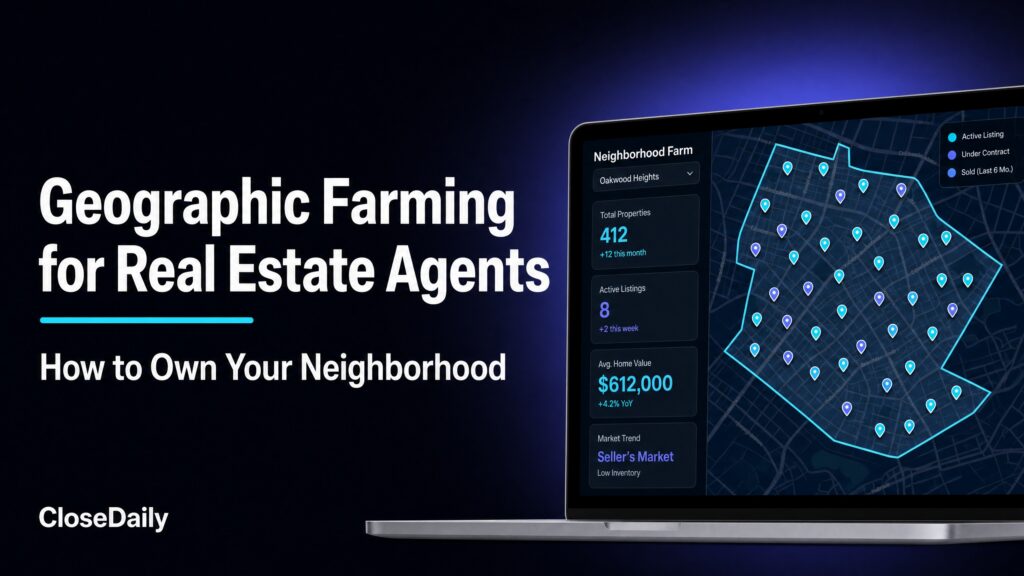
Real estate farming is the strategy of focusing your marketing on one geographic area until you become its go-to agent: the name residents think of the moment they consider selling. Done right, a farm turns into a renewable source of listings: you invest consistently in one neighborhood, build recognition and trust over months, and reap repeat listings and referrals for years. It’s the opposite of chasing random leads; it’s planting one field and harvesting it again and again.
The catch is in the word “farming.” It’s a long game that rewards patience and punishes dabbling. Most agents who try it quit before the harvest. This guide covers how to pick the right farm, run the numbers before you spend a dollar, and market it so you actually become the neighborhood’s agent.
How to choose a farm area
Picking the wrong neighborhood is the most expensive mistake in farming, because you won’t know for a year. Weigh five things:
Turnover rate
Turnover is how often homes in the area sell, and it decides how many listings even exist to win. Calculate it simply: homes sold in the area last year ÷ total homes. A rate above 6% is workable, above 8% is good, and above 10% is excellent. A beautiful neighborhood where nobody ever moves is a bad farm.
Size you can afford to touch consistently
Start with something manageable, around 300 to 500 homes for most agents. If the neighborhood you want is bigger, farm a section of it first. The number that matters isn’t how big the farm is; it’s how many homes you can afford to reach every single month without fail.
Competition
Check who already lists in the area. If one agent has a dominant, entrenched share, that’s a hard farm to take. Look for neighborhoods with no clear “mayor” yet, where consistent effort can make you the obvious choice.
Price point
Match the neighborhood’s typical sale price to your income goals. A farm of lower-priced homes needs far more transactions to produce the same gross commission as a farm of higher-priced homes, so weigh the price point alongside turnover, not instead of it. The ideal farm has both: enough sales and enough commission per sale to justify the spend.
A real connection
You’ll be marketing to this area for years, so pick one you know and ideally live near or in. Authenticity is hard to fake over a long farming campaign, and residents can tell.
Run the numbers before you spend a dollar
Farming is an investment, so treat it like one. Here’s the back-of-the-envelope math, with illustrative numbers you’d swap for your own market:
- A 400-home farm with a 7% turnover produces about 28 sales a year.
- If you capture a realistic 20% market share once established, that’s roughly 5 to 6 listings a year from the farm.
- At your average listing commission, multiply that out and compare it to your cost.
On the cost side, a common rule of thumb is a minimum of about $1 per home per month for marketing, plus extras, so a 400-home farm runs roughly $400 to $600 a month. If a handful of listings a year clears well above your annual farming cost (and in most markets it will), the farm pencils out. If the turnover or your realistic share can’t support the cost, pick a different area. Running this math first is exactly what separates farming from just spending money on postcards.
The multi-touch farming plan
Recognition comes from repetition across channels. One postcard does nothing; a consistent, multi-channel presence does everything.
- Direct mail, monthly. The backbone of farming. Lead with value residents actually want (recent sales on their street, a market snapshot, a home-value offer), not just your headshot.
- A neighborhood home-valuation page. An IDX-powered “What’s your [Neighborhood] home worth?” landing page turns your mail and online presence into captured seller leads.
- Digital reinforcement. Run low-cost social ads geo-targeted to the farm, post neighborhood content, and stay visible online between mailers.
- In-person presence. Sponsor the block party, host a neighborhood shred day or food drive, and simply be around. Becoming a familiar face is worth more than any postcard.
- Just-listed and just-sold updates. Every sale you make in or near the farm is proof and a reason to reappear, which is where circle prospecting scripts complement farming.
Choose one core message and one look so all of it sounds like a single, recognizable voice rather than five experiments.
What to actually send your farm
Value beats self-promotion every time. Rotate touches residents find genuinely useful:
- Monthly market updates: recent sales, average days on market, and price trends for their specific streets.
- Just-listed and just-sold cards for nearby homes: proof you’re active in the area.
- A home-value offer: “Curious what your home is worth today? Scan here.”
- Seasonal and practical pieces: property-tax-appeal deadlines, a local event calendar, trusted contractor recommendations.
- Neighborhood interest: a new restaurant opening, school news, a resident spotlight.
The test for every piece is simple: would someone stick it on the fridge, or toss it in the recycling? Aim for the fridge.
Consistency and timeline: why most farms fail
The hard truth about farming is that it rarely produces a listing in the first few months, and often takes six to twelve months of consistent touches before the phone rings. The agents who fail aren’t the ones who picked a bad area; they’re the ones who mailed twice, saw nothing, and quit. Farming only works if you commit to a full year minimum and show up every month without exception. Budget for the whole campaign up front so you’re never tempted to skip a month.
What the first year actually looks like
Knowing the shape of the year helps you hold the line when the early months feel quiet.
Months 1 to 3: foundation
Build the farm database, start the monthly mailers, launch the neighborhood social presence, and knock the doors around every nearby transaction. This phase is about visibility and name recognition; expect little direct business and don’t read anything into that.
Months 4 to 6: momentum
Add live touches: check-in calls to homeowners you’ve met, your first community event or sponsorship, and follow-up with everyone who has engaged. This is usually when you start hearing “I’ve seen your name around,” and sometimes when the first listing appears.
Months 7 to 9: traction
Your share of the area’s listings becomes measurable and referrals start to trickle in. Every sale you’re part of gives you fresh proof and a fresh reason to circle prospect, so the work starts feeding itself.
Months 10 to 12: compounding
By now you’re one of the most visible agents in the neighborhood, and the cost of each listing falls as recognition does more of the work. This is the payoff that paid leads can’t match: a farm you’ve earned keeps producing after the campaign that built it.
The system behind a productive farm
A farm has hundreds of contacts and a cadence to maintain, which is impossible to run from memory. Your CRM is the engine: store every resident and lead, tag them to the farm, and automate the monthly touches and follow-up so nothing slips. Pair it with a neighborhood valuation page that captures sellers and AI follow-up that nurtures them until they’re ready to list.
In a platform like CloseDaily, the CRM organizes your farm and its cadence, an IDX valuation page captures neighborhood sellers, and AI follow-up keeps every lead warm between mailers. The marketing builds recognition; the system makes sure the leads it produces convert.
Farming vs. circle prospecting
They’re cousins, not the same thing. Farming is the long-term project of owning a neighborhood through consistent marketing; circle prospecting is event-driven outreach to the homes around a specific listing or sale. The best approach combines them: farm the area for the long game, and use every nearby sale as a circle-prospecting reason to reappear and prove you’re the neighborhood’s agent. Once the farm is running, the rest of the lead generation playbook covers the channels that pair well with it.
Frequently asked questions
What is real estate farming?
It’s a marketing strategy of concentrating your efforts on one geographic area to become its recognized, go-to agent, generating a steady stream of listings and referrals from that neighborhood over time.
How many homes should be in a real estate farm?
Start with a manageable size, around 300 to 500 homes, that you can afford to market to every month. It’s better to dominate a small farm than to under-touch a large one.
How do I calculate a neighborhood’s turnover rate?
Divide the number of homes sold in the area last year by the total number of homes. Aim for at least 6%; the higher the turnover, the more listings there are to win.
How long does real estate farming take to work?
Usually six to twelve months of consistent monthly touches before it produces listings. Farming is a long game, and quitting early is the main reason agents don’t see a return.
How much does real estate farming cost?
A common rule of thumb is at least $1 per home per month plus extras, so a 400-home farm runs roughly $400 to $600 monthly. Run the ROI math against your area’s turnover before committing.
Is real estate farming still worth it in 2026?
Yes, when the numbers support it and you commit for the long haul. Farming’s advantage is durability: an established farm produces listings and referrals year after year, which most paid-lead sources can’t match. It rewards patience over quick wins.
Can I farm a neighborhood with digital marketing only?
Digital ads and content reinforce a farm, but the strongest farms pair geo-targeted online presence with physical mail and in-person visibility. Mail still cuts through in a specific neighborhood, and being a familiar face builds trust that ads alone can’t.
Ready to close more deals?
Join thousands of agents using CloseDaily to build their business.