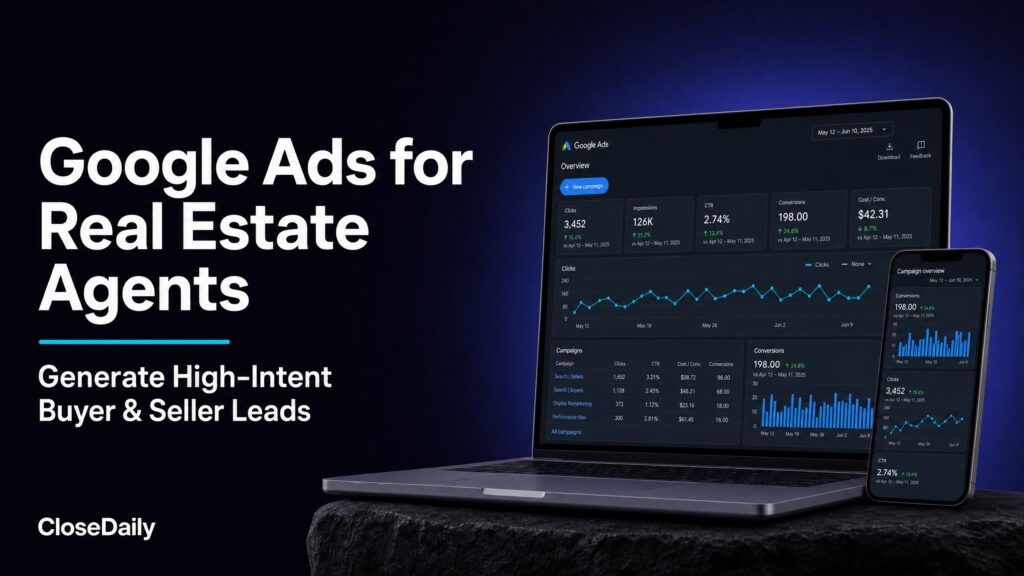
Google Ads for Real Estate Agents: How to Generate High-Intent Buyer and Seller Leads in 2026
You’re leaving money on the table if you’re not running Google Ads right now. Your competitors are already there, capturing buyers actively searching for homes in your market and sellers desperately looking for an agent to list their property. This isn’t theory. This is how the top 1% of agents build unstoppable lead pipelines that convert at 3-5x higher rates than traditional marketing.
Here’s what most agents don’t understand: Google Ads isn’t about luck or budget. It’s about intent. When someone types “sell my house fast” or “homes for sale in [your city],” they’re raising their hand. They’re ready. Your job is to be there with the right message, the right landing page, and the right follow-up system. That’s the difference between spinning your wheels and building a real business.
Paid search is one channel in our complete real estate marketing guide, and for high-intent leads it is often the fastest.
Why Google Ads Dominate Real Estate Lead Generation
You’re targeting demand that already exists. Unlike social media where you’re hoping someone becomes interested, Google Ads puts you in front of people actively searching. A buyer searching “homes under $400k” or a seller searching “how to sell my house fast” has already made a decision to move. You’re not convincing them they need real estate, you’re just showing them you’re the agent to work with.
The numbers prove this. According to NAR data, 97% of home buyers use online search during their home buying journey. If you’re not showing up at that critical moment, you don’t exist to them. Google Ads bridges that gap in seconds, not weeks.
Key Stat: Real estate professionals using paid search report 40-50% better conversion rates than those relying on organic traffic alone. Your competition isn’t sleeping, and neither should your ad spend.
Intent beats audience size every time. You could have 100,000 impressions from people who don’t care about real estate, or 10,000 impressions from people actively buying or selling. Which do you think generates better leads? The math is simple: fewer people, higher intent, better leads, better ROI.
The Three Essential Google Ads Campaigns for Real Estate
Not all Google Ads campaigns are created equal. You need a diversified approach that covers three critical stages: awareness, consideration, and conversion. Let’s break down each one.
Campaign #1: High-Intent Buyer Keywords
These are the money keywords. Phrases like “homes for sale in [city],” “buy a house,” “homes under $X price,” and “move to [neighborhood].” When someone searches these terms, they’re already in the market. Your job is to intercept them with a strong headline, a compelling offer, and a landing page optimized for conversion.
Your headline should be specific and action-oriented. Not “Real Estate Agent in Denver” (that’s boring and everyone says it). Try “Find Your Perfect Home in Denver, See Available Listings Today” or “Sell Your Denver Home Fast, Top Agent, No Hassle.” You’re speaking to their exact problem and showing you have the solution.
For buyer ads, include proof points in your messaging. “Helped 200+ clients find their dream home” or “Average sale time: 12 days” beats “We’re a great real estate team” every single time. Specificity sells.
Campaign #2: Seller-Intent Keywords
Sellers are even more desperate for solutions than buyers. They’re searching “sell my house,” “sell my house fast,” “how to price my home,” and “find a real estate agent.” These are golden. A seller ready to list is ready to make a decision immediately, often within days.
Your seller ads should focus on speed, certainty, and results. “Get Your Home Listed in 48 Hours” beats “We’re experienced agents” every single time. Sellers want to know: How fast can I sell? Will I get my asking price? What’s the process? Answer those in your ad copy and you’ll generate seller leads that convert.
Create seller-specific landing pages that speak directly to their concerns. Not a generic homepage. A focused page that says “Here’s exactly what happens next” with a clear form that captures name, address, and phone number. Nothing more. Friction kills conversions.
Campaign #3: Branded & Location-Based Keywords
Your name. Your neighborhood names. Variations like “best real estate agent in [city]” and “[city] homes for sale.” These campaigns have lower cost-per-click because they’re less competitive, but they convert exceptionally well because the intent is laser-focused.
If someone is already searching your name, they’re close to a decision. Your landing page should immediately show social proof, testimonials, and a clear next step. Don’t waste warm traffic with weak conversion mechanics.
Building Landing Pages That Convert Leads, Not Just Visitors
Here’s where 90% of agents fail. They drive traffic to their homepage. Big mistake. A generic homepage is a conversion killer because it doesn’t speak to the specific search intent.
Build separate landing pages for buyers and sellers. When a buyer clicks your ad about homes for sale, they should land on a page about homes for sale. When a seller clicks your ad, they should land on a “get your home valued” page. Match the message to the click.
Your landing page formula should be: headline (matching their search) + social proof (testimonials, sold stats) + clear value proposition + single conversion goal (form, phone number, demo booking) + trust builders (years in business, certifications, before-and-after results).
Remove navigation menus from conversion pages. You want them filling out your form, not clicking away. Make the path to conversion obvious and friction-free.
Ready to launch your Google Ads campaigns? CloseDaily’s Ads Manager integrates directly with your CRM, automatically capturing and organizing Google Ads leads. Stop juggling spreadsheets. Start converting. Learn more about Ads Manager
Budget Strategy: How Much to Spend & Where
This is the question I get asked constantly: “How much should I spend on Google Ads?” The answer: as much as you can while maintaining positive ROI.
If you’re new to Google Ads, start with $10-15 per day ($300-450/month) on your high-intent campaigns. Track every lead, every call, every conversion. Calculate your actual cost-per-lead and cost-per-conversion. Once you know your numbers, scale up. If a lead costs you $40 and converts to a $5,000 commission on average, you should spend more, not less.
Allocation should reflect intent: 50-60% to buyer keywords, 30-40% to seller keywords, 10-15% to branded terms. Sellers convert faster, so they might have higher ROI, but buyers provide more volume. You need both.
Pro tip: Test different bid strategies before scaling. Google offers automated bidding (maximize conversions, target CPA), but manual bidding often outperforms when you’re new. You’ll have more control and better learning data. Once you have 50+ conversions per month, revisit automated strategies.
Scripts That Stop Leads From Going Cold
“Your Google Ads lead just filled out a form. You have 5 minutes to contact them before they fill out someone else’s form. Every minute you wait, your conversion probability drops 20%.”
Speed is your competitive advantage. Here’s your immediate response script when a Google Ads lead comes in:
“Hi [Name], thanks for reaching out! I saw you were looking for [homes in Denver/how to sell your home]. Perfect timing, I just had a buyer looking for exactly what you were searching for / a seller in your neighborhood sell in 10 days. I know you’re probably talking to other agents, so I want to jump on a quick call today to show you what we can do. Are you free for 15 minutes this afternoon or tomorrow morning?”
This script works because it: (1) shows you noticed them, (2) provides immediate relevance, (3) creates urgency, and (4) gives a simple yes/no choice with two time options. Three follow-ups if they don’t answer. Most agents give up after the first call, that’s why they fail.
Want a complete lead nurture sequence? Check out our 5 Text Message Templates That Get Seller Leads to Respond. These same principles apply to Google Ads leads.
Measuring What Actually Matters
Impressions, clicks, and CTR are vanity metrics. Here’s what you should actually track:
Critical Metrics: Cost-per-lead (total spend / total leads), cost-per-qualified-lead (accounting for bad leads), lead-to-appointment rate (what percentage of leads you actually meet with), appointment-to-contract rate (what percentage close), and total ROI (gross commission / total ad spend). If you’re not tracking these, you’re flying blind.
Set up conversion tracking immediately. Google Ads has a native conversion tracking pixel, but if you’re using a CRM like CloseDaily, integrate your ads directly. You’ll see exactly which ad campaigns and keywords drive actual closed deals, not just leads.
Review your numbers weekly. What’s working? Double down. What’s not? Kill it or optimize it. The agents making the most money from Google Ads adjust constantly, they don’t set and forget. Your market changes. Your competition changes. Your messaging needs to change too.
Avoiding the Mistakes That Drain Your Budget
Mistake #1: Broad match keywords without negative keywords. You end up paying for clicks from people searching “Google Ads course,” “real estate license,” and other irrelevant terms. Use phrase match and exact match. Add negative keywords aggressively (e.g., “-course,” “-license,” “-jobs”).
Mistake #2: Weak ad copy that doesn’t differentiate you. “Experienced real estate agent” could describe thousands of agents. Your copy needs to answer “Why you?” What’s unique? Fastest sale times? Best neighborhoods? Top client reviews? Lead with that.
Mistake #3: No mobile optimization. 70% of real estate searches happen on mobile. If your landing page isn’t mobile-first, you’re throwing away budget. Test every landing page on your phone before launching campaigns.
Mistake #4: Paying for clicks instead of conversions. Optimize for actual leads, not clicks. Google’s conversion-focused bidding saves money and gets better quality leads. This alone can reduce your cost-per-lead by 30-40%.
For a complete breakdown of how to build a sustainable lead generation system, read How to Build a Lead Generation System in 2026. Google Ads is one piece, the system is everything.
Stop wasting time and money on ads that don’t work. Get a free analysis of your current Google Ads performance and specific recommendations to increase your lead quality and ROI. Get your free analysis
The AI Advantage: Modern Tools Real Estate Agents Should Use
Google Ads management has evolved. AI can now optimize bids, test ad copy variations, and predict which leads will convert, all automatically. The agents using AI are outpacing the ones using spreadsheets.
Your CRM should integrate directly with your Google Ads account. When a lead comes in from an ad, it should automatically populate your pipeline, get assigned to you, and trigger your follow-up sequence. No manual data entry. No leads falling through the cracks.
CloseDaily’s Analytics dashboard shows exactly which ads drive appointments and closed deals. You can see that Campaign A costs $50/lead but closes at 40%, while Campaign B costs $30/lead but closes at 20%. Campaign A is your money-maker, even though it’s more expensive. Most agents optimize for cost-per-lead. Winners optimize for profit-per-lead.
If you want a deeper dive into how AI is changing lead generation, check out How CloseDaily’s AI Dialer Is Changing the Way Agents Prospect in 2026.
Your Google Ads Action Plan
Week 1: Set up your Google Ads account (or audit your existing account). Define your three campaign types: buyer keywords, seller keywords, branded keywords. Build two landing pages: one for buyers, one for sellers. Set up conversion tracking.
Week 2-3: Launch campaigns with conservative budgets ($10-15/day). Write 3-5 different ad variations per campaign. Track every lead that comes in. Calculate your actual cost-per-lead and conversion rates.
Week 4+: Analyze what’s working. Double down on top performers. Kill underperformers or optimize. Increase budget as your ROI proves positive. Aim for $0.50-1.00 profit on every $1 spent after 30-60 days.
The real estate agents dominating their markets aren’t the ones working harder, they’re the ones who mastered one lead generation channel at a time and scaled it. Google Ads is that channel for 2026. The setup takes a week. The results take a month. But once it’s working, you have a lead faucet that runs 24/7.
Stop hoping leads show up. Start building a system that makes them inevitable.
See how top agents manage Google Ads + CRM integration in one unified platform. Watch CloseDaily in action and discover how to automate your entire lead management workflow. Schedule your demo
The agents you’re competing against are already running ads. The question is: will you join them, or keep doing things the old way? The choice determines your income. Make the right one.
Ready to close more deals?
Join thousands of agents using CloseDaily to build their business.