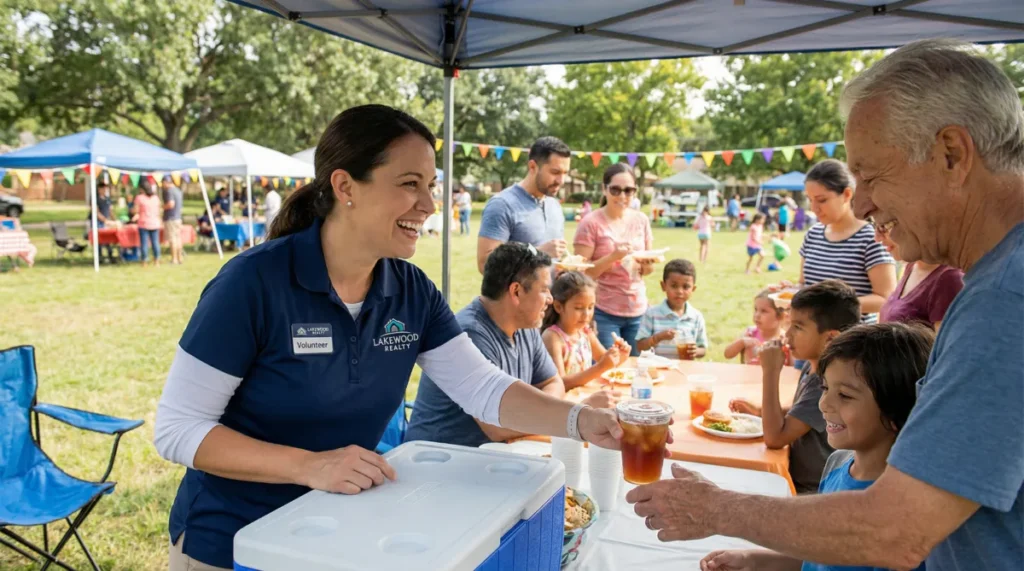
Stop Playing Small: How Top Agents Dominate by Getting Known Locally
You’re competing against agents who show up. Every single day. They’re at the chamber of commerce breakfast. They sponsor the little league team. They’re quoted in the local paper about market trends. And their phones ring constantly because half the neighborhood knows their face.
Meanwhile, you’re running ads online, hoping someone in your zip code clicks. It’s backwards. The agents winning in your market aren’t doing it through digital noise, they’re doing it through relentless, visible, strategic community involvement.
This isn’t cheerleading. This is how you build a business that doesn’t depend on algorithms, ad spend, or luck. Community involvement is the single most sustainable lead source available to real estate agents, and most agents aren’t taking it seriously enough.
Community presence is branding in its most local form, and how a strong agent brand attracts business explains why familiarity converts.
Why Community Involvement Beats Every Other Lead Source
Let’s talk about ROI. When you sponsor a local nonprofit, speak at a business networking event, or serve on the chamber board, you’re not running ads that disappear when you stop paying. You’re building social proof and proximity that compounds over time.
Consider the math: you show up to 24 networking events per year. At each event, you meet 15-30 people. That’s 360-720 interactions annually with people in your market. More importantly, people who see your face repeatedly are statistically more likely to remember you when they need a realtor. Psychologists call this the “mere exposure effect”, and it’s free.
Compare that to your online advertising. You spend $1,000 per month on digital ads, and the moment you pause, impressions drop to zero. With community involvement, your investment compounds. After 12 months of consistent showing up, your reputation is working for you 24/7.
STAT: According to research from the National Association of Realtors, 31% of consumers list with an agent because of a personal recommendation or referral. Community visibility is the foundation of referrals.
But there’s another layer. When you’re involved in your community, you’re not just building relationships with potential buyers and sellers, you’re building authority. You understand local schools, neighborhood character, investment trends, and development plans because you’re embedded in the community. That expertise becomes your competitive advantage.
The Three Types of Community Involvement That Actually Drive Business
Not all community involvement is equal. Showing up to events and hoping for referrals is passive. Real agents play strategic offense. There are three categories of involvement, ranked by ROI.
Tier 1: Leadership Positions (Highest ROI)
Serving on boards, committees, or as an officer puts you in front of decision-makers and consistent networkers. Chamber of commerce boards, nonprofit boards, rotary clubs, homeowners associations, these positions come with visibility and credibility.
The advantage: you’re in the room where things happen. You’re quoted in press releases. You’re recognized as a community pillar. This tier takes 5-10 hours per month but generates the highest conversion rates.
Strategy: Aim for one leadership position minimum. Choose organizations where your ideal clients naturally gather. If you sell luxury homes in established neighborhoods, target the country club board or historic preservation society. If you work in growing suburbs, focus on the chamber and school-related organizations.
Tier 2: Consistent Sponsorships & Event Hosting (Medium ROI)
Sponsor the 5K fundraiser. Host a homebuyer seminar at the library. Buy a table at the gala. These create touchpoints without requiring you to commit to ongoing governance.
The advantage: people see your brand. They get a tangible experience with you. You’re not invisible, you’re the agent who gives back.
Strategy: Pick 4-6 events per year where your target market congregates. Make it a habit. The key is consistency, not sporadic involvement. People remember the agent who shows up to the same charity gala every year, not the one who shows up once.
Tier 3: Passive Membership (Lower ROI)
Being a member of the chamber, business networking groups, or community organizations still counts. You get access to directories, events, and a platform to introduce yourself.
The advantage: low time commitment, low cost. You stay connected to your community without heavy lifting.
Strategy: This is the floor, not the ceiling. Membership alone won’t differentiate you. Use it as a foundation, then move into Tier 1 and Tier 2 activities.
How to Position Yourself to Convert Community Involvement Into Leads
Involvement without strategy is networking with zero conversion. You need a system that turns visibility into business.
Make Your Real Estate Focus Known (Without Being Sleazy)
When you sponsor an event or show up to a meeting, people should know you’re a real estate agent. Not in a pushy way, but it should be clear. Your sponsorship mentions your brokerage. You mention your profession naturally in conversation. You wear a name tag with your title.
Too many agents hide their profession at networking events, trying to be “relatable.” That’s backward. People remember you because you’re the real estate expert in the room. Own that.
Tell Your Story About the Community
When you’re introducing yourself, don’t lead with “I sell houses.” Lead with “I help families find homes in this community, and I’m passionate about our neighborhood because…” Then talk about something specific, the schools, the growth, the character, the investment potential.
This positions you as someone who cares about the community beyond transactions. People buy from people they trust, and trust comes from shared values.
Follow Up With Systems
Meeting someone at a networking event is worthless if you don’t follow up. This is where your CRM becomes essential. When you meet someone at a chamber event, add them to a drip sequence. Send them a thoughtful email about the market outlook for your area. Invite them to your next community event or educational webinar.
Don’t spray-and-pray. Instead, segment your community contacts and nurture them with relevant, non-salesy content that keeps you top-of-mind. That’s how involvement turns into leads.
Build Your Lead Generation Engine
Community involvement is one pillar of a sustainable real estate business. Get the full system for generating predictable leads without depending on ads or luck.
The Script: How to Start Conversations That Lead to Referrals
Knowing what to say separates agents who network effectively from agents who just show up. Here’s a script you can adapt to any community event:
“I’m [Your Name]. I help families buy and sell homes here in [neighborhood/area]. My favorite part of this job is really getting to know what makes our community special, whether that’s the schools, the investment potential, or just the sense of belonging. What about you, how long have you been in the area?”
This script does three things: (1) It identifies you as a real estate professional, (2) It shows you value the community beyond transactions, (3) It shifts focus to them, which makes people feel heard. People who feel heard become people who refer you.
From there, listen. Ask follow-up questions. If they’re new to the area, ask about their home search. If they’ve been here awhile, ask about neighborhood changes. Most people want to talk about their homes and their communities, you’re just facilitating the conversation.
Build a Content Strategy Around Your Community Involvement
Here’s the multiplier effect: every community event you attend becomes content.
Sponsor a youth soccer tournament? Post about the kids, the energy, your team’s involvement. Share it across social media. This does two things, it extends your reach beyond the people physically present, and it reinforces your community investment to people already in your network.
Serve on the chamber board? Share insights about local business trends. Contribute a brief article to the chamber newsletter about the real estate market in your area. Position yourself as the housing expert for the community.
Attend a networking breakfast? Take a few photos of the event. Share them with your audience. “Great seeing the community out at this morning’s chamber event, shoutout to everyone building this area.” This keeps you visible without being pushy.
The best part? Tools like CloseDaily’s social planner make it easy to batch-create and schedule this content. You’re not spending hours on social media, you’re leveraging the work you’re already doing in the community.
Track Your Community Involvement ROI
You need to know what’s working. Track which community activities generate leads and conversions.
When a client asks, “How did you hear about me?” write it down. After 12 months, you’ll see patterns. Maybe the chamber generates great referrals. Maybe your nonprofit board is a time-sink with zero business returns. Maybe the local business association is where your ideal clients actually hang out.
Once you have data, double down on what works and ruthlessly cut what doesn’t. Your time is your most finite resource. Invest it where it converts.
STAT: According to Inman Intelligence research, top-producing agents dedicate an average of 8-12 hours per week to community and networking activities. This isn’t fluff, it’s their primary lead source. If you’re not allocating significant time to showing up in your community, you’re leaving deals on the table.
The 90-Day Community Involvement Action Plan
Stop thinking about this in theory. Here’s what to execute in the next quarter:
Month 1: Audit & Choose
List every community organization, networking group, and nonprofit in your area. Identify which organizations have the highest concentration of your ideal clients. Choose one leadership opportunity, three sponsorships, and two events to attend monthly.
Month 2: Show Up & Collect Connections
Attend your chosen events. Have a goal for each event, meet five new people, collect three business cards, start one meaningful conversation. Bring business cards. Add every contact to your CRM with notes about how you met them and what you learned about their situation.
Month 3: Follow Up & Measure
Execute your follow-up sequence. Send personalized emails to people you met. Invite them to upcoming events or educational webinars. Track where leads come from. Evaluate your ROI and adjust for the next quarter.
This isn’t complex. It’s just consistent execution. And after 90 days, you’ll have a pipeline that didn’t exist before.
Real Estate Success Starts With Being Known
You can’t scale what you don’t repeat. Community involvement is the most repeatable, sustainable lead source available to agents who are willing to show up consistently.
The agents dominating your market aren’t smarter than you. They’re just more visible. They’ve made a decision to be known in their community, and they’ve stuck with it long enough for it to compound.
Your turn. Pick one organization this week. Make one commitment. Show up to one event. Then do it again next week. After 90 days, you won’t believe the difference in your pipeline.
If you want to systematize the lead generation piece, nurture sequences, follow-up automation, client management, that’s where CloseDaily comes in. Check out how top agents are organizing their community involvement into a predictable business engine.
Automate Your Follow-Up System
Community involvement only pays off if you follow up. Learn how CloseDaily’s social planner helps agents turn visibility into consistent leads without the administrative headache.
Recommended Reading for Building Your Business
Community involvement is one pillar of sustainable real estate success. For a complete picture of how top agents build predictable pipelines, check out our in-depth guides. You can also find latest industry trends and insights on HousingWire to stay informed about market developments that impact your strategy:
- 7 Daily Habits of Top-Producing Real Estate Agents in 2026, The routines that separate six-figure earners from average agents.
- How to Build a Lead Generation System That Works While You Sleep, Combine community involvement with automated follow-up for maximum ROI.
- 10 Listing Strategies to Secure More Seller Clients, Your community reputation is the foundation, here’s how to convert it into listings.
- 5 Text Message Templates That Get Seller Leads to Respond, Follow-up sequences that actually convert community connections.
Ready to Turn Visibility Into Business?
Community involvement generates leads, but only if you have systems to manage relationships, nurture prospects, and track results. CloseDaily’s CRM pipeline helps you organize every contact from every community event into actionable next steps.
Or explore our content studio to repurpose your community involvement into marketing materials that amplify your reach. And for automated nurture sequences that keep contacts warm without manual effort, our drip sequences are designed specifically for real estate agents.
See CloseDaily in Action
Watch how top agents use CloseDaily to manage leads from community involvement, track ROI, and build a business that runs on systems, not hustle alone.
Final Thought: Stop Waiting for Your Breakthrough
Most agents have the same insight: community involvement works. But insight without execution is just daydreaming. The difference between agents making $50k and agents making $500k often comes down to execution, showing up week after week when it would be easier to stay home and scroll social media.
Your breakthrough in real estate isn’t coming from the next marketing trend or the next tool. It’s coming from the decision to be the agent everyone in your community knows. That takes commitment. It takes consistency. But it works.
Start this week. One event. One conversation. One follow-up. Then repeat.
Ready to close more deals?
Join thousands of agents using CloseDaily to build their business.