A brokerage’s IDX needs are fundamentally different from a solo agent’s. When you’re managing 20, 50, or 100 agents who all need websites, lead flow, and pipeline management, the platform requirements shift from “does this generate leads?” to “does this generate leads AND help me run a business?”
Most IDX platforms were designed for individual agents and stretched to fit brokerage use cases. The result is usually a compromise, adequate for agents but lacking the administrative tools, compliance features, and scalability that brokerage operations demand.
Here are the enterprise features that separate brokerage-ready IDX platforms from agent-only tools.
Centralized Lead Distribution
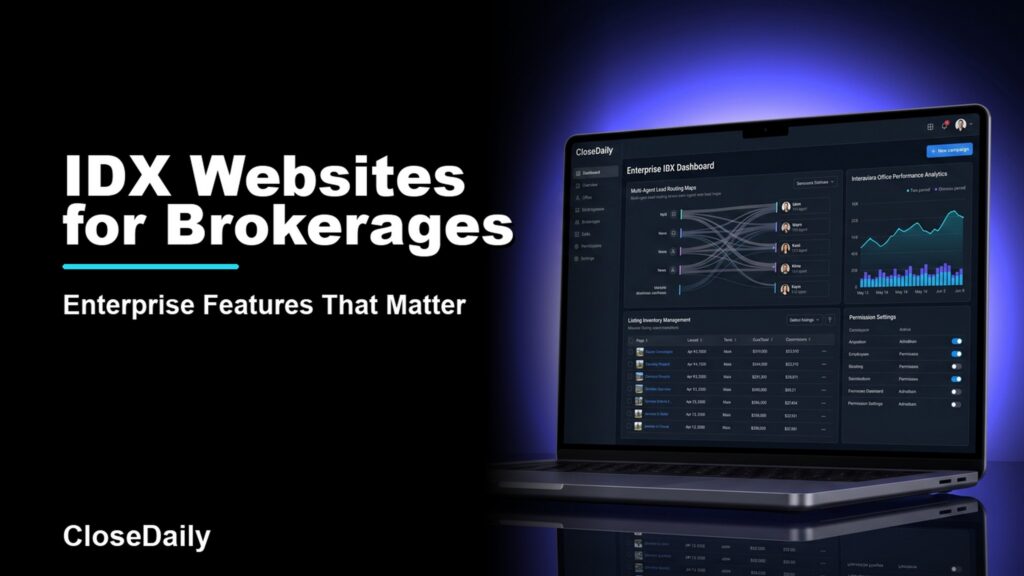
When your brokerage website generates 200 leads per month, someone has to decide which agent gets which lead. Manual distribution is a bottleneck that delays response times and creates fairness disputes. Automated lead routing is essential.
The routing options that matter: round robin (equal distribution), geographic assignment (leads go to agents based on property location or the buyer’s preferred area), performance-based routing (more leads to agents with higher conversion rates), and source-based routing (leads from different marketing campaigns go to different agents or teams).
The routing needs to be instant. A lead that sits in a distribution queue for 30 minutes while the system figures out who gets it is a lead that’s going cold. The best platforms assign leads within seconds of registration.
Agent Sub-Sites Under One Umbrella
Each agent in your brokerage wants their own branded web presence. But managing 50 separate websites is an operational nightmare. The solution is agent sub-sites, individual, branded pages for each agent that exist within the brokerage’s main website infrastructure.
Agent sub-sites should include: the agent’s bio and contact info, their personal listings, their own lead capture (feeding into the brokerage CRM with agent assignment), and customization options for their personal brand. All of this should be manageable from a central admin panel without requiring each agent to have their own platform account.
Compliance and Data Governance
Brokerages have compliance obligations that individual agents don’t worry about. IDX display rules, fair housing compliance, data retention policies, and agent departure protocols all need to be handled at the platform level.
When an agent leaves your brokerage, what happens to their leads? The platform should support lead reassignment without data loss. The agent’s sub-site should be deactivatable without affecting the rest of the brokerage website. Contact data that belongs to the brokerage (leads generated through brokerage marketing) should remain with the brokerage.
Reporting and Accountability
As a broker or team leader, you need visibility into how leads are being handled across your organization. Response times by agent. Conversion rates by source. Lead volume trends. Pipeline value by team or office. Marketing ROI by campaign.
This reporting should be available without requiring each agent to manually log their activity. The platform should track lead assignment, first contact time, follow-up frequency, and deal progression automatically based on system activity.
Cost Considerations at Scale
Brokerage IDX pricing works differently than individual agent pricing. Most platforms offer per-agent pricing that decreases at scale, or flat-rate brokerage plans that cover unlimited agents.
kvCORE has traditionally dominated the brokerage market here, with enterprise plans that bring the per-agent cost down significantly. The platform’s breadth of features, even if individual feature quality is uneven, becomes more justifiable when the cost is spread across dozens of agents.
For smaller brokerages (10 to 30 agents), platforms like CloseDaily with team pricing can deliver the core lead generation and CRM functionality at a fraction of kvCORE’s cost. The tradeoff is fewer enterprise admin features, but if your primary need is lead generation and conversion rather than brokerage operations management, the value calculation often favors the more focused platform.
The Integration Ecosystem
Brokerages typically run multiple software systems: transaction management, accounting, commission tracking, marketing automation, and communication tools. Your IDX and CRM platform needs to integrate with this ecosystem rather than replace it entirely.
API availability is crucial. Can the platform send lead data to your transaction management system when a deal goes under contract? Can it sync with your accounting software for commission tracking? Can it connect with your existing email and communication tools?
The platforms that play well with others reduce operational friction. The platforms that try to replace everything create switching costs that make future changes painful. For brokerages, flexibility and integration matter as much as any individual feature.
Making the Brokerage Decision
Evaluate brokerage IDX platforms on four criteria: lead generation capability (does it capture and convert leads effectively?), agent management tools (can you administer 50+ agents efficiently?), reporting and accountability (can you see what’s working and what isn’t?), and total cost at your current and projected agent count.
The right platform makes your brokerage more productive and your agents more successful. The wrong platform becomes an expensive administrative burden that nobody fully uses. Talk to brokerages currently running the platform, not just the sales team. Ask about the day-to-day reality, not the demo.
Ready to close more deals?
Join thousands of agents using CloseDaily to build their business.