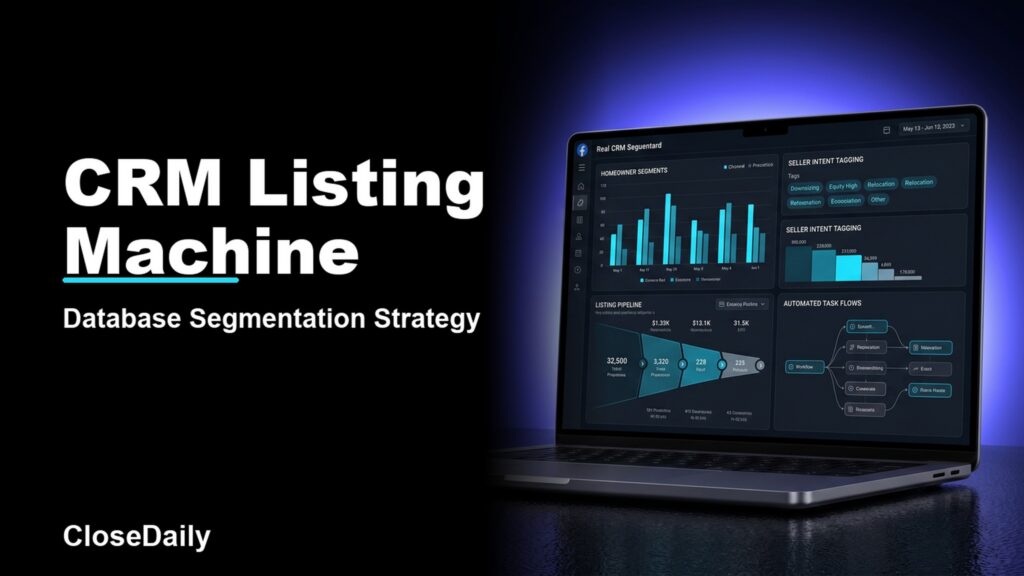
Most real estate agents treat their CRM like a digital Rolodex, a place to store names and phone numbers. The top producers treat it like a listing machine. The difference isn’t the software. It’s how they segment their database.
Database segmentation is the practice of dividing your contacts into specific groups based on their likelihood to transact, their relationship to you, and where they are in the buying or selling timeline. When you segment properly, every contact in your CRM gets the right message at the right time, and the listings start coming to you instead of you chasing them.
This guide walks you through the exact CRM database segmentation strategy that high-producing agents use to generate predictable listing inventory in 2026.
Ready to turn your CRM into a listing machine?
CloseDaily’s CRM includes built-in segmentation, automated drip campaigns, and engagement scoring, so you always know who to call next.
Why Most CRM Databases Don’t Produce Results
The average agent has 200-500 contacts in their CRM. Most of those contacts receive the same generic monthly email, or worse, no communication at all. The result is a database full of people who’ve forgotten you exist.
The problem isn’t the size of the database. It’s the lack of differentiation. A past client who closed with you six months ago needs a completely different communication strategy than a cold lead from a Facebook ad who downloaded a home valuation report but never responded to your follow-up.
When you send the same message to everyone, you’re optimizing for no one. Segmentation fixes this by ensuring each contact receives communication that’s relevant to their situation, their timeline, and their relationship with you.
The Zillow Consumer Housing Trends Report consistently shows that the majority of buyers and sellers start their search online but ultimately work with an agent they know or were referred to. Your CRM database is where those relationships live, segmentation is how you activate them.
According to NAR research, 64% of sellers found their agent through a referral or used an agent they’d worked with before. Your database is where those referrals and repeat clients live, but only if you’re nurturing them with intention.
The Five Core Segments Every Agent Needs
Start with these five segments. Every contact in your CRM should belong to at least one of them. As your database grows, you can add sub-segments, but these five will cover 90% of your needs.
Segment 1: Active Pipeline. These are leads with a defined timeline, they’ve told you they’re buying or selling within the next 6 months. This segment gets the highest-touch communication: weekly check-ins, market updates specific to their situation, and property alerts (for buyers) or comparable sales data (for sellers).
Your active pipeline should live at the top of your daily call list. These contacts are closest to a transaction and deserve your most focused attention. Use your CRM’s task management to set follow-up reminders so nobody slips through the cracks.
Segment 2: Warm Sphere. Past clients, family, friends, colleagues, and anyone who knows you personally. These people are your highest-value long-term asset because they can refer you at any time, but only if you stay top-of-mind.
Communication for your warm sphere should feel personal, not salesy. Monthly market updates, quarterly phone calls, birthday and home anniversary acknowledgments, and occasional in-person events keep the relationship strong. The goal is to be the first agent they think of when someone mentions real estate. Your sphere of influence strategy should make this segment feel valued, not marketed to.
Segment 3: Nurture Leads. These are contacts who’ve shown interest but don’t have a defined timeline. Maybe they filled out a form on your website, attended an open house, or responded to an ad. They’re not ready now, but they will be eventually.
Nurture leads receive automated drip campaigns that provide value over time: market reports, educational content, homeownership tips, and periodic check-ins. The key is patience. Some nurture leads take 12-18 months to convert, but when they do, the cost per acquisition is almost zero because the automation did the work.
Segment 4: Geographic Farm. Homeowners in your target neighborhood who don’t know you yet, or are just starting to recognize your name. These contacts receive location-specific communication: sold reports for their street, neighborhood market updates, and community event information.
Your geographic farming segment is a long-term play. It takes 6-12 months of consistent outreach before you see meaningful listing opportunities. But once you’ve established credibility in a farm area, the listings compound year over year.
Segment 5: Past Transaction (Re-engagement). Clients who closed with you more than two years ago and haven’t been in regular contact. These are at risk of using a different agent next time, which happens more often than most agents realize.
Re-engagement campaigns for this segment should be personal and direct: “It’s been a while since we connected, I’d love to hear how you’re enjoying the home.” Follow up with a home value update and a referral request script that feels natural, not forced.
Advanced Segmentation: Behavioral and Engagement Scoring
Once your five core segments are established, the next level is behavioral segmentation, grouping contacts based on what they do, not just who they are.
Modern CRMs can track email opens, link clicks, website visits, and response rates. When a nurture lead suddenly opens three emails in a row, visits your listing page twice, and clicks on a home valuation link, that’s a behavioral signal that they’re moving closer to a transaction.
Engagement scoring assigns a numerical value to each of these actions. A contact who opens every email might score a 3. One who clicks a link scores a 5. One who responds to a text scores a 10.
When a contact crosses a threshold, say, 25 points, your CRM alerts you to make a personal call. This is the moment when a generic database contact becomes a warm, qualified prospect worth your focused attention.
This kind of predictive intelligence means you’re calling prospects at exactly the right moment, when their interest is highest and their receptivity is strongest. It turns your CRM from a storage tool into a timing tool.
Let your CRM tell you who to call next.
CloseDaily’s engagement scoring automatically identifies your hottest leads based on their behavior, so you spend your prospecting time on the contacts most likely to convert.
The Weekly Segmentation Maintenance Routine
Segmentation isn’t a one-time project. It’s an ongoing practice that requires 15-20 minutes of weekly maintenance. Here’s the routine that keeps your database clean and productive.
Every Monday: Review new contacts. Any lead that came in during the previous week needs to be tagged and placed in the appropriate segment. Don’t let untagged contacts accumulate, a messy database defeats the purpose of segmentation.
Every Friday: Update active pipeline. Review every contact in your active pipeline segment. Has anyone’s timeline changed? Has a buyer gone cold?
Move contacts between segments as their situation evolves. A nurture lead who just told you they’re listing in 60 days should move to your active pipeline immediately. A seller who decided to wait six months moves back to nurture with an updated follow-up date.
Monthly: Audit engagement scores. Look for nurture leads whose scores are climbing, they may be ready to move to the active pipeline. Also identify contacts whose engagement has dropped to zero and decide whether to re-engage or archive them.
Quarterly: Re-engage dormant contacts. Send a personal outreach to your Past Transaction segment. A simple “thinking of you” email with a home value update can reactivate relationships that have gone quiet.
This maintenance routine, combined with your automated drip campaigns, ensures your database is always working for you, generating referrals, identifying hot leads, and keeping your brand top-of-mind across hundreds of relationships simultaneously.
Common Segmentation Mistakes That Kill Your Database
Even agents who understand the value of segmentation make mistakes that undermine their results. Here are the three most common ones.
Over-segmenting too early. Some agents create 15-20 segments before they’ve mastered the basics. Start with five core segments and get your communication cadence dialed in for each one.
Only add sub-segments when you have a specific, measurable reason to treat a group differently. Complexity for its own sake doesn’t improve results, it just makes the system harder to maintain.
Neglecting data hygiene. A segmented database full of bad phone numbers, old email addresses, and duplicate contacts is worse than no segmentation at all. Dedicate time each month to cleaning your data, merge duplicates, remove bounced emails, and update phone numbers. Clean data is the foundation everything else builds on.
Automating without personalizing. Drip campaigns are powerful, but they can’t replace personal outreach entirely. The agents who generate the most listings from their database combine automation with personal touches, a handwritten note after automation warms the relationship, a phone call when the engagement score spikes. The best email marketing strategies blend automated sequences with genuine human connection.
Failing to track results by segment. If you don’t know which segment is producing the most transactions, you can’t optimize your time allocation. Track closings by segment quarterly.
You may discover that your geographic farm is producing more listings than your paid lead sources, or vice versa. Let the data guide your effort, and reallocate your prospecting time accordingly.
Turning Segments Into Listings
Segmentation only matters if it produces transactions. Here’s how each segment converts into listing opportunities when managed correctly.
Your Warm Sphere generates referral listings. When a past client’s neighbor mentions they’re thinking about selling, your name comes up first because you’ve been consistently present. This is the highest-quality, lowest-cost lead source in real estate.
Your Geographic Farm generates brand-recognition listings. When a homeowner in your farm area decides to sell, they’ve seen your circle prospecting mailers, your sold reports, and your neighborhood updates for months. You’re not a stranger, you’re the neighborhood agent.
Your Nurture Leads generate timing-based conversions. The lead who wasn’t ready six months ago is ready now, and because your drip campaign kept you in their inbox, you’re the agent they contact when they’re finally ready to move.
Your Active Pipeline generates immediate closings. These are the deals happening now. Proper segmentation ensures they get priority attention, which increases your conversion rate and shortens your sales cycle.
And your Past Transaction Re-engagement generates repeat business. The client who bought with you three years ago and just got a promotion might be ready to upsize. The couple whose kids just left for college could be downsizers.
Your CRM knows these milestones if you track them, and segmentation ensures you reach out at the right time with the right message. Life events drive real estate transactions, and your database is full of people experiencing those events right now.
The agents who master CRM segmentation don’t worry about where their next listing is coming from. Their database tells them. Every morning, they open their CRM and know exactly who to call, what to say, and why it matters. That’s the difference between an agent who uses a CRM and an agent whose CRM uses itself to generate business.
Turn your database into a listing machine.
CloseDaily’s CRM gives you built-in segmentation, engagement scoring, automated drips, and daily call prioritization, everything you need to work your database like a top producer.
CloseDaily: The All-in-One Platform for Real Estate Agents Who Want to Close More Deals
CRM, AI dialer, scripts, drip campaigns, lead capture, listing tools, and coaching, all in one place. Join thousands of agents who’ve made the switch.
Ready to close more deals?
Join thousands of agents using CloseDaily to build their business.