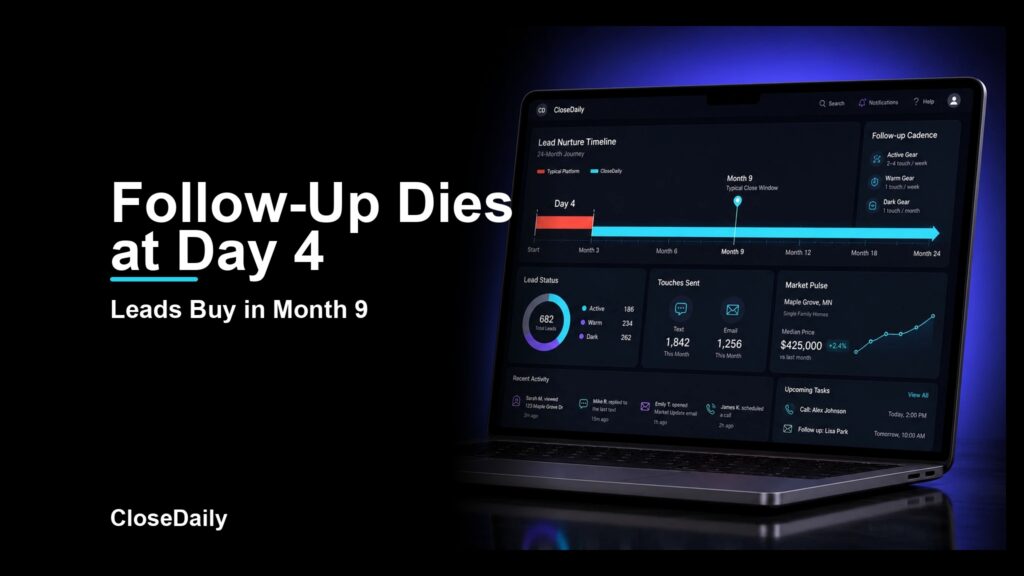
Most follow-up systems quit 20 months too early
Here’s the uncomfortable math of real estate follow-up: the biggest lead platforms in the industry pour everything into the first few days after a lead registers, then go generic or silent. Meanwhile, the leads themselves transact months later (published platform data puts typical online lead conversions around 9 to 13 months out). The gap between when systems stop working and when leads start buying is the single biggest revenue leak in an agent’s business. We rebuilt CloseDaily’s follow-up engine specifically for that gap.
Before we wrote a single message, we did something unglamorous. We read the fine print on the industry’s most celebrated platforms: the help docs, the FAQs, the support articles, and hundreds of verified agent reviews. This post is what we found, and what we built because of it.
None of this works without a system of record, which is why our complete real estate CRM guide treats follow-up automation as the core feature, not an add-on.
What the fine print actually says
Every lead platform demos the same way. A test lead comes in, a text fires within five minutes, an AI answers a question, and everyone nods. That part is real. The first week of automated follow-up is a solved problem, and has been for years.
What the demo never shows you is month seven. Straight from public documentation:
- The flagship “speed to lead” program on one of the priciest platforms in the industry runs for exactly four days. Then it stops.
- The most talked-about AI texting product in real estate promises a floor of just two scripted texts per month for the long haul. Its own FAQ, asked whether you can change the schedule or frequency, answers with one word: “No.” The wording isn’t editable either.
- Another major platform’s automations mechanically expire at 720 days. Want a five-year homeowner nurture? The system can’t do it.
- One vendor’s own blog warns customers that “prospects can recognize stale drip content in a blink.” A warning about the very drips it ships.
- Another platform officially recommends agents generate their own follow-up copy with ChatGPT. Read that again: the copy in the box, by the vendor’s own suggestion, isn’t worth sending.
- There’s an entire cottage industry of third parties selling replacement drip campaigns for these platforms. Enough agents found the stock content unusable that fixing it became a business model.
None of this is hidden. It’s just fine print. And it all points to the same structural decision: the industry’s biggest platforms front-load their effort into the window when leads are least likely to transact, then go quiet for the window when they actually do.
The month 9 problem
Speed still matters at the start. The classic lead response study found that contacting a lead within 5 minutes instead of 30 makes you roughly 100x more likely to reach them. Every platform built its first week around that stat, and it’s true. We’ve written before about why speed to lead matters so much, and it’s also where most systems stop building.
Now the part that should keep you up at night. According to NAR’s 2025 Profile of Home Buyers and Sellers:
- About 90% of buyers say they’d use their agent again or recommend them.
- 18% actually do use them again.
- 43% of buyers found their agent through a referral.
- 80% of sellers contacted exactly one agent before listing.
That last number is the whole game. Most sellers don’t interview three agents and pick the best pitch. They call whoever is already in their phone, already in their inbox, already useful. And they call only them. The gap between 90% would and 18% did isn’t a marketing problem, it’s an abandonment problem. Somebody stopped showing up.
If you want the full statistical picture, we keep a running library of real estate lead generation statistics and a full real estate lead generation guide, and the short version is this: lead conversion, not lead generation, is where the money hides. Front-loaded automation optimizes for the four days when consumers compare agents the least, and disappears for the twenty months when the decision actually forms.
We built for the twenty months.
We treated one-star reviews as our product spec
We read hundreds of verified customer reviews of the biggest platforms and treated them as a spec. Five complaints came up over and over, on every review site, about every major platform. Each one became an engineering requirement. (Quotes below are condensed from verified reviews.)
1. “My leads were getting slammed with texts and emails. I lost clients over it.”
An agent lost business because their own follow-up system was carpet-bombing people on their behalf, without them even knowing what was being sent.
What we built: Engagement Gears. Every contact sits in one of three gears (Active, Warm, or Dark), and the system shifts automatically based on behavior. Reply to a text? Cadence accelerates and your call task fires. Go quiet for two months? CloseDaily downshifts to a monthly whisper instead of a weekly shout. On top of that sits a global frequency governor: a hard cap on touches per contact across all running sequences, so a lead enrolled in two playbooks never gets double-teamed. Volume isn’t a setting you have to babysit. It’s physics the system enforces.
2. “The automated texts sound robotic. Leads can tell.”
Of course they can. Most AI follow-up free-runs on a script, texting because the calendar says so, with nothing real to say.
What we built: AI follow-up that only speaks when something actually happened. A lead re-views the same listing three times? The AI has something real to talk about. They come back to your site after six silent weeks? That’s a conversation, and it starts within five minutes. They check their home’s value again? That’s a raised hand. Our AI never free-runs a drip of its own, its persona and scripts are fully editable (yours to shape, not locked behind a vendor FAQ that says “No”), and it hands off to you the moment things get real, with the full conversation and a suggested reply waiting.
3. “The drip content is generic. Buyers smell it instantly.”
The vendors quietly agree. That’s why one tells you to write your own copy with ChatGPT and another’s blog warns you about stale drips.
What we built: copy as a craft discipline, enforced by software. Every message in the CloseDaily library follows rules the evidence demands. Plain text that reads like a person typed it: in HubSpot’s A/B tests, designed HTML templates cut clicks by 21 to 51%, which means the pretty newsletter your CRM sends is actively suppressing responses. Subject lines that are specific instead of clever: a 12-million-email study by Backlinko found specific subject lines lift replies by roughly a quarter to a third, and one extra follow-up lifts replies by about 66%. Texts of three sentences or fewer that end in exactly one easy question. “Just checking in” and “touching base” are banned strings; our editor literally won’t let them through. Every template carries a one-line note explaining why it exists. And all of it is editable: set your voice once (market, formality, humor, sign-off) and the entire library re-renders in your tone in about five minutes.
4. “My emails go to spam.”
One major platform maintains an official help article explaining why its customers’ emails land in spam. That’s not a support doc, that’s a confession.
What we built: deliverability by design. Plain-text sends from your name. No image-block templates. The first text in any thread never contains a link (carriers filter them, and humans distrust them). A slot-audit system refuses to send any message with an unfilled variable, so no lead will ever get “Hi , homes in are moving fast!” from you. Registered, compliant SMS from day one. Engagement-based list hygiene that protects your sender reputation instead of burning it.
5. “Follow-up dies right when my leads start getting serious.”
Four-day sprints. 720-day ceilings. Two locked texts a month. The industry’s long game is a rounding error.
What we built: the long game as the product. From month four onward, CloseDaily’s content gets better instead of staler, because it’s generated from live data instead of a template written two years ago. Monthly market-pulse notes built on your lead’s actual search area and price band. Equity digests for every homeowner in your database: value, equity, and one number they didn’t know, every month, forever. Seasonal windows (“why January buyers in Maple Grove get deals”). Quarterly nine-word revival messages for cold leads. And behavioral resurrection that never sleeps: a lead who’s been dark since spring walks back onto your site in October, and you’re in their texts before their coffee’s cold. No sequence in CloseDaily has an expiration date, because no future seller has one either.
Want to see the whole system live? Book a 20-minute demo and we’ll walk you through months 4 through 24, not week one.
What it sounds like
Theory is cheap. Here are three messages from the CloseDaily library, verbatim.
The first text a new buyer lead gets (within five minutes, no links, one question):
“Hi Sarah, it’s Jon with Smith Realty. Saw you were checking out homes near Maple Grove. Are you trying to move by a certain date, or just seeing what’s out there?”
Two sentences and an easy question from a real human name. The conversation it starts gets handled instantly, at 11pm on a Sunday if that’s when it happens.
The nine-word revival (quarterly, to leads who’ve gone dark):
Subject: Sarah
Are you still thinking about buying in Maple Grove?
That’s the whole email. No signature block, no listings, no banner. Practitioners across industries treat it as the most-answered email in the follow-up playbook for one reason: it reads like a friend asking, and it costs the reader four seconds to answer. Most platforms have nothing like it, because it can’t be made to look like a newsletter.
The home-iversary text (every past client, every year, automatically):
“Two years in the Alder St house today 🎉 You’re up roughly 11% since closing. Want the full report?”
Roughly 9 in 10 past clients say they’d use their agent again, and the industry converts 18% of them. This message, plus the equity digest behind it, plus the call task it drops on your calendar, is how that gap closes. Every touch delivers something a homeowner actually wants to know, so when the referral moment comes, it rides on a year of gifts instead of a cold ask.
Ten playbooks, one system
CloseDaily ships a complete, opinionated playbook for every lead type you actually work. Not a folder of templates. A system with cadences, triggers, and handoffs already wired:
- First 10 + Forever (new online buyer leads): eight calm, sharp touches in ten days, then a nurture arc built to still be interesting in month nineteen.
- The Equity Engine (seller and valuation leads): the real number first, then presence, monthly, until the listing decision forms.
- The Listing Machine (your homeowner database): eight annual campaigns that ask real questions, like “I’m working with a buyer who wants your street. Know anyone thinking of selling?”
- The Referral Flywheel (past clients): home-iversaries, equity milestones, tax-season value, and referral moments that ride on gifts.
- Same Night or Never (open house attendees): contact the same evening, six touches in ten days, then the long game.
- The Helpful Pro (FSBO): out-help everyone until they’re ready. Email and call tasks only, because automated texting to FSBO lists is a lawsuit waiting to happen, so we made it impossible.
- The Diagnosis (expired listings): a specific, honest read on why the launch failed, through channels built for compliance.
- The 18-Month Bridge (renters): a real curriculum from “I need 20% down, right?” (you don’t) to keys in hand.
- Deal Flow (investors): math, monthly, matched to their buy-box. No relationship drips. Numbers.
- The Lazarus System (reactivation): quarterly nine-word revivals plus always-on behavioral resurrection, because a meaningful share of eventual closings come from leads more than six months old. The exact leads everyone else’s system already dropped.
Compliance is architecture, not fine print
One national brokerage agreed to pay up to $40 million to settle claims over its agents’ calls and texts. Courts are letting direct-liability suits proceed against another. The rules tightened again in 2025: opt-outs by any reasonable means, quiet hours enforced by plaintiffs’ firms filing suits by the hundred. Most platforms’ answer is a checkbox and a prayer.
CloseDaily treats compliance as architecture. A consent record on every contact (source, timestamp, proof). Quiet hours enforced on the recipient’s local time. Plain-language opt-out detection, so “please stop texting me” counts, not only STOP. And hard channel locks: lead types that can’t lawfully receive automated texts can’t be put into text automations at all. Not a warning you click through. A wall.
Why we’re showing our work
Because ideas are cheap, and we’re betting on execution.
Every message in CloseDaily displays its live reply rate to every agent using it. When a variant of a subject line wins across the network, the library gets better for everyone, permanently. A year from now, our follow-up won’t be the library you just read about. It’ll be the version that won a year of A/B tests. That compounding is the moat, and it’s why we can afford to publish the philosophy.
Your follow-up system’s best week shouldn’t be its first week.
See what months 4 through 24 are supposed to look like. Book a CloseDaily demo.
FAQ: real estate follow-up that actually converts
How long does it take online real estate leads to convert?
Months, not days. Published platform data puts typical online lead conversions around 9 to 13 months, with a realistic range of 6 to 24 months. Your follow-up system has to be built for that timeline, because the first week only wins the leads who were already in motion.
Why do most real estate follow-up systems fail?
Front-loaded design. They concentrate effort in the first days after registration, then fall back to generic calendar drips or silence. Agent reviews consistently cite three symptoms: too many messages early, robotic AI texts, and stale template content that leads recognize instantly.
Does speed to lead still matter?
Yes. Responding within 5 minutes makes you roughly 100x more likely to reach a lead than waiting 30 minutes. But speed is the start of the system, not the system. The same lead you reach in 5 minutes will likely transact many months later, and that stretch decides who they hire.
How does CloseDaily keep automated follow-up compliant?
Consent records on every contact, quiet hours enforced by the recipient’s local time, plain-language opt-out detection beyond just STOP, and hard channel locks that keep lead types like FSBO and expired listings out of text automation entirely, since those numbers usually carry no texting consent.
Ready to close more deals?
Join thousands of agents using CloseDaily to build their business.
