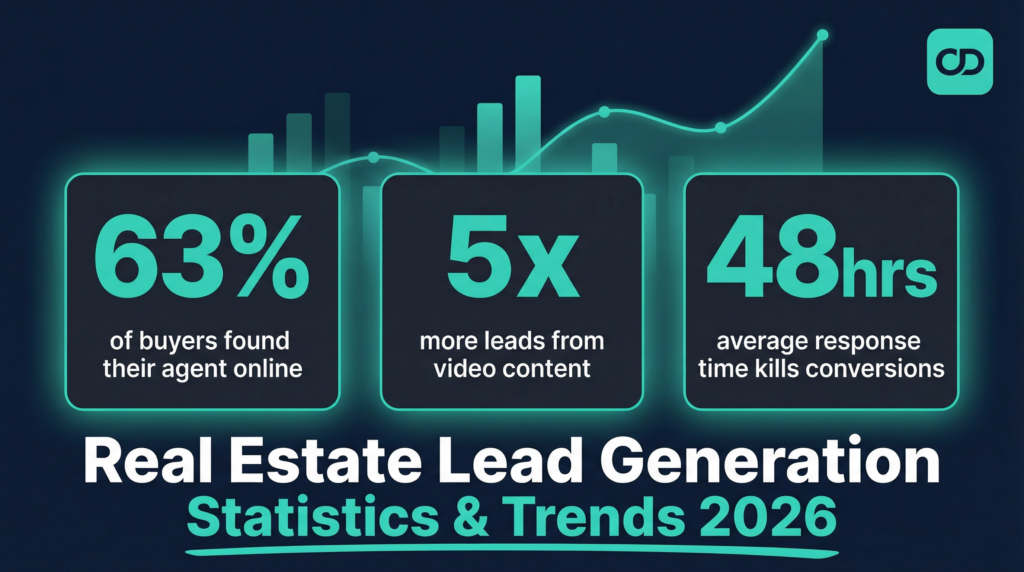
If you’re still guessing which lead generation strategies actually work, stop. The data has already answered that question for you.
Real estate lead generation statistics reveal exactly where agents should be spending their time and money, and where they’re wasting both. The problem is that most agents never look at the numbers. They chase whatever strategy their broker recommended, whatever guru hyped on a podcast, or whatever feels comfortable. Meanwhile, the top producers are making decisions based on conversion rates, response time data, and ROI benchmarks.
Here are the most important real estate lead generation statistics for 2026, backed by NAR data and broader industry research, along with what each number actually means for your business.
Real Estate Lead Generation Statistics: Online Search and Buyer Behavior
1. 96% of homebuyers use online tools during their home search. (NAR, Real Estate in a Digital Age) If you don’t have a digital presence, a website, landing pages, active social media, you’re invisible to virtually every buyer in the market.
2. 88% of buyers purchased their home through a real estate agent or broker. (NAR, 2025 Profile of Home Buyers and Sellers) Despite all the disruption talk, agents remain the dominant path to homeownership. The key is being the agent they find first.
3. The median buyer searched for 10 weeks before purchasing. (NAR, 2025) This means your lead nurture sequences need to be at least 10 weeks long. Agents who give up after 3 follow-ups are quitting right before the buying decision happens.
4. 85% of buyers rated their real estate agent as the most useful information source. (NAR, 2025) More useful than online listings, open houses, or yard signs. The agent relationship is what buyers value most, which means your follow-up and responsiveness matter more than your ad spend.
5. Only 21% of buyers were first-time buyers in 2025, a record low. (NAR, 2025) The typical first-time buyer is now 40 years old. If your marketing targets 25-year-olds, you’re targeting the wrong audience. Adjust your messaging and channels accordingly.
Use your real-time analytics dashboard to track exactly which channels and campaigns are driving buyer leads to your pipeline, so you can double down on what’s working.
Lead Response Time Statistics
6. Leads contacted within 5 minutes are 21x more likely to be qualified. (Harvard Business Review) This is the most cited lead response statistic in real estate, and agents still ignore it. Five minutes. Not five hours. Not “when I get back to the office.”
7. 78% of buyers work with the first agent who responds. (NAR) Speed to lead isn’t a nice-to-have. It’s the entire game. The agent who responds first wins the client, period. Set up automated SMS follow-up so every new lead gets an instant response, even when you’re on a showing or at dinner.
8. The average real estate agent takes 15+ hours to respond to a web lead. (Industry benchmarks) By that point, the lead has contacted 2-3 other agents, booked a showing with one of them, and forgotten your name. Instant response isn’t aggressive, it’s expected.
9. Calling a lead 6 times increases contact rates by 70%. (Sales performance research) Most agents call once, maybe twice, then mark the lead as “bad.” The data says the magic number is six attempts. After that, contact rates plateau. But most agents never get past two.
Respond to Every Lead in Under 60 Seconds
Automated SMS, instant lead routing, and AI-powered follow-up, so no lead ever waits 15 hours for a response again. The data says speed wins. CloseDaily makes speed automatic.
Lead Source Conversion Statistics
10. Expired listings remain one of the highest-intent seller lead sources. Expired sellers have already raised their hand and tried to sell. The opportunity is not just the list itself; it is the speed, empathy, and follow-up system you bring after the listing expires.
11. FSBOs are a consistent seller lead source when you follow up correctly. Most owners do not list with an agent after the first call. A dedicated FSBO follow-up sequence, patient education, and clear net-proceeds conversations are what create the opportunity.
12. Only 5% of homes sold as FSBO in 2025, an all-time low. (NAR, 2025) This is great news for agents. Sellers are increasingly recognizing that they need professional help. And the 5% who try FSBO? Most of them eventually list with an agent anyway.
13. Referrals remain the #1 lead source: 66% of sellers found their agent through a referral or past relationship. (NAR, 2025) No amount of paid advertising replaces a strong sphere of influence. The agents generating the most listings aren’t necessarily the ones spending the most on ads, they’re the ones maintaining relationships consistently.
14. Internet leads convert at 2-3% from inquiry to closing. (Industry averages) This sounds low, and it is. But volume makes up for it. If you generate 100 internet leads per month at 2% conversion, that’s 2 closings per month or 24 per year. The key is having a system to nurture all 100, not just the ones who seem ready now. Track every lead through your CRM pipeline so nothing falls through the cracks.
15. Social media is the #1 lead-generating technology for agents (39%). (NAR Technology Survey) Followed by CRM (23%) and local MLS (17%). If you’re not posting consistently on social media, you’re ignoring the single most productive technology channel in real estate.
Email Marketing and Nurture Statistics
16. Automated email campaigns increase lead conversion by 30%. (Industry lead generation research) Drip campaigns work. Not because any single email is magic, but because consistent, automated follow-up keeps you top of mind over the 10+ weeks that buyers are searching.
17. Email marketing converts 40% better than social media for lead generation. (Industry research) Social gets attention. Email gets action. The best strategy uses social to build awareness and email to drive conversions. Your lead capture forms should funnel every social follower into your email list.
18. The optimal email send frequency for real estate nurture is 1-2 times per week. (Industry benchmarks) Less than once a week and you’re forgotten. More than twice a week and you’re annoying. Find the sweet spot and be consistent.
19. Personalized email subject lines increase open rates by 26%. (Industry email benchmarks) “New listings in [Neighborhood]” outperforms “Weekly Market Update” every time. Use your CRM data to segment and personalize. This applies to every email you send, drip campaigns, market updates, listing alerts, and personal check-ins.
Listing and Seller Lead Statistics
20. 91% of sellers used a real estate agent, matching the all-time high. (NAR, 2025) The market for listing agents has never been stronger. Sellers are choosing agents at record rates, which means the competition for listings is fierce, but the opportunity is massive for prepared agents.
21. 72% of sellers only interviewed one agent before listing. (NAR, 2025) If you get the appointment, you’re probably the only one in the room. The listing is yours to lose. Preparation is everything, walk in ready with your CMA, marketing plan, and proven scripts.
22. 35% of sellers said reputation was the most important factor in choosing an agent. (NAR, 2025) Reviews, testimonials, and word-of-mouth matter more than flashy marketing. Build your reputation through results and ask every happy client for a review.
23. Listings with professional photography sell 32% faster. (NAR) And listings with video receive 403% more inquiries. If you’re still using phone photos, you’re actively hurting your sellers, and your reputation. Professional visual content isn’t optional in 2026.
Get the Complete Lead Gen Statistics Report
All 30+ statistics in a printable PDF with source links, benchmarks by lead type, and an action plan for applying each data point to your business.
Cold Calling and Prospecting Statistics
24. The best time to cold call real estate prospects is 10 AM – 12 PM local time. (Industry data) Late morning consistently outperforms early morning and afternoon for contact rates. Plan your power dialing sessions around this window for maximum results.
25. Agents who prospect for 2+ hours daily produce 3x more listings. (Coaching industry benchmarks) It’s not about talent or luck. It’s about volume and consistency. Two hours of focused prospecting every single day is the dividing line between average agents and top producers. Build it into your daily schedule using a structured daily planner.
26. It takes an average of 8 cold call attempts to reach a prospect. (Industry research) Most agents stop after 1-2 attempts. The prospects who answer on attempt 6, 7, or 8 are often the best ones, because nobody else was persistent enough to reach them.
27. Door knocking has a 1-3% conversion rate but delivers some of the highest-quality listings. (Agent surveys) The conversion rate is low, but the quality of face-to-face contact is unmatched. Agents who door knock consistently report higher average commission checks because the relationships they build are stronger. The key to making door knocking work is targeting, knock around your just-solds and just-listeds where you have a built-in conversation starter, not random neighborhoods where you have zero context.
Technology and AI Statistics
28. 82% of real estate agents report using AI tools in their business. (Industry surveys, 2025) But there’s a confidence gap, most agents use AI for basic tasks like writing descriptions and haven’t adopted it for lead generation, follow-up automation, or predictive analytics. The agents who go deeper with AI implementation will have a significant competitive advantage. See how CloseDaily’s AI assistant handles follow-up, content creation, and lead scoring automatically.
29. CRM adoption correlates with a 29% increase in sales. (Sales technology benchmarks) Agents who use a CRM consistently close more deals than those who don’t. The keyword is “consistently”, having a CRM you never log into doesn’t count. The agents seeing the biggest CRM-driven results are those who log every interaction, set follow-up reminders, and use pipeline stages to track where each lead stands in the buying or selling process.
30. Agents who use video in their marketing generate 66% more qualified leads per year. (Industry research) Video builds trust faster than any other medium. A 60-second neighborhood walkthrough or market update creates more connection than a 1,000-word blog post.
What These Statistics Mean for Your Business in 2026
The data tells a clear story. Speed wins, respond to leads within 5 minutes or lose them. Consistency wins, 2 hours of daily prospecting, 6+ follow-up attempts per lead, and weekly email nurture. Systems win, CRM usage, automated drip campaigns, and AI-powered follow-up dramatically outperform manual effort.
The agents who are growing their business in 2026 aren’t doing anything secret. They’re doing the basics, faster, more consistently, and with better technology backing them up. Every statistic on this list points to the same conclusion: the agents who build systems around speed, persistence, and automation will outproduce everyone else.
Stop guessing. Start measuring. And build the system that the data says works. Every statistic on this page is a signal pointing you toward where your next closing is coming from, if you’re willing to act on it.
Build the Lead Generation System the Data Says Works
Instant lead response, automated drip sequences, AI-powered follow-up, power dialer, CRM pipeline, and real-time analytics, one platform built around the statistics that actually drive closings.
Ready to close more deals?
Join thousands of agents using CloseDaily to build their business.
Ready to close more deals?
Join thousands of agents using CloseDaily to build their business.