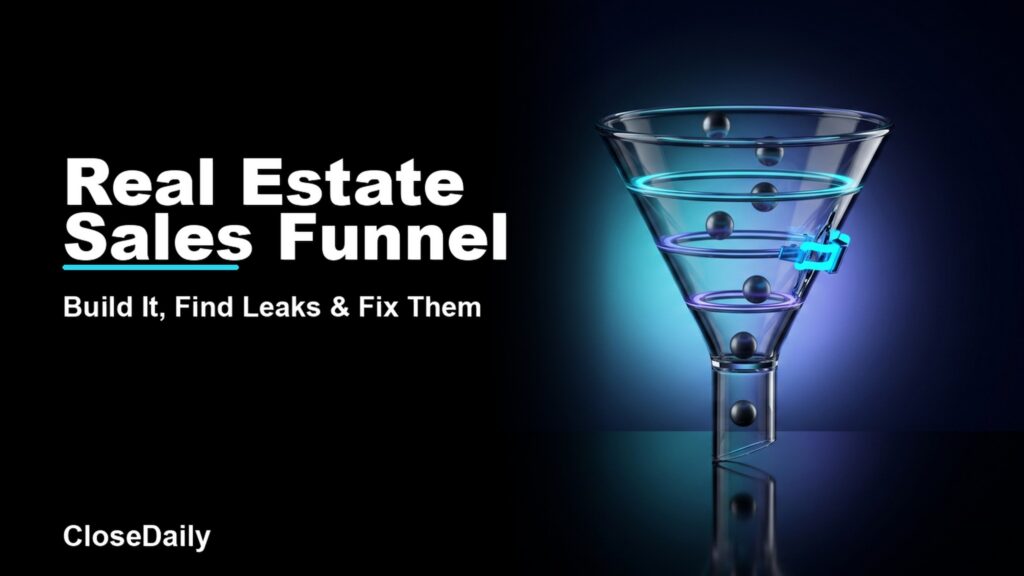
A real estate sales funnel is the path a stranger travels to become your client, and then your repeat client, broken into clear stages you can see and improve. Picture a funnel: a lot of people enter at the top as casual prospects, and a smaller number come out the bottom as closed deals. The value of thinking this way is that it shows you exactly where people fall out, so you can fix the specific leak instead of vaguely trying to “get more leads.”
This guide walks through the stages of a real estate funnel, how to build one, the metrics that tell you where it’s leaking, and the tools that hold it together. If the vocabulary is new to you, start with what real estate lead generation actually means.
The stages of a real estate sales funnel
Real estate funnels have one quirk worth knowing up front: they’re unusually long. A prospect can sit in the middle for months or years before they transact, so the stages that keep people warm matter more here than in almost any other business.
| Stage | Goal | Tool | Metric to watch |
|---|---|---|---|
| Attract | Get in front of buyers and sellers | Ads, SEO, social, prospecting | Traffic and reach |
| Capture | Turn attention into a contact | IDX, valuation, forms, sign-in | Leads captured |
| Qualify | Sort by readiness | Questions, lead scoring | Percent qualified |
| Nurture | Stay in touch until they’re ready | Drip and AI follow-up | Replies and engagement |
| Convert | Close the deal | CRM, appointments, transactions | Appointments and closings |
| Retain | Turn clients into referrals | Post-sale touches, reviews | Referrals and repeat |
1. Attract (awareness)
The top of the funnel, where people first encounter you: a social post, a Google search, a yard sign, an ad, a referral, or a prospecting call. The goal at this stage is simply reach, getting in front of buyers and sellers who don’t know you yet.
2. Capture
Attention is worthless until it has a name. Capture is where an anonymous visitor becomes a contact, by registering to search listings on your IDX site, requesting a home valuation on a landing page, downloading a guide, or signing in at your open house. If you’re generating attention but not capturing it, the funnel is broken at the very top.
3. Qualify
Not every contact is ready or real, so this stage sorts them. A few questions about location, price, motivation, timeline, and whether they’re already working with an agent tell you who to prioritize, and lead scoring based on behavior (email opens, repeat visits, saved searches) does it automatically. Qualifying protects your time for the people most likely to act.
4. Nurture
This is the longest and most important stage in real estate, and the one most agents neglect. Because prospects sit for months, you have to stay helpfully in touch, with market updates, matching new listings, and genuine answers, until the timing is right. Most of your future business is sitting in this stage right now, and whoever nurtures it best wins it. The day-to-day mechanics are covered in how to manage real estate leads.
5. Convert (close)
The prospect becomes a client: they book the appointment, sign the buyer or listing agreement, and move through the transaction to closing. This stage is about preparation, responsiveness, and doing what you promised.
6. Retain and repeat
The stage almost everyone forgets, and the most valuable one. A closed client should re-enter the top of your funnel as a source of referrals and repeat business. Referrals and repeat clients are how most established agents get the bulk of their business; the survey numbers are in our lead generation statistics roundup. A real estate funnel isn’t really a funnel at all. It’s a loop, where happy clients feed the top.
A funnel in action
Here’s how one lead moves through it. A homeowner sees your Facebook ad for a home-valuation tool (attract), clicks and enters their details to get an estimate (capture), and your system scores them as a warm seller lead based on the request (qualify). They aren’t ready to list yet, so they get monthly market updates and the occasional check-in (nurture). Six months later, they reply to a market update, you book a listing appointment (convert), win the listing, and close. A month after moving, they refer their neighbor (retain), who enters the top of your funnel as a fresh lead. That’s the loop working as designed.
How to build your funnel
You build a funnel by putting something deliberate at each stage instead of leaving it to chance.
- Map your stages. Write down the six above and be honest about what you currently do at each. Most agents find they have an attract habit and a convert habit, and almost nothing in between.
- Put a tool at each stage. An IDX site and lead capture at the top, a CRM to hold and qualify contacts in the middle, automated and AI follow-up for nurture, and a transaction workflow at the close.
- Automate the handoffs. The leaks happen between stages, so a captured lead should flow straight into your CRM and trigger follow-up with no manual step. Every gap you close by hand is a gap where leads slip.
- Set one metric per stage. Leads captured, percent qualified, replies from nurture, appointments booked, deals closed. Numbers turn a vague funnel into something you can improve.
The metrics that show where your funnel leaks
You can’t fix a leak you can’t see. Track the conversion rate from each stage to the next, and the weak number will jump out. If you get plenty of traffic but few contacts, your capture is broken. If you capture leads but book few appointments, your nurture or speed is the problem. If you close well but get few referrals, your retain stage needs work. Watch cost per closing by source too, because that’s the number that actually pays you.
The point isn’t to obsess over dashboards. It’s to know which one stage to fix next, so your effort goes where it matters instead of everywhere at once.
Where real estate funnels actually leak
In practice, almost every agent’s funnel leaks in the same two places: capture and nurture. They pour energy into attracting attention, then lose most of it because there’s no clean way to capture the interest, and no system to follow up over the long haul. Speed makes it worse, because the odds of ever reaching a new online lead fall fast once the first few minutes pass. A slow or missing middle is where most real estate money leaks out. And if the top of your funnel is thin too, our complete guide to real estate lead generation walks through every channel that can feed it.
The tools that hold a funnel together
A funnel breaks at the seams, so the fewer seams the better. When your capture forms, CRM, follow-up, and transaction tools are five disconnected apps, leads fall into the gaps between them. When they’re one connected system, a lead moves through every stage without anything slipping.
That’s the case for running your funnel on one platform. In CloseDaily, IDX and lead capture handle the top, the CRM and lead scoring hold and qualify the middle, AI follow-up nurtures automatically, and transaction tools carry the close, all in one place with the source tracked the whole way. However you tool it, connect the seams first. A funnel that holds its leads will outproduce a bigger one that leaks.
Frequently asked questions
What is a real estate sales funnel?
It’s the staged path a prospect follows from first hearing about you to closing and beyond: attract, capture, qualify, nurture, convert, and repeat. Mapping it shows exactly where prospects drop out so you can fix that specific stage.
What are the stages of a real estate sales funnel?
Commonly six: attract (awareness), capture (turn attention into a contact), qualify (sort by readiness), nurture (stay in touch until they’re ready), convert (close the deal), and retain (turn clients into referrals and repeat business).
How do I build a real estate sales funnel?
Map the stages, put a deliberate tool at each one (IDX and capture at the top, a CRM in the middle, automated follow-up for nurture, a transaction workflow at the close), automate the handoffs so nothing slips, and track one metric per stage.
Where do most real estate funnels leak?
At capture and nurture. Most agents attract attention but fail to capture it, or capture leads and never follow up consistently. Fixing the middle, with strong capture and fast, automated nurture, recovers more business than adding traffic at the top.
What’s the difference between a sales funnel and a lead generation system?
A sales funnel is the map of the stages a prospect moves through; a lead generation system is the set of tools and habits that move them through it. The funnel is the what, the system is the how. You need both, and they describe the same pipeline from two angles.
Published to WordPress as draft: [pending]
Ready to close more deals?
Join thousands of agents using CloseDaily to build their business.