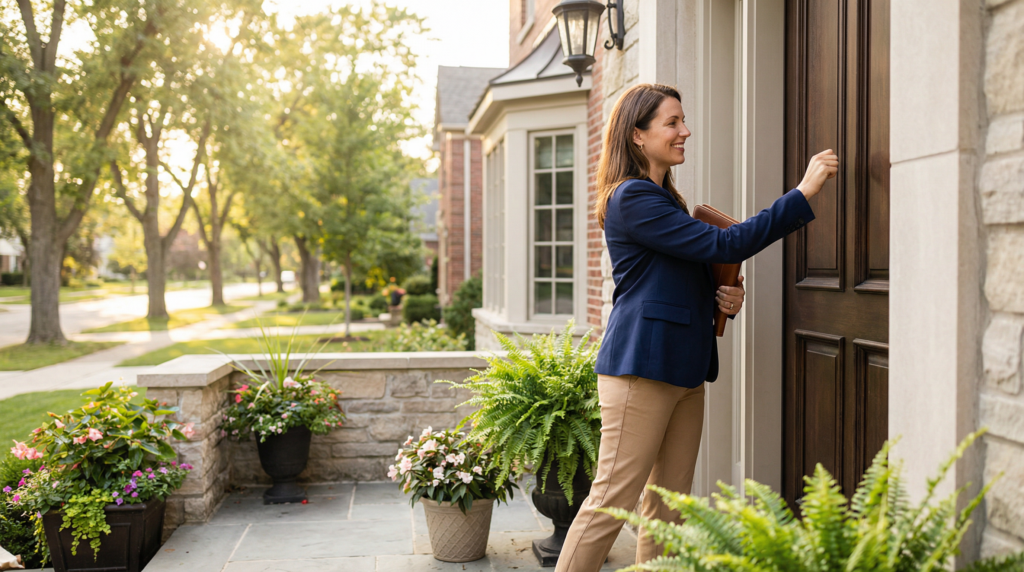
The Uncomfortable Truth: Why Door Knocking Still Dominates in a Digital World
Let’s be honest: the idea of knocking on a stranger’s door in 2026 feels… archaic. In an era of targeted digital ads, viral TikToks, and AI-powered CRMs, pounding the pavement seems like a relic from a bygone era. Most agents would rather spend a thousand dollars on Facebook ads than face a single slammed door. And that is precisely why door knocking remains one of the most powerful, underutilized, and profitable lead generation strategies in real estate.
While the average online real estate lead converts at a rate of just 0.4% to 1.2%, industry data consistently shows that door-to-door prospecting yields a 2-3% conversion rate. [1] [2] That’s not just a marginal improvement; it’s a doubling or tripling of your effectiveness. It’s the difference between one conversion per 100 leads and three. For the agent willing to embrace the discomfort, the rewards are immense.
This guide is not a list of generic tips. It is a deep dive into the psychology, strategy, and systems that turn a dreaded chore into a predictable, scalable, and lucrative pillar of your business. We will dissect what actually works at the door, provide scripts for any scenario, and lay out a step-by-step plan to make you the undisputed go-to agent in your geographic farm.
Door knocking is the most analog entry in the master plan for real estate leads, and it still works when it is done with a system.
The Psychology of the Porch: Why Face-to-Face Persuasion Wins
Understanding *why* door knocking works is the first step to mastering it. It’s not about luck; it’s about leveraging fundamental principles of human psychology that digital methods can’t replicate.
The Power of Reciprocity
The principle of reciprocity states that when someone gives us something of value, we feel a deep-seated psychological urge to give something back. In door knocking, this doesn’t mean giving away expensive gifts. It means leading with value, not with a request. Instead of asking for their business, you offer a piece of valuable information, a genuine compliment, or a helpful resource.
“The key is sincerity. If a prospect senses manipulation, reciprocity backfires. Frame your offering as genuine help or goodwill.” [3]
Actionable Tactic: Never approach a door empty-handed. Have a hyper-local market report, a list of recent comparable sales, or an invitation to a community event. Your opening line should be about giving, not taking.
Building Instant Rapport Through Mirroring
People trust people who are like them. The psychological technique of “mirroring”, subtly matching a person’s tone of voice, speech pace, and energy level, is a powerful way to build subconscious rapport. If a homeowner speaks slowly and softly, a high-energy, fast-talking pitch will feel jarring and untrustworthy. Matching their demeanor signals empathy and understanding.
The Foot-in-the-Door Technique
This classic compliance strategy involves starting with a small, low-commitment request, which makes it easier to gain agreement for a larger request later. Instead of asking, “Are you thinking of selling your home?” which is a huge commitment, you start with, “I’m just stopping by to share some surprising new data about our neighborhood’s home values. Do you have 30 seconds to see it?” Once they’ve said “yes” to the small request, they are psychologically primed to be more receptive to the larger conversation.
The Modern Door Knocking Playbook: A System for Predictable Results
Success in door knocking is not about having the “gift of gab.” It’s about having a system. Here is a comprehensive, step-by-step playbook for turning your farm area into a consistent source of listings.
Step 1: Strategic Farm Selection & Pre-Knock Research
Don’t just pick a neighborhood at random. Your ideal farm should have a healthy turnover rate (6-8% annually is a good target) and a price point that aligns with your business goals. Once you’ve selected your farm, your work begins *before* you ever knock on a door.
- Map Your Route: Use a tool like Google Maps or a specialized app to plan your exact path. This eliminates decision fatigue in the field and ensures maximum efficiency. Aim for 30-50 homes per session.
- Know the Market Cold: Pull the latest stats for the specific neighborhood. How many homes are for sale? What’s the average days on market? What was the sale-to-list price ratio of the last three homes that sold?
- Prepare Your Value Offering: Create a one-page “Neighborhood Market Update” with these key stats. This is your reciprocity tool and your reason for being at their door.
Step 2: The Approach & The First 10 Seconds
Your first 10 seconds at the door determine whether you’ll have a conversation or be dismissed. Your body language and opening line are critical.
- Non-Threatening Body Language: After knocking, take a step *back* from the door. This is a non-verbal cue that you are not a threat and are respecting their space. Stand at a slight angle, not directly in front of the peephole.
- The Opening Line (Lead with Value): Do not start with your name or brokerage. Start with the value.
Step 3: The Scripts That Actually Work
Your script is not a monologue; it’s a dialogue framework. Here are several battle-tested scripts for different scenarios, designed to be adapted, not recited verbatim.
| Scenario | Opening Line | Key Talking Points | Goal of the Conversation |
|---|---|---|---|
| General Introduction | “Hi, I was just next door talking with the Smiths and wanted to give you a quick update on our neighborhood’s home values, they’ve shifted quite a bit in the last 60 days. Do you have a minute?” | Share a surprising local stat. Ask about their experience living in the neighborhood. Offer the market update sheet. | Establish yourself as the friendly neighborhood expert. Get their email to send future updates. |
| Just Sold | “Hi, I’m the agent who just sold the home down the street at 123 Main. We had over 15 offers, and there are still several qualified buyers looking for a home just like yours. I was wondering if you’ve had any thoughts of selling?” | Leverage social proof of your success. Create urgency by mentioning active buyers. Ask if they know anyone else who might be interested. | Identify immediate seller leads and build your database of potential future sellers. |
| Open House Invite | “Hi, I’m hosting an open house for your neighbor at 123 Main this Saturday. I wanted to personally invite you to a ‘neighbors-only’ preview before the general public arrives. It’s a great way to see how the market is trending.” | Make them feel like a VIP. Emphasize that they get to be nosy neighbors. Ask for their opinion on the home’s value. | Drive traffic to your open house and identify potential sellers who are benchmarking their own home’s value. |
| The Value-Check | “Hi, with rates stabilizing, a lot of your neighbors have been curious about their home’s new value. I’m offering free, no-obligation equity reports this week. It only takes a few minutes. Have you checked your home’s value recently?” | Focus on their equity, not on selling. Use the term “equity report” instead of “CMA.” Make it a low-pressure, informational offer. | Start a conversation about their financial position and long-term real estate goals. |
Step 4: The Follow-Up System
The fortune is in the follow-up. 80% of sales are made on the fifth to twelfth contact. A single door knock is just the beginning.
- Immediate Follow-Up: Within an hour of a good conversation, send a handwritten note. “It was great chatting with you today about…”
- CRM & Drip Campaigns: Every person you speak with goes into your CRM. Tag them based on the conversation (e.g., “Hot Lead,” “Future Seller,” “Neighborhood Influencer”). Enroll them in a relevant drip campaign that provides value over time.
- The Re-Knock: Return to your farm area every 6-8 weeks. Familiarity breeds trust. On your second visit, you’re no longer a stranger; you’re “that friendly agent who keeps us updated.”
Leveraging Technology to Amplify Your Efforts
While door knocking is a physical activity, technology can make it exponentially more effective. A platform like CloseDaily is designed to be the engine behind your prospecting.
- Smart Daily Planner: Use the Smart Daily Planner to schedule your prospecting blocks and ensure you are consistently hitting your numbers.
- AI Script Practice: Before you go out, use an AI Practice Partner to roleplay your scripts and build confidence.
- AI Dialer for Follow-Up: After you’ve made initial contact, use the AI Dialer to efficiently follow up with warm leads without spending hours manually dialing.
Conclusion: Your Unfair Advantage
Door knocking is not for everyone. It requires courage, consistency, and a system. But for the small percentage of agents willing to do what others won’t, it offers an almost unfair advantage. While your competitors are burning money on oversaturated digital channels, you are building real, human relationships and creating a moat of trust around your business that no algorithm can replicate. The doors are waiting. It’s time to start knocking.
References
Ready to close more deals?
Join thousands of agents using CloseDaily to build their business.