Why Real Estate Agents Need Dedicated Email Marketing in 2026
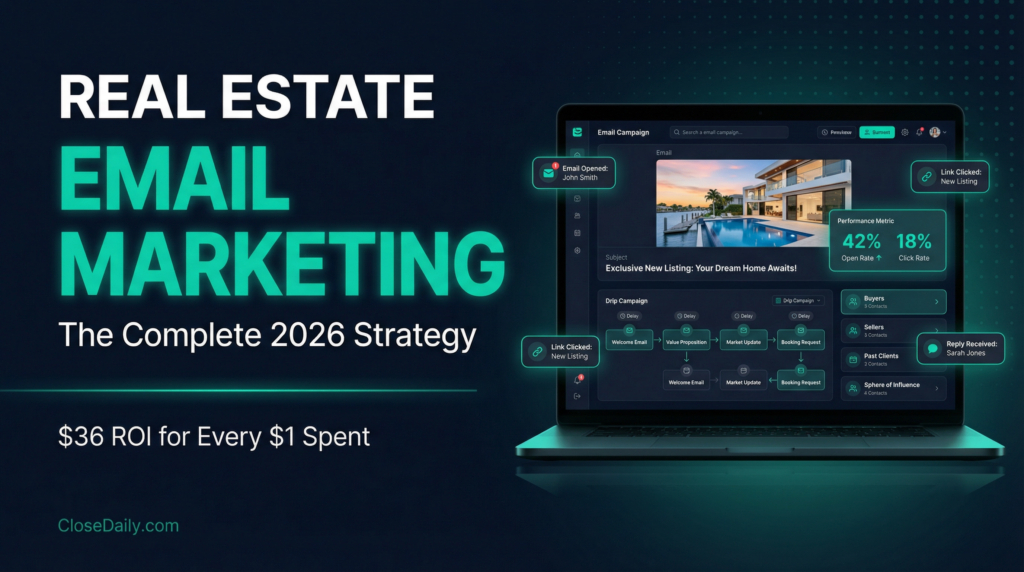
If you are still sending listing updates from your personal Gmail account or relying on your brokerage’s generic newsletter, you are leaving money on the table. The numbers tell the story: email marketing generates an average return of $36 for every $1 spent, making it the highest-ROI channel available to real estate professionals. Yet the vast majority of agents either ignore email entirely or use tools that were never designed for real estate.
The problem is not a lack of effort. Most agents understand that staying in front of their sphere is critical. The problem is that general-purpose email platforms like Mailchimp and Constant Contact were built for e-commerce brands and online retailers. They have no concept of listing inventory, buyer versus seller segmentation, temperature scoring, or the compliance requirements specific to real estate marketing. Agents end up spending hours wrestling with tools that do not speak their language, and the results reflect that frustration: low open rates, minimal engagement, and a steady trickle of unsubscribes.
Dedicated real estate email marketing solves this by embedding the tools agents actually need directly into their workflow. Instead of exporting contacts from your CRM, uploading them to a separate platform, building an email from scratch, and then manually tracking results, a purpose-built system lets you segment your database, choose from real estate-specific templates, personalize at scale, and measure performance, all without leaving the platform where your contacts already live.
This guide covers everything you need to know about building, executing, and optimizing a real estate email marketing strategy that generates listings, nurtures buyers, and turns your sphere of influence into a predictable referral engine.
Building a Real Estate Email List That Actually Converts
Your email list is only as good as the people on it. A list of 5,000 contacts who never open your emails is worth less than a list of 500 who engage consistently. The foundation of effective real estate email marketing is building a list of people who opted in, expect to hear from you, and find genuine value in what you send.
Organic List-Building Strategies
The most valuable contacts on your email list are people who gave you their information voluntarily. These include past clients, active leads from your lead generation efforts, open house attendees, and sphere-of-influence contacts who know and trust you. Start by making sure every one of these people is in your CRM with a valid email address and proper consent to receive marketing communications.
Beyond your existing database, there are several proven methods to grow your list with high-quality contacts. Free home valuation tools on your website capture seller leads who are actively thinking about their property’s worth. Neighborhood market reports offered as downloadable resources attract homeowners in your geographic farm. Community event registrations, first-time buyer webinars, and relocation guides all serve as lead magnets that deliver real value in exchange for an email address.
The key principle is simple: every lead magnet should be directly relevant to a real estate transaction. A generic “Sign up for our newsletter” call to action converts poorly because it promises nothing specific. A “Get your free 2026 home equity report” converts well because it offers something the homeowner actually wants.
What to Avoid
Buying email lists is a waste of money and a serious risk to your sending reputation. Purchased lists are full of outdated addresses, spam traps, and people who have no idea who you are. Sending to them will spike your bounce rate, trigger spam complaints, and potentially get your sending domain blacklisted by Gmail and Yahoo. There is no shortcut here. Build your list the right way, even if it grows slowly.
How to Segment Your Real Estate Database for Maximum Impact
Sending the same email to your entire database is the single biggest mistake agents make with email marketing. A first-time buyer who just started looking does not need the same information as a past client celebrating their third home anniversary. A hot seller lead who requested a CMA last week requires a completely different touch than a cold contact you have not spoken to in two years.
Segmentation is the practice of dividing your contact list into smaller groups based on shared characteristics, then sending each group content that is specifically relevant to them. It is the difference between a 15% open rate and a 40% open rate.
Essential Segments for Real Estate
By contact type. At minimum, separate your database into buyers, sellers, past clients, sphere of influence, investor contacts, and agent-to-agent referral partners. Each group has fundamentally different interests and information needs.
By temperature. A hot lead who just submitted an inquiry needs speed-to-lead follow-up, not a monthly newsletter. A warm contact who attended your open house last month needs nurturing content that keeps you top of mind. A cold contact who has been inactive for six months or more may need a re-engagement campaign before you invest further effort.
By transaction stage. Buyers at the pre-approval stage need different content than buyers who are actively touring homes. Sellers who are “just curious” about their home’s value need different messaging than sellers who have committed to listing this quarter. Aligning your email content with where each contact sits in their journey dramatically increases engagement.
By geography. If you work across multiple neighborhoods, zip codes, or cities, geographic segmentation lets you send hyper-local market updates that feel personally relevant. A contact in the Heights does not care about market stats for the Woodlands, and vice versa.
By engagement level. Track who opens your emails and who does not. Contacts who consistently open and click are your most engaged audience, they deserve your best content, exclusive previews, and first access to new listings. Contacts who have not opened in 90 days or more should be moved into a re-engagement sequence or removed from your active list to protect your sender reputation.
The 7 Types of Emails Every Real Estate Agent Should Be Sending
A well-rounded real estate email strategy is not just a monthly newsletter. It is a system of different email types, each designed for a specific purpose and sent to the right audience at the right time.
1. New Listing Announcements
When you take a new listing, your email list should be among the first to know. A well-designed “Just Listed” email with a hero photo, key property details, and a clear call to action to schedule a showing generates immediate interest and positions you as an active, productive agent. Send these to your buyer segments and sphere of influence, not your entire list.
2. Market Update Reports
Monthly or quarterly market updates establish you as the local expert. Include median home prices, days on market, inventory levels, and a brief commentary on what the numbers mean for buyers and sellers in your area. This is the single best long-term nurturing email because it provides genuine value that homeowners actually want, and it gives you a natural reason to stay in their inbox every month.
3. Just Sold and Social Proof Emails
Nothing builds credibility like results. When you close a transaction, send an email highlighting the sale, over-ask price, multiple offers, days on market, whatever makes you look good. This is especially powerful when sent to neighbors in the same subdivision, because it demonstrates that you are actively working their area and achieving strong results.
4. Drip Campaigns and Nurture Sequences
Not every lead is ready to transact today. Drip campaigns are automated sequences that deliver a series of emails over days, weeks, or months to keep leads warm until they are ready to act. A buyer nurture sequence might include emails about the buying process, mortgage pre-approval tips, neighborhood guides, and new listing alerts. A seller nurture sequence might cover home prep tips, pricing strategy insights, and market timing advice.
5. Open House Invitations
Email is one of the most effective channels for driving open house attendance. Send invitations to your buyer list and to neighbors within a half-mile radius of the listing. Include the date, time, address, a property photo, and a reason to attend, whether it is a “neighbors-only preview” or a chance to see comparable home values in action.
6. Relationship and Milestone Emails
Birthday emails, home purchase anniversary emails, holiday greetings, and post-closing thank-you messages keep the personal connection alive long after the transaction closes. These emails have some of the highest open rates in real estate because they feel personal rather than promotional. They are also the emails most likely to trigger a referral conversation.
7. Re-Engagement Campaigns
When contacts stop opening your emails, do not just keep sending to them. A re-engagement sequence directly acknowledges the silence: “We haven’t heard from you in a while, are you still interested in market updates?” Give them a clear option to stay subscribed or opt out. This protects your sender reputation and ensures your active list is full of people who actually want to hear from you.
Real Estate Email Templates That Get Results
Starting from a blank email every time is a productivity killer. Professional templates designed specifically for real estate give you a polished starting point that you can customize with your branding, photos, and content in minutes instead of hours.
The most effective real estate email templates fall into several categories. Listing marketing templates (just listed, just sold, price reduction, coming soon) feature large hero photos, clean property details, and prominent calls to action. Market update templates present data in an easy-to-scan format with neighborhood-specific stats. Nurture templates use a more personal, text-forward design that feels like a one-to-one message rather than a mass email.
What separates a great template from a mediocre one is mobile responsiveness. Over 60% of email opens happen on mobile devices, and that number is even higher for real estate because agents and homeowners are constantly checking their phones. If your email template does not look perfect on a 4-inch screen, you are losing the majority of your audience before they read a word.
The best approach is to use a drag-and-drop email editor that lets you customize templates visually, moving blocks around, swapping photos, editing text, without needing to know HTML. Look for an editor that includes real estate-specific content blocks like listing cards, market stats widgets, agent bio sections, and CMA call-to-action buttons. These purpose-built blocks save significant time and ensure your emails look professional regardless of your design skills.
Email Compliance for Real Estate Agents: CAN-SPAM and Beyond
Email marketing compliance is not optional. The CAN-SPAM Act is federal law, and violations carry penalties of up to $53,088 per email. Beyond the legal requirements, Gmail and Yahoo now enforce strict bulk sender guidelines that affect whether your emails reach the inbox or land in spam.
CAN-SPAM Requirements
Every marketing email you send must include your physical mailing address in the footer, a clear and conspicuous unsubscribe mechanism, accurate “From” and “Subject” information, and honest header information. You must process opt-out requests within 10 business days, though best practice is to process them instantly. You cannot require the recipient to log in, pay a fee, or take any steps beyond a single click to unsubscribe.
Gmail and Yahoo Bulk Sender Rules
Since February 2024, Gmail and Yahoo require bulk senders to implement one-click unsubscribe via the List-Unsubscribe header (RFC 8058), authenticate their sending domain with SPF and DKIM, publish a DMARC policy, and maintain a spam complaint rate below 0.3%. Failing to meet these requirements means your emails will increasingly be filtered to spam or rejected entirely.
What This Means for Your Platform Choice
Your email marketing tool should handle compliance automatically. The unsubscribe link and physical address should be injected into every email without you having to remember. The List-Unsubscribe headers should be added to every send. Bounce handling should automatically suppress invalid addresses. And the platform should block you from sending if required compliance elements are missing. If your current tool does not do these things, you are one mistake away from a serious deliverability problem.
Measuring Email Marketing Performance: The Metrics That Matter
Sending emails without tracking results is like door knocking without keeping notes on who answered. You need data to know what is working, what is not, and where to focus your effort.
Open Rate
The percentage of recipients who opened your email. Industry average for real estate is 25-30%. If you are consistently below 20%, your subject lines need work or your list quality is poor. If you are above 35%, you are doing something right. Note that Apple Mail Privacy Protection can inflate open rates by pre-loading tracking pixels, so treat this metric as directional rather than exact.
Click-Through Rate
The percentage of recipients who clicked a link in your email. This is a stronger engagement signal than opens because it requires active intent. A healthy real estate click-through rate is 3-8%. If your click rate is below 2%, your content or calls to action are not compelling enough.
Unsubscribe Rate
The percentage of recipients who opted out after receiving your email. Anything below 0.5% per send is normal. If a single campaign triggers more than 1% unsubscribes, something is wrong, either you are emailing too frequently, your content is not relevant to the audience, or the recipients did not expect to hear from you.
Bounce Rate
The percentage of emails that could not be delivered. Soft bounces (temporary issues like a full inbox) are normal in small numbers. Hard bounces (invalid email addresses) should be suppressed immediately to protect your sender reputation. A bounce rate above 2% on any campaign indicates a list hygiene problem.
Best Send Times
Tracking when your audience opens and clicks reveals the optimal days and times for your market. For most real estate databases, Tuesday through Thursday mornings between 9am and 11am tend to perform best, but your specific audience may be different. A good email platform provides a heatmap showing opens by hour and day of week so you can optimize your send schedule based on actual data rather than guesswork.
How to A/B Test Real Estate Emails to Improve Results
A/B testing is the practice of sending two variations of an email to a small portion of your list, measuring which version performs better, and then sending the winner to the rest. It is the fastest way to systematically improve your email performance over time.
The most impactful variable to test is your subject line, because it determines whether the email gets opened at all. Split your test group (typically 10-20% of your audience) into two halves, send each half a different subject line, wait 2-4 hours for results to accumulate, and then send the winning subject to the remaining 80%. Over time, this compounds: a 5% improvement in open rate on every campaign means thousands more eyeballs on your content over the course of a year.
Beyond subject lines, you can test send times (morning versus afternoon), sender names (your personal name versus your team name), call-to-action text (‘”Schedule a Showing”‘ versus ‘”See This Home”‘), and email layout (single image hero versus photo grid). Test one variable at a time so you know exactly what caused the difference.
Choosing the Right Email Marketing Platform for Real Estate
The platform you choose determines how much time you spend on email marketing and how effective your campaigns are. Here is what to look for.
CRM Integration Is Non-Negotiable
If your email marketing tool is separate from your CRM, you will spend hours on data entry and import/export gymnastics every time you want to send a campaign. The ideal setup is email marketing built directly into your CRM, so your contact data, segmentation, transaction history, and email engagement all live in one place. When a lead opens your email, that activity should show up on their CRM contact record automatically, not in a separate dashboard you have to cross-reference.
Real Estate-Specific Features
Generic email tools do not include listing card blocks, market stats widgets, CMA call-to-action buttons, or open house RSVP templates. You end up building these from scratch every time, or settling for emails that look like they came from a retail brand instead of a real estate professional. A platform built for real estate includes these out of the box.
Automation That Actually Fires
The whole point of automation is that it runs without you. When a new lead enters your CRM, a welcome sequence should fire automatically. When a contact’s stage changes from “nurture” to “active buyer,” the messaging should shift. When a deal closes, a post-close follow-up sequence should start. If your platform has automation templates but requires you to manually enroll contacts, you are doing the system’s job for it.
Built-In Compliance
As covered above, compliance is not optional. Your platform should automatically inject unsubscribe links and physical addresses, add RFC 8058 List-Unsubscribe headers, suppress bounced and complained addresses, and block sends when required elements are missing. You should not have to think about compliance on every send, the system should enforce it for you.
Deliverability Infrastructure
The best-looking email in the world is worthless if it lands in spam. Look for a platform that supports SPF, DKIM, and DMARC authentication, provides warm-up tools for new sending domains, monitors your sender reputation, and uses reputable sending infrastructure (Amazon SES, SendGrid, or similar). Some platforms also let you connect your own sending provider if you want full control over your deliverability.
Getting Started: Your First 30 Days of Real Estate Email Marketing
If you are starting from scratch or switching platforms, here is a practical 30-day roadmap to get your email marketing running.
Days 1-7: Foundation. Import your contacts into your CRM, clean up invalid email addresses, and add basic segmentation tags (buyer, seller, past client, sphere). Set up your sending domain authentication (SPF, DKIM) and configure your physical mailing address in your email settings.
Days 8-14: First campaign. Choose a market update template, customize it with your local stats and branding, and send it to your most engaged segment first, typically past clients and sphere of influence. This is your warm-up send. Monitor opens, clicks, and bounces closely.
Days 15-21: Expand and automate. Set up your first drip campaign for new buyer leads. Create a “Just Listed” template that you can quickly customize for each new listing. Schedule your second market update campaign. Start tracking which subject lines drive the highest open rates.
Days 22-30: Optimize. Review your analytics from the first three weeks. Which emails had the highest open and click rates? What send times performed best? Use the Smart Daily Planner to block time for weekly email marketing, and set a goal to send at least two campaigns per month going forward. Consider running your first A/B test on your next send.
The agents who win at email marketing are not the ones with the biggest lists or the most expensive tools. They are the ones who show up consistently, send relevant content to the right segments, and treat every email as an opportunity to provide value. The tools exist to make this easy. The strategy is what makes it work.
Ready to close more deals?
Join thousands of agents using CloseDaily to build their business.