You spend 30 minutes crafting the perfect real estate email, a market update, a listing alert, a follow-up that could lead to a $15,000 commission check. You hit send. And nobody sees it. Not because they ignored it, but because it landed in their spam folder or promotions tab, invisible and unread.
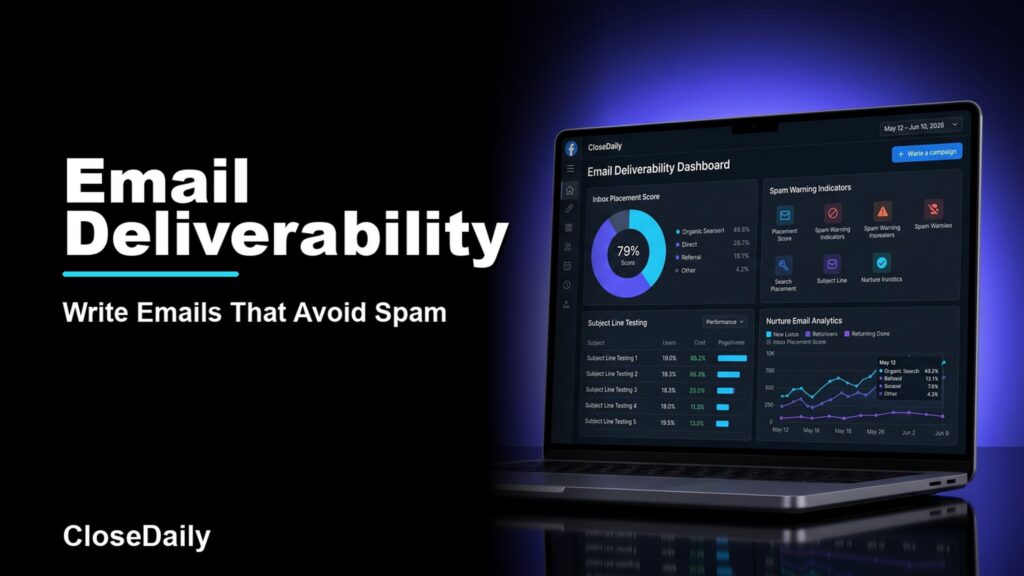
Email deliverability is the invisible problem killing real estate agents’ marketing efforts in 2026. You can have the best email content in the world, but if it doesn’t reach the inbox, it doesn’t exist. The average real estate email open rate hovers around 20-25%, meaning three out of four emails you send are likely being ignored or filtered.
This guide shows you exactly how to write real estate emails that land in the primary inbox, get opened, and generate responses, without triggering spam filters, getting flagged by Gmail, or ending up in the wasteland of the promotions tab.
Send emails that actually reach your leads’ inbox.
CloseDaily’s email tools are built for deliverability, with clean sending infrastructure, smart templates, and engagement tracking that keeps your emails out of spam.
Why Real Estate Emails End Up in Spam
Email providers like Gmail, Outlook, and Yahoo use sophisticated algorithms to filter incoming messages. These algorithms evaluate dozens of signals to decide whether your email belongs in the primary inbox, the promotions tab, or the spam folder.
The most common reasons real estate emails get filtered include trigger words in the subject line (like “FREE,” “ACT NOW,” “GUARANTEED”), excessive use of images and HTML formatting, sending to contacts who never opted in or who haven’t engaged with your emails in months, and poor sending reputation from your email domain or platform.
But here’s what most agents miss: the single biggest factor in email deliverability isn’t technical, it’s engagement. Email providers track whether recipients open your emails, click your links, reply to your messages, or mark them as spam. If your engagement rate is low, the algorithm starts routing your emails to spam preemptively, even for contacts who want to hear from you.
This means that improving your email content and targeting isn’t only a marketing strategy. It’s a deliverability strategy. Better emails get more engagement, which improves your sender reputation, which gets more of your future emails into the inbox. It’s a virtuous cycle.
Subject Lines That Get Opened, Not Filtered
Your subject line is the first thing both the recipient and the spam filter evaluate. Here’s how to write subject lines that pass both tests.
Keep it under 50 characters. Short subject lines outperform long ones in both open rates and deliverability. “Market update for [Neighborhood]” beats “INCREDIBLE market update you won’t believe, open now for exclusive data!”
Avoid spam trigger words. Words like “free,” “guaranteed,” “act now,” “limited time,” “urgent,” and “congratulations” are red flags for spam filters. Real estate agents often use these words without realizing the deliverability cost.
Use personalization. Subject lines that include the recipient’s first name or their neighborhood see significantly higher open rates. “Sarah, your home’s value increased this quarter” is personal and relevant, two things spam filters reward.
Write like a human, not a marketer. The subject lines that perform best in 2026 look like they came from a friend, not a marketing department. “Quick question about your home search” outperforms “EXCLUSIVE BUYER ALERT: New Listings in Your Area!” by a wide margin.
Test your subject lines by asking: “Would I open this if a friend sent it?” If the answer is no, rewrite it.
Email Body Best Practices for Deliverability
Once your email gets past the subject line filter, the body content determines whether it stays in the inbox or gets demoted to promotions.
Minimize images and HTML. Emails that are image-heavy or use complex HTML templates are more likely to end up in the promotions tab. The best-performing real estate emails look like personal messages, plain text or minimal formatting with one or two images at most.
Keep your text-to-image ratio high. If your email is mostly images with little text, spam filters flag it. Aim for at least 60% text and no more than 40% images. Your email marketing strategy should prioritize readability over visual design.
Include a clear call to action. Every email should have one primary purpose and one clear next step. “Reply to this email if you’d like a free home value estimate” gives the reader a simple action to take, and replies are one of the strongest positive signals for email deliverability.
Avoid link stuffing. Emails with more than 3-4 links are more likely to be flagged. One or two relevant links is plenty. If you need to share more resources, direct them to a single landing page that contains everything.
Don’t use URL shorteners. Shortened links from services like bit.ly are heavily associated with spam. Always use full, clean URLs in your emails.
Write a compelling preview text. The preview text (or preheader) is the snippet that appears next to or below the subject line in most email clients. If you don’t set it intentionally, email platforms will pull the first line of your email body, which might be “Having trouble viewing this email?”
That’s wasted real estate. Write a custom preview text that complements your subject line and encourages the open. A strong preview text can increase your open rate by 10-20%.
Send at the right time. Data from email marketing platforms consistently shows that Tuesday through Thursday mornings (8-10 AM local time) produce the highest open rates for real estate emails. Avoid sending on weekends and Monday mornings when inboxes are overflowing. Your email strategy should schedule sends during these optimal windows.
Proofread before sending. Typos, broken links, and formatting errors don’t just look unprofessional, they can trigger spam filters. Some filters interpret poor grammar and broken HTML as signs of a spam message. Take two minutes to preview your email in both desktop and mobile formats before hitting send.
Stop guessing if your emails are being delivered.
CloseDaily’s email analytics show you open rates, click rates, and bounce rates in real time, so you can fix deliverability issues before they cost you deals.
List Hygiene: The Foundation of Email Deliverability
Even perfect emails will end up in spam if you’re sending them to a dirty list. List hygiene is the most impactful, and most neglected, aspect of email deliverability for real estate agents.
Remove bounced email addresses immediately. Hard bounces (invalid addresses) damage your sender reputation every time you hit them. Most email platforms handle this automatically, but verify that your system is removing them, not just suppressing them.
Segment by engagement. Contacts who haven’t opened an email in 6+ months should be moved to a re-engagement campaign or removed from your active sending list. Sending to disengaged contacts drags down your overall engagement rate, which hurts deliverability for everyone on your list.
Never buy email lists. Purchased lists are full of spam traps, fake addresses maintained by email providers specifically to catch spammers. One send to a purchased list can destroy your sender reputation permanently. Build your list organically through lead capture, open houses, and your sphere of influence.
Use double opt-in when possible. When a new contact subscribes to your email list, send a confirmation email that requires them to click a link to verify. This ensures you’re only emailing people who genuinely want to hear from you.
Double opt-in dramatically reduces spam complaints and bounce rates. It may result in a slightly smaller list, but the contacts on that list are genuinely engaged, which improves every metric that matters for deliverability and conversion.
Technical Setup That Protects Your Deliverability
Beyond content and list management, there are technical configurations that significantly impact whether your emails reach the inbox.
Set up SPF, DKIM, and DMARC records. These are email authentication protocols that verify you are who you say you are. According to Google’s email authentication guidelines, senders who haven’t configured these records are far more likely to have their emails rejected or filtered. Ask your email platform or IT provider to verify these are in place.
Use a consistent “from” address. Sending from the same email address every time builds recognition with both recipients and email providers. Switching between multiple sending addresses confuses the algorithm and hurts your reputation.
Warm up new sending domains. If you’re starting with a new email platform or domain, don’t send 5,000 emails on day one. Start with small batches (50-100) to your most engaged contacts and gradually increase volume over 2-4 weeks. This teaches email providers that you’re a legitimate sender.
Monitor your sender score. Tools like Mail Tester can evaluate your email deliverability and identify issues before they become serious. Run a check monthly to catch problems early.
Five Email Templates That Get Replies (Not Spam Reports)
Here are five email templates designed for maximum deliverability and engagement. Notice how they’re short, personal, and focused on a single call to action.
The Market Update: “Hi [Name], home values in [Neighborhood] shifted this quarter, your home’s estimated value is now around $[X]. Want me to send you the detailed breakdown? Just reply ‘yes’ and I’ll put it together for you.”
The Check-In: “Hey [Name], it’s been a while since we connected. How’s everything going with the house? If you ever need a contractor recommendation or have a real estate question, I’m always here.”
The Warm Lead Follow-Up: “Hi [Name], I noticed you checked out [Property Address] on our site. Would you like me to schedule a showing, or would you prefer more details first? Either way, happy to help.”
The Referral Request: “Hi [Name], I loved working with you on your home purchase. If you know anyone thinking about buying or selling, I’d be grateful for the introduction. Just reply with their name and I’ll reach out personally.”
The Re-Engagement: “Hi [Name], I want to make sure I’m only sending you emails you actually find useful. Would you still like to receive market updates for [area]? If so, just reply ‘keep them coming’, if not, no hard feelings at all.”
Each of these templates is under 100 words, asks for a reply (the strongest deliverability signal), and avoids every spam trigger. They’re the kind of emails your drip campaigns should be built around.
Notice what’s missing from these templates: no heavy HTML formatting, no image-only designs, no excessive links, and no sales pressure. They read like messages from a real person, because that’s exactly what email providers want to see in the primary inbox. The agents who convert the most leads through email treat every message like a conversation, not a billboard.
Email marketing remains one of the highest-ROI channels in real estate, but only when your messages actually reach the inbox. Clean your list, write like a human, set up your technical authentication, and focus on generating replies. Do these things consistently and you’ll see your open rates climb, your engagement increase, and your database start producing the referrals and repeat business it was always meant to generate.
Send emails your leads actually read.
CloseDaily’s email marketing tools are built for real estate deliverability, clean infrastructure, smart templates, engagement tracking, and automated drip campaigns that keep you in the inbox.
CloseDaily: The All-in-One Platform for Real Estate Agents Who Want to Close More Deals
CRM, AI dialer, scripts, drip campaigns, lead capture, listing tools, and coaching, all in one place. Join thousands of agents who’ve made the switch.
Ready to close more deals?
Join thousands of agents using CloseDaily to build their business.