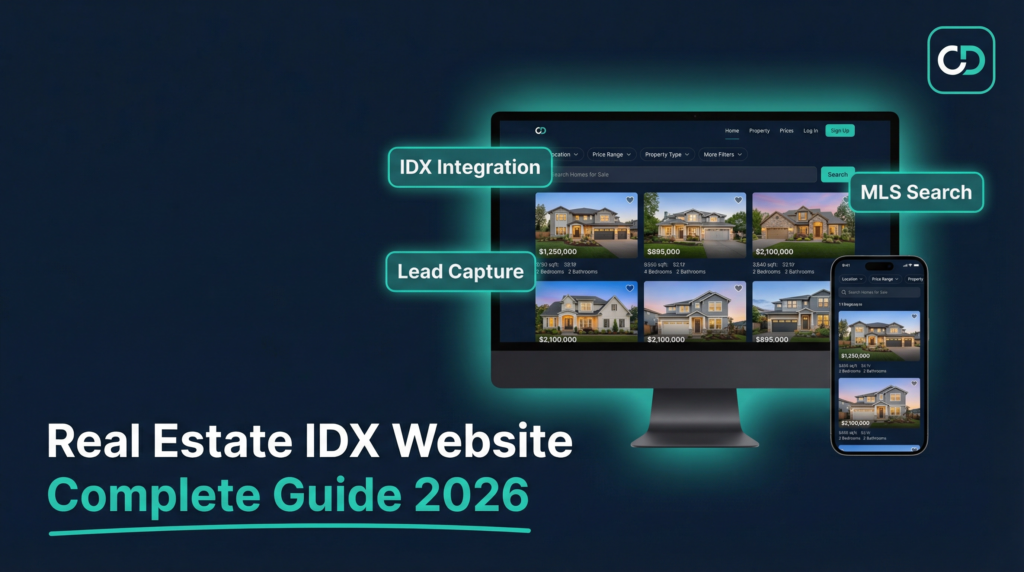
A homebuyer lands on your website, searches for homes in their target neighborhood, saves three listings, and you never know about it. Why? Because your website doesn’t have IDX integration. Or worse, it has IDX but it’s clunky, slow, and sends buyers straight to Zillow instead.
A real estate agent website with IDX is the foundation of your entire digital lead generation strategy. Without it, you’re sending every online buyer to someone else’s platform to search for homes, and that platform is capturing the lead, not you.
According to NAR’s Real Estate in a Digital Age report, 96% of homebuyers use online tools during their search. And the 2025 Profile of Home Buyers and Sellers confirms that the median buyer searches for 10 weeks before purchasing. That’s 10 weeks of property searches, neighborhood research, and market browsing, all of which should be happening on your website, feeding leads into your pipeline.
Here’s what to look for in a real estate IDX website in 2026, and why the right platform can be the difference between generating leads on autopilot and losing them to the portals.
For a primer on the technology itself before the buying criteria, see why your website needs IDX at its core.
The Anatomy of a High-Converting IDX Website [Infographic]
Everything your real estate website needs to generate leads on autopilot, from property search to analytics.
🔍 Click the infographic to expand

Share this infographic: Feel free to embed it on your blog with a link back to closedaily.com
What Is IDX and Why Does Every Real Estate Agent Website Need It?
IDX stands for Internet Data Exchange. It’s the technology that allows you to display MLS listings directly on your website. When a buyer searches for homes on your IDX-enabled site, they see the same listings they’d find on Zillow or Realtor.com, but on your domain, with your branding, and with your contact information attached to every listing.
Here’s why that matters. Every search a buyer makes on Zillow generates a lead for Zillow, not for you. They sell that lead to 3-4 agents who then compete for the same buyer. But when a buyer searches on your IDX website, that lead is yours exclusively. No competition. No bidding. No sharing.
An IDX website turns your online presence from a digital business card into an actual lead generation machine. Buyers search, save listings, set up alerts, and every one of those actions feeds data into your CRM. You know what they’re searching for, what price range they’re in, which neighborhoods they prefer, and how active they are. That’s intelligence you can’t get from any portal lead.
The 7 Features Your Real Estate IDX Website Must Have in 2026
1. Fast, Mobile-Responsive Property Search
More than half of all real estate searches happen on mobile devices. If your IDX search is slow, clunky, or hard to use on a phone, buyers will bounce within seconds. Your property search needs to load in under 2 seconds, display beautifully on any screen size, and offer intuitive filters, price range, bedrooms, neighborhood, property type, and map-based search at minimum.
2. Automatic Listing Alerts
When a buyer saves a search or favorites a listing on your site, your IDX should automatically send them new matching listings via email. This is the single most powerful lead nurture feature on any real estate website. It keeps buyers coming back to your site daily, builds the habit of searching on your platform instead of Zillow, and gives you insight into exactly what they want. Look for IDX solutions that offer AI-powered listing alerts that learn buyer preferences over time and send smarter, more relevant notifications.
3. Lead Capture That Doesn’t Drive People Away
Most IDX sites force registration before showing any listings, and 70% of visitors leave rather than register. Smart lead capture finds the middle ground: let buyers browse freely, then prompt registration after they’ve viewed 3-5 listings or try to save a search. By that point, they’re invested and more willing to share their information. Your lead capture system should integrate directly with your CRM so every new registration is tagged, scored, and routed to the right follow-up sequence automatically.
4. Neighborhood and Community Pages
Buyers don’t just search for listings, they search for neighborhoods. “Best neighborhoods in [City] for families,” “schools near [Neighborhood],” and “[City] cost of living” are all high-intent searches that should lead to your website. Your IDX site needs dedicated neighborhood pages with local data, school ratings, lifestyle descriptions, and embedded property search filtered to that area. This is how you rank for local SEO terms and capture buyers at the top of the funnel. Build these pages efficiently using AI-powered content tools that generate neighborhood descriptions, market summaries, and local guides in minutes.
5. CRM and Pipeline Integration
Your IDX website should talk to your CRM. When a lead registers, their data should flow into your CRM pipeline automatically, no manual entry, no copy-pasting. And every action they take on your site (listing views, saved searches, email opens) should update their contact record in real time. This gives you the context to have relevant, informed conversations instead of generic follow-up calls.
6. SEO-Friendly Architecture
A beautiful website that Google can’t find is worthless. Your IDX platform needs clean URL structures, fast page load speeds, proper meta tags, and the ability to create custom content pages that rank for local keywords. Many IDX solutions generate listing pages with dynamic URLs that search engines can’t index effectively. Make sure your platform creates static, crawlable pages for neighborhoods, property types, and market data that Google can rank. Check your site’s performance through your analytics dashboard to track which pages are driving organic traffic and leads.
7. Blog Integration
Your website needs a blog, and it needs to be integrated with your IDX, not bolted on as an afterthought. Blog content is how you rank for informational keywords (like “how to buy a home in [City]” or “best time to sell in [State]”) that bring buyers and sellers to your site before they’re ready to search listings. When they are ready, your IDX captures them. A blog-to-IDX pipeline is the most sustainable organic lead generation strategy in real estate.
Get an IDX Website That Actually Generates Leads
Property search, listing alerts, lead capture, CRM integration, neighborhood pages, and built-in SEO, all in one platform designed specifically for real estate agents.
Start Your Free TrialIDX Website Mistakes That Cost You Leads
Mistake #1: Forcing registration too early. If the first thing a visitor sees is a login wall, they’ll leave. Let them browse, build interest, and then ask for their information. Gate the value (saved searches, listing alerts, CMA reports) not the search itself.
Mistake #2: Ignoring mobile experience. Test your website on your phone right now. Can you search for homes easily? Can you filter by neighborhood? Can you view listing photos without pinching and zooming? If any of those answers are no, you’re losing mobile leads, which is more than half your traffic.
Mistake #3: No follow-up system connected to registration. Getting a lead to register on your IDX site is only step one. If they register and hear nothing for 48 hours, they’ve already moved on to another agent’s site. Connect your IDX registrations to instant automated text and email follow-up so every new lead hears from you within minutes.
Mistake #4: No content beyond listings. An IDX website with nothing but property search is a Zillow clone with less traffic. What differentiates your site is original content, neighborhood guides, market reports, buying and selling guides, and blog posts that answer the questions your target audience is asking. Content is what gets you found. IDX is what captures the lead.
Mistake #5: Slow page speed. According to Statista research on web performance, 53% of mobile visitors abandon a site that takes more than 3 seconds to load. If your IDX property pages are sluggish, every second of delay is costing you leads. Test your speed regularly and optimize images, scripts, and hosting.
How to Drive Traffic to Your Real Estate IDX Website
An IDX website without traffic is an empty storefront. Here’s how to get buyers and sellers to your site.
Local SEO. Optimize your Google Business Profile, get reviews, and create content targeting “[City] real estate” and “[Neighborhood] homes for sale” keywords. Local SEO is the highest-ROI traffic source for agent websites because the intent is commercial, people searching these terms are actively looking to buy or sell.
Blog content. Write articles targeting the questions buyers and sellers in your market are asking. “Best neighborhoods in [City] for families,” “How much house can I afford in [State],” and “[City] real estate market trends 2026” are all keywords that bring high-intent traffic to your site. Your blog feeds your IDX by warming up visitors before they start searching.
Social media traffic. Share listing tours, market updates, and neighborhood spotlights on Instagram, Facebook, and YouTube, always linking back to your website. Use your social media planner to schedule consistent posts that drive traffic to your IDX search and lead capture pages.
Paid advertising. Run Google Ads targeting “[City] homes for sale” and Facebook retargeting ads to bring website visitors back. Every paid campaign should land on a page with IDX search and lead capture, not your homepage. Manage all your campaigns through your built-in ad management so leads flow directly into your CRM.
Get the IDX Website Launch Checklist
A step-by-step guide to setting up your IDX website for maximum lead capture, including SEO setup, lead capture configuration, neighborhood page templates, and traffic strategy.
Download the ChecklistYour IDX Website Should Be Your #1 Lead Source
The agents who generate the most leads online aren’t the ones spending the most on portal advertising. They’re the ones who own their platform, their website, their IDX, their content, their data. Every buyer who searches on your site is your lead. Every saved search generates an alert that keeps them engaged. Every registration feeds your pipeline.
In 2026, your website is either generating leads for you or generating leads for someone else. There’s no middle ground. Build the platform, fill it with content, connect it to your CRM, and let it work for you 24 hours a day. That’s what an IDX-powered agent website is designed to do.
Launch an IDX Website That Works While You Sleep
Property search, listing alerts, automatic lead capture, CRM pipeline, drip sequences, and built-in analytics, everything you need to turn your website into a lead generation machine.
Start Your Free TrialReady to close more deals?
Join thousands of agents using CloseDaily to build their business.
Start Free Today →Related: website examples, Browse real CloseDaily agent websites to see these features in action.
Related: getting started, Get your IDX website live in under 48 hours with CloseDaily.
Ready to close more deals?
Join thousands of agents using CloseDaily to build their business.